

Kotak
Stockshaala
Chapter 3 | 3 min read
Choosing the Right Stocks for Swing Trading
Not every stock deserves a place on your watchlist. Some move too slowly to generate meaningful swing profits. Others move so erratically that stop-losses get hit before setups mature. Some are technically perfect but so thinly traded that exiting at your planned price is impossible.
Stock selection is the invisible edge in swing trading. Two traders using the same strategy will produce very different results if one is trading from a well-filtered watchlist and the other is taking whatever catches the eye on a given day. This chapter builds the three-filter system that turns an ocean of listed stocks into a focused, manageable watchlist of genuine candidates.
By the end of this chapter, you will be able to:
- Apply three sequential filters to evaluate whether a stock belongs on a swing trading watchlist.
- Use liquidity, ATR, and momentum indicators to screen stocks before any setup analysis begins.
- Build a repeatable weekly watchlist process that eliminates guesswork from stock selection.
The Three Filters
Liquidity: A stock that cannot be exited at your intended price is dangerous regardless of how good the setup looks. For swing trading on NSE, a minimum of ₹10 to 15 crore in average daily traded value is a reasonable floor. Avoid stocks that are liquid only when news hits. Consistent daily liquidity matters, not peak liquidity.
Volatility: Measured by the 14-day Average True Range. A stock with an ATR of ₹6 on a ₹300 stock (2% daily range) has enough movement to generate swing profits whilst keeping stop-losses at a practical distance. Look for stocks where ATR is at least 1.5% to 2% of current price. This filters out slow movers without chart-by-chart evaluation.
Momentum: Once a stock passes the first two filters, momentum confirms it is in a phase worth trading. Two quick checks work: price above the 50 EMA (uptrend bias) and RSI between 40 and 70, showing directional energy without being extended or exhausted.
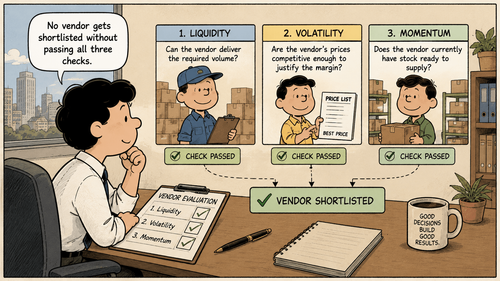
Think of how a procurement manager at a large company selects vendors. First, they check if the vendor can deliver the required volume (liquidity). Then they check whether the vendor's prices are competitive enough to justify the margin (volatility). Finally, they confirm the vendor currently has stock ready to supply (momentum). No vendor gets shortlisted without passing all three checks. Your watchlist works exactly the same way.
Stock | Avg Daily Value | ATR (14) | Price | ATR % | EMA Position | RSI | Verdict |
|---|---|---|---|---|---|---|---|
Stock A | ₹22 Cr | ₹18 | ₹500 | 3.75% | Above 50 EMA | 58 | Pass all 3 |
Stock B | ₹4 Cr | ₹14 | ₹500 | 2.9% | Above 50 EMA | 61 | Fail liquidity |
Stock C | ₹18 Cr | ₹4 | ₹500 | 0.8% | Above 50 EMA | 54 | Fail ATR |
Common Mistakes
Mistake 1: Adding stocks to the watchlist based on news or tips without running the filters
A stock appearing in a financial headline may be temporarily liquid and moving, but may not pass sustained volatility or momentum criteria. Every addition to the watchlist must go through all three filters, regardless of how compelling the story sounds.
Mistake 2: Using ATR in absolute rupee terms without adjusting for price
An ATR of ₹20 means very different things on a ₹200 stock versus a ₹2,000 stock. Always express ATR as a percentage of current price to make meaningful comparisons across different price levels.
Key Takeaways
- The three filters for swing trading stock selection are liquidity (minimum ₹10 to 15 crore average daily traded value), volatility (14-day ATR of at least 1.5% to 2% of price), and momentum (price aligned with 50 EMA direction, RSI between 40 and 70).
- All three filters must be applied in sequence. A stock that fails any single filter is removed from consideration regardless of how attractive the setup looks.
- The goal of the watchlist is not to find every possible trade. It is to concentrate attention on stocks where liquidity, movement, and momentum are already working together.
Assignment
Open NSE's market data page or your broker's screener. Find five stocks you have been watching recently. For each one, record:
(1) Average daily traded value over the past month,
(2) 14-day ATR as a percentage of current price,
(3) Whether price is above the 50 EMA
(4) Current RSI. Mark each stock Pass or Fail on each filter. Keep only those that pass all three. This is your first properly filtered watchlist.
With a filtered watchlist in hand, the next chapter moves into market structure — the objective framework that tells you whether a stock is trending, reversing, or going sideways before you evaluate any entry.
Prefer watching over reading? We also have a video course covering this topic in full detail. Check it out here→
Disclaimer: This article is for informational purposes only and does not constitute financial advice. It is not produced by the desk of the Kotak Neo Research Team, nor is it a report published by the Kotak Neo Research Team. The information presented is compiled from several secondary sources available on the internet and may change over time. Investors should conduct their own research and consult with financial professionals before making any investment decisions. Read the full disclaimer here.
Investments in securities market are subject to market risks, read all the related documents carefully before investing. Brokerage will not exceed SEBI prescribed limit. The securities are quoted as an example and not as a recommendation. SEBI Registration No-INZ000200137 Member Id NSE-08081; BSE-673; MSE-1024, MCX-56285, NCDEX-1262.
Recommended Courses for you



















Learn, Invest, and Grow with Kotak Videos
Explore our comprehensive video library that blends expert market insights with Kotak's innovative financial solutions to support your goals.

Trading with collateral as margin with Kotak Neo

How India is Redefining Space Exploration