
1,017 Views| 22 Oct 2026
Snapdeal IPO Details
Issue Date
25 Sep - 29 Sep'26
Price Band
₹30 - ₹32
Lot Size
468 Shares
IPO Size
₹420 Cr
Listing At
NSE,BSE
Overall Subscription
4.9x
Snapdeal IPO Listing Details
Listing On
5 Oct'26
Issue Price
₹32
Listed Price
₹ 28.3
Retail Gain/Listing Gain
-11.56%Decrease
Schedule of Snapdeal IPO
IPO Open Date
25/09/2026
IPO Close Date
29/09/2026
Basis of Allotment
30/09/2026
Refund Initiation
01/10/2026
Credit of Shares
01/10/2026
Listing on exchange
05/10/2026
Snapdeal IPO Subscription Status Live
(Last updated on 29 Sep 2026 04:45 PM)
Day | Total | QIB | Retail | NII |
|---|---|---|---|---|
Day 1 25-Sep-2026 | 0.18x | 0x | 0.51x | 0.2x |
Day 2 28-Sep-2026 | 1.04x | 1.03x | 1.18x | 0.97x |
Day 3 29-Sep-2026 | 4.83x | 3.38x | 4.21x | 8.07x |
About Snapdeal IPO
AceVector (Snapdeal) IPO, a mainboard IPO, opens on Friday, September 25, 2026 and closes on Tuesday, September 29, 2026. The allotment of shares will take place on Wednesday, September 30, 2026. The listing of shares will take place on Monday, October 5, 2026.
AceVector (Snapdeal) IPO's price band is set at ₹30 to ₹32 per share. The lot size for an application is 468. The minimum amount of investment required by a retail investor is ₹14,976 (468 shares) based on the upper price.
The offer comprises a fresh issue and an offer for sale component, aggregating to 13,12,50,000 equity shares with a total offer size of ₹420 crore.
AceVector operates an asset light, capital efficient digital commerce ecosystem across three engines: Snapdeal, a value focused online marketplace; Unicommerce, an e-commerce enablement SaaS provider; and Stellaro Brands, a consumer brands business. Across these three businesses, the company runs five proprietary platforms addressing both B2C and B2B opportunities in India’s e-commerce value chain. Snapdeal delivered 25.98 million units during the Financial Year 2026 and served customers across 18,972 pin codes.
Objectives of Snapdeal IPO
- Funding a portion of the marketing and business promotion expense of the Marketplace business of the company.
- Funding the technology infrastructure costs of the Marketplace business of the company.
- Funding inorganic growth through acquisitions and general corporate purposes.
Watch Video On Snapdeal IPO
Snapdeal IPO Review
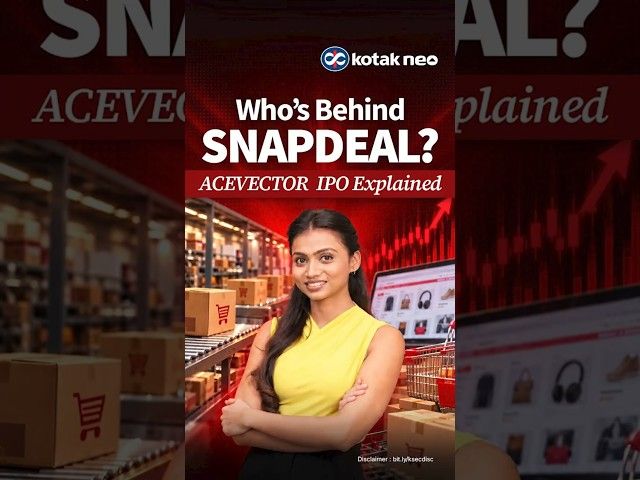
Snapdeal IPO is coming to the market with a ₹420 crore IPO. But here's the catch — Snapdeal is not directly launching the IPO. Acevector, Snapdeal's parent company, is bringing the issue.
In this #Shorts, we cover the Acevector IPO, including its issue size, price band, lot size, minimum investment, business model, financial performance, IPO fund utilisation and key dates.
Snapdeal IPO (Acevector) Review - ₹420 Cr IPO Opening on 25th Sep'26
Kotak Neo
•1m 42s
Snapdeal IPO Valuation
Detail | Information |
|---|---|
Upper Price Band | ₹32 |
Fresh Issue | 8,96,87,500 shares aggregating up to ₹287 crore |
Offer for Sale | 4,15,62,500 shares aggregating up to ₹133 crore |
EPS Diluted (in ₹) for FY 26 | (1.32) |
IPO Lot Size
Application | Lots | Shares | Amount |
|---|---|---|---|
Individual investors (Retail) (Min) | 1 | 468 | ₹14,976 |
Individual investors (Retail) (Max) | 13 | 6,084 | ₹1,94,688 |
S-HNI (Min) | 14 | 6,552 | ₹2,09,664 |
S-HNI (Max) | 66 | 30,888 | ₹9,88,416 |
B-HNI (Min) | 67 | 31,356 | ₹10,03,392 |
Anchor Investor Allocation for Snapdeal IPO
Rank | Anchor Investor | No. of Shares | Anchor Portion (%) | Amount (Cr) |
|---|---|---|---|---|
1 | Negen Undiscoverd Value | 1,24,99,812 | 21.16 | ₹40.00 |
2 | Singularity Growth Opportunities Fund II | 84,37,104 | 14.29 | ₹27.00 |
3 | Turnaround Opportunities Fund | 62,49,672 | 10.58 | ₹20.00 |
4 | Alchemy Long Term Ventures Fund Series 3 | 46,87,488 | 7.94 | ₹15.00 |
5 | Mavira Growth Opportunities Fund | 46,87,488 | 7.94 | ₹15.00 |
Note: The above table shows the top five anchor investors in the Snapdeal IPO based on their percentage share of the Anchor Investor Portion.
Share Offer and Subscription Details
Investor Category | Shares Offered |
|---|---|
QIBs | Not less than 75% of the offer |
Non-institutional Investors (NIIs) | Not more than 15% of the offer |
Retail-individual Investors (RIIs) | Not more than 10% of the offer |
Industry Outlook
India’s e-commerce market is large and expanding fast. It grew from USD 32.5 billion in FY20 to USD 95.8 billion in FY25 and is projected to reach USD 234.4 billion by FY30 at a compound annual growth rate of 19.6%, driven by wider internet access, digital payment adoption, and rising demand beyond the metro cities.
Electronics leads. The category held a 46.7% share, worth USD 44.7 billion, in FY25. Fashion, spanning apparel and footwear, is projected to grow at a 23.8% CAGR to reach a 27.8% share, or USD 65.1 billion, by FY30, while food and grocery expands on the back of quick commerce.
The value segment is the fastest-moving pocket. Value lifestyle e-commerce, estimated at USD 25.0 billion in FY25, is projected to reach USD 75.3 billion by FY30 at a 24.7% CAGR, a roughly threefold expansion over five years. India’s value shopper base, estimated at 190–210 million in FY25, is expected to grow to 540–560 million by FY30, as digital adoption deepens across smaller cities.
Enabling infrastructure supports this shift. Internet users reached 971.5 million, or 69.1% of the population, in FY25, and UPI transaction volumes rose from 12.5 billion in FY20 to 185.9 billion in FY25 at a 71.9% CAGR. AceVector is positioned across this value chain, with Snapdeal focused on value shoppers in Tier 2 and smaller cities that form the largest untapped e-commerce cohort.
About Snapdeal Limited
AceVector was incorporated as Jasper Infotech Private in 2007 and later operated as Snapdeal Limited. It runs an asset-light digital commerce ecosystem through three engines. Snapdeal is a value-focused online marketplace, Unicommerce is an e-commerce enablement SaaS provider, and Stellaro Brands is an early-stage consumer brands business. Together these three businesses span five proprietary platforms across the B2C and B2B e-commerce value chain.
Snapdeal targets value shoppers. It recorded marketplace revenue of ₹2,936.75 million in FY26, and served customers across 18,972 pin codes. During FY26, 83.75% of delivered units were priced below ₹599, and 82.22% of delivered units came from non-metro cities. Snapdeal had 376.25 million installations on the Google Play Store as of March 31, 2026, with an average rating of 4.4 out of 5.
Unicommerce supplies the technology backbone. Its stack includes Uniware for inventory and order fulfilment, Shipway for courier aggregation, and Convertway for marketing automation, and many Snapdeal sellers use these tools to manage orders and shipping. Shipway benefits from Snapdeal’s shipment volumes, and the SaaS business generated revenue of ₹2,043.38 million in FY26. Logistics expense accounted for 41.78% of the Company’s total expense in FY26.
Strengths of Snapdeal
- The company operates five proprietary platforms across three businesses, spanning marketplace, SaaS, and consumer brands within a single asset-light ecosystem.
- The tech enabled Unicommerce stack of Uniware, Shipway, and Convertway serves Snapdeal sellers and drives shared logistics scale that accounted for 41.78% of total expense in FY26.
- A discovery led, personalised technology platform draws on large-scale e-commerce data to power AI-based use cases across the businesses.
- A demonstrated ability to identify, acquire, and integrate complementary businesses, such as Shipway, extends the Company’s reach across the e-commerce value chain.
Risks of Snapdeal
- The company reported restated losses of ₹455.06 million in FY26, ₹1,263.06 million in FY25, and ₹512.97 million in FY24, and may keep incurring losses if revenue growth does not outpace expenses.
- The company recorded net cash outflows from operating activities in FY26, FY25, and FY24, and a financing outflow in FY26, which could strain liquidity if the pattern continues.
- Snapdeal’s marketplace contributed 57.54% of revenue from operations in FY26, so weakness in this single business would sharply reduce overall revenue.
- The company operates in a highly competitive e-commerce industry, and failing to compete effectively could compress margins and erode market share.
- A potential loss of control over Unicommerce would remove a core SaaS revenue engine and disrupt the shared technology and logistics that support the other businesses.
- The technology infrastructure of the company and its cloud providers is exposed to security breaches and cyber-attacks, which could interrupt operations and damage reputation.
Snapdeal Financials
Use arrow keys to navigate between tabs, Enter or Space to select, Home and End to go to first or last tab.
Year | Year Data |
|---|---|
FY24 | 379.76 |
FY25 | 395.02 |
FY26 | 510.38 |
Peer Comparison
Company Name | Revenue from Operations (Cr) | EPS (Diluted) (₹) | NAV per share (₹) | P/E Ratio |
|---|---|---|---|---|
AceVector | 510.38 | (1.32) | 2.21 | - |
FSN E-Commerce Ventures Limited | 10,022.35 | 0.70 | 5 | 462.50 |
Brainbees Solutions Limited | 8,547.94 | (2.90) | 90.71 | - |
Meesho Limited | 12,626.35 | (3.11) | 9.25 | - |
Notes: All listed-peer financial information is on a consolidated basis, sourced from annual reports and financial results for the year ended March 31, 2026 filed with the stock exchanges. P/E is computed on the NSE closing price of September 17, 2026 divided by FY26 diluted EPS. Return on Net Worth is profit or loss after tax, before other comprehensive income, attributable to equity shareholders, divided by year-end net worth. NAV per share is total equity as on March 31, 2026 divided by outstanding equity shares. P/E is not ascertainable for AceVector Limited, Brainbees Solutions Limited, and Meesho because their FY26 diluted EPS is negative.
Anchor Investor Bidding Date
Thursday, September 24, 2026
IPO Registrar and Book Running Lead Managers
Registrar Details
MUFG Intime India Private (formerly Link Intime India Private Limited)
E-mail: acevector.ipo@in.mpms.mufg.com
Tel: +91 810 811 4949
Book Running Lead Manager(s):
- IIFL Capital Services (formerly IIFL Securities Limited)
- CLSA India Private Limited
- Systematix Corporate Services Limited
Snapdeal Contact Details
Mezzanine Floor, A-83, Okhla Industrial Area, Ph-II, New Delhi 110 020, India
Tel: +91 124 473 9850
Email: companysecretary@acevector.com
Snapdeal Business Model
The company earns its revenue through three complementary engines. Snapdeal generates marketplace revenue by connecting value-conscious shoppers with sellers across lifestyle categories such as fashion, home, general merchandise, and beauty. Unicommerce earns SaaS revenue from its Uniware, Shipway, and Convertway products, which brands and sellers use for inventory management, order fulfilment, courier aggregation, and marketing automation.
Snapdeal Growth Trajectory
AceVector Limited's Total Income for FY26 was ₹537.67 crore, whereas in FY25 and FY24 it was ₹406.77 crore and ₹384.74 crore, respectively.
The Profit After Tax for FY26 was ₹(45.51) crore, whereas in FY25 and FY24 it was ₹(126.31) crore and ₹(51.30) crore, respectively.
Their EBITDA for FY26 was ₹(22.17) crore, whereas in FY25 and FY24 it was ₹(107.79) crore and ₹(35.77) crore, respectively.
Snapdeal Market Position
AceVector reaches value shoppers nationally through Snapdeal, which served customers across 18,972 pin codes and delivered 25.98 million units during FY26, with 82.22% of delivered units coming from non-metro cities. Snapdeal is among the top two pure-play value marketplaces in India by revenue and among the top nine shopping apps by downloads on the Google Play Store as of June 30, 2026.
As of 31 March 2026, the company’s Total Income, Profit After Tax, and EBITDA were ₹537.67 crore, ₹(45.51) crore, and ₹(22.17) crore, respectively.
Snapdeal Profit and Loss Statement (in ₹ crore)
Parameter | FY 26 | FY 25 | FY 24 |
|---|---|---|---|
Total Income | 537.67 | 406.77 | 384.74 |
Profit Before Tax | (37.56) | (120.59) | (45.76) |
Profit After Tax | (45.51) | (126.31) | (51.30) |
EPS (Diluted) ₹ | (1.32) | (3.04) | (1.26) |
EBITDA | (22.17) | (107.79) | (35.77) |
Snapdeal Balance Sheet
Parameter | FY 26 | FY 25 | FY 24 |
|---|---|---|---|
Profit Before Tax | (37.56) | (120.59) | (45.76) |
Net Cash from Operating Activities | (1.80) | (27.35) | (54.85) |
Net Cash from Investing Activities | 17.60 | (103.04) | (32.68) |
Net Cash from Financing Activities | (6.04) | 126.93 | 69.30 |
Cash & Cash Equivalents | 17.47 | 7.70 | 11.16 |
Note: () denotes negative
How to apply for Snapdeal IPO?
- Step 1: Log in to your Kotak Neo Demat account to access IPO investments. Next, select the current IPO section.
- Step 2: Specify IPO details. Enter the number of lots and the price you wish to apply for.
- Step 3: Enter UPI ID. After entering your UPI ID, click submit. This will place your bid with the exchange.
- Step 4: Mandate Notification. Your UPI app will receive a mandate notification to block funds.
- Step 5: Approve Request. Your funds will be blocked once you approve the mandate request on your UPI.
Snapdeal IPO FAQs
The Snapdeal IPO opens for subscription from 25-09-2026 to 29-09-2026, with a total issue size of ₹420 Cr. The IPO price band is ₹30 to ₹32 per share with a lot size of 468. The company aims to list the shares on BSE & NSE on 05-10-2026.
The Snapdeal IPO will open for subscription on 25-09-2026 and will close on 29-09-2026 for investors.
The minimum lot size for the Snapdeal IPO is 468 equity shares, requiring a minimum investment of ₹14976 for retail investors applying in the IPO.
The price band of the Snapdeal IPO has been fixed at ₹30 to ₹32 per equity share.
You can apply for the Snapdeal IPO online through the Kotak Neo Website or the Kotak Neo App using UPI or ASBA during the IPO subscription period.
Snapdeal IPO allotment will take place on 30-09-2026.
You can check the Snapdeal IPO allotment status online on the registrar’s website or on the NSE and BSE IPO allotment pages using your application number, PAN, or demat account details.
Snapdeal shares will list on the stock exchanges on 05-10-2026.
You can find detailed information about the Snapdeal IPO, including its business operations, financial performance, risk factors, and IPO objectives, in the Draft or Red Herring Prospectus (RHP).
Kunal Bahl and Rohit Kumar Bansal are the Joint Managing Directors of AceVector (Snapdeal) Limited.
Related News
- 1,030 Views| 21 Oct 2026
- 1,039 Views| 21 Oct 2026
- 1,034 Views| 21 Oct 2026
- 1,010 Views| 20 Oct 2026
- 1,047 Views| 20 Oct 2026
- 1,032 Views| 19 Oct 2026
- 1,061 Views| 19 Oct 2026
- 1,080 Views| 19 Oct 2026
- 1,081 Views| 19 Oct 2026








This article is for informational purposes only and does not constitute financial advice. It is not produced by the desk of the Kotak Securities Research Team, nor is it a report published by the Kotak Securities Research Team. The information presented is compiled from several secondary sources available on the internet and may change over time. Investors should conduct their own research and consult with financial professionals before making any investment decisions. Read the full disclaimer here.
Investments in securities market are subject to market risks, read all the related documents carefully before investing. Brokerage will not exceed SEBI prescribed limit. The securities are quoted as an example and not as a recommendation. SEBI Registration No-INZ000200137 Member Id NSE-08081; BSE-673; MSE-1024, MCX-56285, NCDEX-1262.