

Kotak
Stockshaala
Chapter 8 | 3 min read
Dual Supertrend Strategy (18,3 and 14,2)
A single Supertrend tells you the trend regime. But it cannot tell you whether the trend is mature or just beginning, or whether a small dip near the line is a valid entry or the start of a flip. Adding a second, faster Supertrend creates a layered system: one line filters the big trend, the other times the entry within it.
The Dual Supertrend strategy uses a slower line (18,3) as the trend filter and a faster line (14,2) as the entry trigger. In the previous chapter we used (10,3) as the standard single Supertrend. For the dual system, the lines are set differently — (18,3) gives a slower, more stable trend filter, and (14,2) gives a faster trigger. The combination is specifically tuned to reduce false entries inside a confirmed trend.
By the end of this chapter, you will be able to:
- Apply the Dual Supertrend framework using (18,3) as a trend filter and (14,2) as an entry trigger.
- Identify when both Supertrends agree and when they diverge.
- Set entry, stop loss, and exit rules using the two-line system.
The Two Lines and the Rules
Line | Settings | Role | What It Tells You |
|---|---|---|---|
Slow Supertrend | (18,3) | Trend filter | Is the dominant trend bullish or bearish? |
Fast Supertrend | (14,2) | Entry trigger | Within the confirmed trend, when does the faster line flip as a signal to enter? |
For a long entry: the slow Supertrend (18,3) must be green. The fast Supertrend (14,2) must flip from red to green after a brief pullback dip. Entry is on the candle following the fast flip. Stop loss is below the slow Supertrend line or the last swing low, whichever is lower. Exit when the slow Supertrend flips red.
Think of a train signal system on Indian Railways. The distant signal (18,3 slow line) tells the driver whether the track ahead is clear for a stretch — the big picture. The outer signal (14,2 fast line) tells the driver it is safe to enter the station right now. The driver does not move until both signals are clear. The slow line sets the context. The fast line gives the go-ahead.
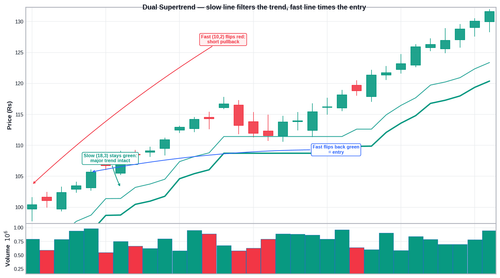
A pullback setup with entry near ₹500. The slow (18,3) remains green throughout:
Event | Slow ST (18,3) | Fast ST (14,2) | Action |
|---|---|---|---|
Base period | Green at ₹482 | Green at ₹488 | Both green; uptrend confirmed |
Pullback begins | Green at ₹484 | Flips red (price dips below ₹500) | Slow ST green; fast ST red. Wait. |
Pullback ends | Green at ₹485 | Flips back green (close above ₹496) | Trigger: fast ST flipped green, slow ST still green |
Entry | Green at ₹486 | Green at ₹497 | Entry on break of trigger candle high: ₹500 |
Stop loss | ₹481 (below slow ST) | Below slow ST or swing low | Risk = ₹19; position size = 263 shares |
Exit | Slow ST flips red | Already red before slow flip | Exit on slow ST flip only |
Common Mistakes
Mistake 1: Entering when only the fast Supertrend flips
The fast (14,2) flip is the entry trigger only when the slow (18,3) is already confirming the trend. A fast flip without slow confirmation is noise.
Mistake 2: Exiting on the fast Supertrend flip instead of the slow
The fast Supertrend flips during normal pullbacks. Exiting on each fast flip produces premature exits. The slow Supertrend (18,3) is the exit signal.
Key Takeaways
- The Dual Supertrend uses (18,3) as the trend filter and (14,2) as the entry trigger. Both must agree on direction before any trade is taken.
- Entry is on the fast (14,2) flip back in the trend direction whilst the slow (18,3) remains confirmed.
- Exit only on the slow (18,3) flip. Ignore fast (14,2) flips during the trade unless accompanied by a slow flip.
Assignment
Add both Supertrend lines — (18,3) and (14,2) — to the Nifty 50 daily chart. Go back two months. Identify every instance where the fast line flipped from red to green whilst the slow line remained green. For each of those instances: did price go on to make a meaningful move? What would the entry, stop, and target have been? Record your findings.
Prefer watching over reading? We also have a video course covering this topic in full detail. Check it out here →
Disclaimer: This article is for informational purposes only and does not constitute financial advice. It is not produced by the desk of the Kotak Neo Research Team, nor is it a report published by the Kotak Neo Research Team. The information presented is compiled from several secondary sources available on the internet and may change over time. Investors should conduct their own research and consult with financial professionals before making any investment decisions. Read the full disclaimer here.
Investments in securities market are subject to market risks, read all the related documents carefully before investing. Brokerage will not exceed SEBI prescribed limit. The securities are quoted as an example and not as a recommendation. SEBI Registration No-INZ000200137 Member Id NSE-08081; BSE-673; MSE-1024, MCX-56285, NCDEX-1262.
Recommended Courses for you



















Learn, Invest, and Grow with Kotak Videos
Explore our comprehensive video library that blends expert market insights with Kotak's innovative financial solutions to support your goals.

Trading with collateral as margin with Kotak Neo

How India is Redefining Space Exploration