

Kotak
Stockshaala
Chapter 2 | 3 min read
Why Most Traders Fail at Swing Trading
Six months in and the account is down. Not by a catastrophic amount, but enough to sting. The trades looked fine on paper. The setups were real. But somewhere between the chart and the executed trade, something went consistently wrong.
Most swing traders who struggle are not undone by one large mistake. They are undone by the same three small ones, repeated quietly across dozens of trades until the damage accumulates. Understanding these failure patterns is not pessimism. It is recognising the specific mechanics of how accounts erode, so you can build specific defences against each one.
By the end of this chapter, you will be able to:
- Identify the three most common failure patterns in swing trading and explain why each one destroys capital.
- Recognise which of these patterns is already present in your trading behaviour.
- Apply one specific counter-rule to each failure pattern before your next trade.
The Three Failure Patterns
The first is overtrading setups. Swing trading rewards patience. The market does not produce high-quality setups every day, and forcing trades when conditions are marginal is the single most consistent way to lose money slowly. Overtrading looks like taking a setup because something has to be on, not because the setup genuinely qualifies. The correction is a written checklist with no exceptions.
The second is chasing entries. A stock breaks out. You hesitate. By the time you enter, it is already 4% above the breakout level. The stop-loss is now uncomfortably wide, the risk-reward has deteriorated, and the trade was entered on emotion rather than plan. The correction is simple but psychologically difficult: if the entry level has passed, the trade has passed.
The third is poor risk management. A position sized too large turns a manageable loss into a damaging one. A stop placed too close gets hit by normal volatility before the trade has a chance to work. Risk management is not a secondary consideration. It is the primary one.
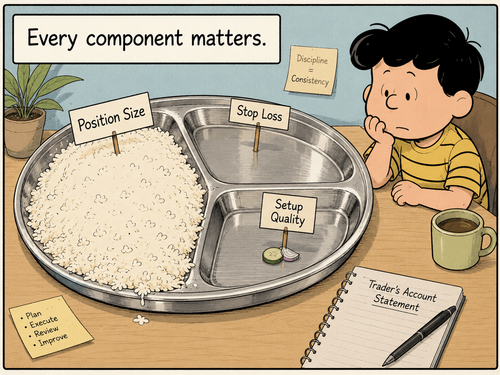
Just like a thali meal works because every item is served in the right portion, a swing trading account works because every element — setup quality, entry discipline, position sizing — is balanced correctly. Overloading one component whilst ignoring others ruins the whole meal.
The following example uses the entry price Rs. 500 and account capital Rs. 5,00,000.
Decision Point | Trader A | Trader B |
|---|---|---|
Entry | Waited for pullback to ₹500 zone as planned | Chased at ₹521 after seeing the move begin |
Stop loss | ₹482, below swing low (₹18 risk) | ₹482, same level (₹39 risk) |
Position size | 277 shares (₹4,986 total risk, approx. 1% of ₹5,00,000) | 277 shares (₹10,803 total risk, approx. 2.2%) |
Target | ₹550 (2.8R) | ₹550 (0.7R) |
Outcome if stopped out | ₹4,986 loss | ₹10,803 loss |
Same setup. Same stock. Same number of shares. Trader B chased the entry, compressed the risk-reward to near zero, and took on more than double the rupee risk simultaneously. Over fifty trades, this difference in process compounds into a significant gap in outcomes.
Common Mistakes
Mistake 1: Treating these failure patterns as personality flaws rather than process gaps
Overtrading, chasing, and poor risk management are not character defects. They are the absence of specific rules. The solution is not more willpower. It is better systems: checklists, entry price alerts, fixed position size formulas.
Mistake 2: Fixing only one pattern whilst leaving the others intact
A trader who solves overtrading but still chases entries and sizes poorly has reduced one leak in a boat with three holes. All three patterns need a specific counter-rule, applied simultaneously.
Key Takeaways
- The three most common swing trading failure patterns are overtrading setups, chasing entries, and poor risk management. Each destroys capital in a distinct and predictable way.
- Overtrading is solved by a written checklist. Chasing is solved by accepting that a missed entry is a saved loss, not a missed opportunity. Poor risk management is solved by calculating position size before entry, every time.
- These are process problems, not personality problems. Specific rules, applied consistently, eliminate each one more reliably than motivation or resolve alone.
Assignment
Review your last five trades. For each one, answer three questions in writing:
(1) Did you enter at your planned price or chase?
(2) Was your position size calculated using a formula or based on gut feel?
(3) Did you take the trade because the setup qualified or because you wanted to be active?
Write your answers down. Which of the three failure patterns shows up most often? That is the first pattern to build a specific rule against.
Now that you understand what causes most traders to fail, the next chapter covers the first practical tool to prevent it — a three-filter stock selection system that ensures you only trade names where conditions are already working in your favour.
Disclaimer: This article is for informational purposes only and does not constitute financial advice. It is not produced by the desk of the Kotak Neo Research Team, nor is it a report published by the Kotak Neo Research Team. The information presented is compiled from several secondary sources available on the internet and may change over time. Investors should conduct their own research and consult with financial professionals before making any investment decisions. Read the full disclaimer here.
Investments in securities market are subject to market risks, read all the related documents carefully before investing. Brokerage will not exceed SEBI prescribed limit. The securities are quoted as an example and not as a recommendation. SEBI Registration No-INZ000200137 Member Id NSE-08081; BSE-673; MSE-1024, MCX-56285, NCDEX-1262.
Recommended Courses for you















Learn, Invest, and Grow with Kotak Videos
Explore our comprehensive video library that blends expert market insights with Kotak's innovative financial solutions to support your goals.

Trading with collateral as margin with Kotak Neo

How India is Redefining Space Exploration