Beta Ratio In Mutual Funds: Meaning, Formula, Interpretation, And Example
- Posted: 29 May 2026, 5:37 PM IST
- | 4m
- 1,075
 Add Preferred News Source
Noticed how only some funds move closely with them? Others swing a little, and a few barely react at all. That difference is not random. It comes down to how sensitive a fund is to overall market movements.
This is where the beta ratio comes in. You get a clearer idea of how a fund could behave as markets rise or fall. That can make fund selection a lot more practical. This article explains the beta ratio in mutual funds, including its meaning, calculation, interpretation, and how it compares with other key ratios.
What Is Beta Ratio In Mutual Funds?
Two funds can deliver similar returns, yet behave very differently when markets fluctuate. That difference is where beta becomes useful.
It gives you an idea of how a fund moves in relation to the broader market. This is done by comparing its returns with a benchmark index over a period of time.
That reference point is usually a well-known index such as the Nifty 50 or the Sensex. These indices help investors understand whether a fund tends to move in line with the market or follow its own path.
Returns tell one part of the story. Beta looks at the other side, which is the behaviour of the fund. It tries to answer a simple question: When the market moves, how does this fund tend to respond?
Beta Ratio Formula
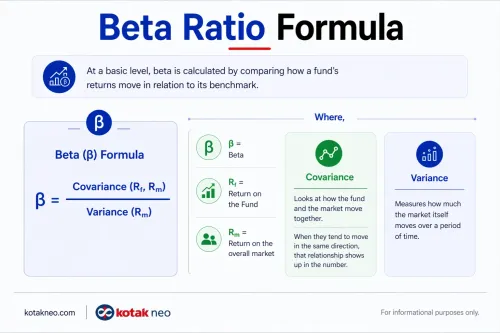
At a basic level, beta is calculated by comparing how a fund’s returns move in relation to its benchmark.
β=Covariance(Rf,Rm)/Variance(Rm)
Where,
β = Beta
Rf = Return on the Fund
Rm = Return on the overall market
Covariance simply looks at how the fund and the market move together. When they tend to move in the same direction, that relationship shows up in the number. Variance, on the other hand, measures how much the market itself moves over a period of time.
You do not need to calculate this manually in most cases. Fund fact sheets usually provide the beta value. Still, knowing what goes into the formula helps you understand that beta is built on actual movement patterns, not just isolated returns.
Interpretation Of Beta Ratio
Once you have the beta number, the next step is to understand what it is actually telling you.
A beta of 1 is usually treated as the baseline. It suggests that the fund tends to move in line with the market. If the market goes up or down, the fund is likely to follow a similar pattern.
A beta greater than 1 usually points to a fund that moves more aggressively than the market. It can do better in good times, but it can also fall faster when things turn negative.
With a beta below 1, the movement is more measured. The fund may not rise as quickly, but it also tends to hold up better during declines.
There is also the case of a negative beta, although it is less common. This suggests that the fund tends to move in the opposite direction of the market.
Beta Vs Alpha Vs Sharpe Ratio
Beta on its own gives only one part of the picture. It tells you how a fund behaves in relation to the market. To get a more rounded view, investors usually look at it alongside alpha and the Sharpe ratio.
Alpha focuses on performance. It tells you how a fund has performed compared to its benchmark. A positive number usually means the fund has done better than the market.
The Sharpe ratio looks at returns through the lens of risk. Instead of just asking how much a fund earned, it looks at how much risk was taken to earn those returns. This makes it easier to compare funds that may deliver similar returns but carry different levels of risk.
Here is how alpha, beta and Sharpe ratios differ:
Basis of Difference | Beta | Alpha | Sharpe Ratio |
|---|---|---|---|
Core focus | Market-linked risk | Performance compared to the benchmark | Risk-adjusted return |
What it compares | Fund vs market movement | Fund return vs benchmark return | Return vs total risk taken |
What it indicates | Volatility relative to the market | Outperformance or underperformance | Efficiency of returns |
Use case | Understand how a fund may react to market changes | Assess the fund manager’s ability to generate extra returns | Compare funds with similar returns but different risk levels |
Nature | Relative to market behaviour | Relative to benchmark performance | Combines both return and risk |
Importance Of Beta Ratio In Investing
When it comes to investing, volatility cannot be ignored. Beta helps you understand it better, and here is why it matters:
-
Beta gives you a clearer sense of how much a fund might fluctuate when markets move, which makes risk easier to gauge.
-
Choosing between funds becomes more practical, especially when you are trying to match investments with your comfort around market ups and downs.
-
It can also help while building a portfolio. Mixing funds with different beta levels allows you to manage overall risk a bit more thoughtfully.
-
Some investors prefer a steadier ride, while others are open to sharper movements. Beta helps you make that distinction.
-
It also adds context to returns. Instead of focusing only on how much a fund earns, you start to see how those returns actually come through.
Example Of Beta Ratio
Assume a fund has a beta of 1.2. When the market goes up 10%, the fund may move closer to 12%. In a falling market, a 10% drop could lead to a similar 12% decline.
Now take a fund with a beta of 0.8. With a 10% market move, the fund may move closer to 8%. The swings are smaller, both on the upside and the downside.
The choice between the two depends a lot on your comfort with market swings. A higher beta, like 1.2, may appeal to those who can handle volatility over the long term. A lower beta, such as 0.8, usually feels more stable and easier to stick with.
Sources:
Economic Times
Moneycontrol
FAQs On Beta Ratio
Think of beta as a way to understand how a fund usually responds when markets shift. So when markets go up or down, beta helps you understand how much the fund is likely to move along with it.
Not really. A higher beta simply means bigger swings, which can feel great in a rising market but uncomfortable during a fall. Whether it works for you depends on how much volatility you are comfortable with and how long you plan to stay invested.
Beta is based on past data, so it may not always reflect future behaviour. It also depends on the benchmark used and does not capture all types of risk, such as fund-specific factors or sudden market events.
The content in this blog is intended purely for educational purposes. Any securities or mutual funds referenced are illustrative in nature and do not constitute a recommendation or endorsement by Kotak Neo. Investors are encouraged to assess their own financial situation and seek professional advice before making any investment decisions. For compliance T&C and disclaimers, Visit www.kotakneo.com/disclaimer
0 people liked this article.

Kotak Neo (Kotak Neo) is India's venerable stockbroking company with a rich legacy. It offers comprehensive investment services across asset classes, prioritising a technology-first approach for a seamless experience. Trusted by 5 million+ customers, it guides you toward financial success with ease of investment and speed of trade.
Note: The opinions expressed in this blog are personal viewpoints and should not be construed as recommendations.