India’s GLP-1 Market: A ₹5,000 Cr Opportunity
- Updated: 22 May 2026, 5:17 PM IST
- | 4 min read
- 1,003
 Add Preferred News Source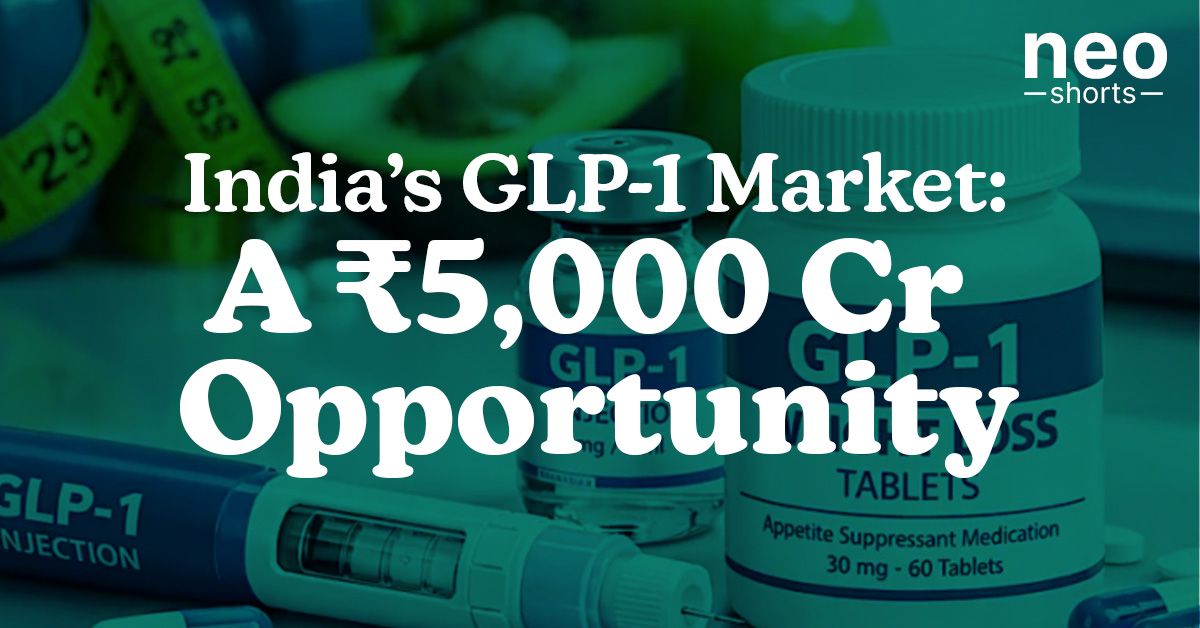
A single patent expiry.
That’s all it took to change the trajectory of an entire market.
Until March 20, 2026, Novo Nordisk largely dominated India’s GLP-1 (semaglutide) market.
Then, in March 2026, the patent expired in India, and the market opened up.

What has opened up is not just competition, but a ₹5,000 crore opportunity for India’s generic drug players.
At its core, GLP-1 (glucagon-like peptide-1) drugs were originally developed for diabetes management.
They work by regulating appetite, slowing digestion, and controlling blood sugar levels.
But that’s no longer their only role. They are now being used as first-line treatments for weight loss.
This shift is particularly significant in the Indian context, where the underlying patient base is large and continues to grow.
India already has over 100 million people living with diabetes, a number expected to reach 156 million by 2050.
At the same time, obesity levels are rising, with nearly 25% of the population currently classified as obese, a figure projected to exceed 440 million by 2050.
Importantly, demand is no longer limited to diabetic patients.
A growing segment of non-diabetic individuals is turning to GLP-1 drugs for weight management, expanding the addressable market far beyond traditional estimates.
This trend is not isolated to India.
Globally, the weight-loss drug market is witnessing rapid expansion, expected to grow from $62 billion in 2025 to $150 billion by 2030.
In India, the market is still relatively small, estimated at ₹1,000-₹1,200 crore in 2025, but is projected to reach ₹4,500-₹5,000 crore by 2030.
The gap reflects both the early stage of adoption and the scale of the opportunity ahead.
Until recently, the Indian market was largely shaped by a few global brands. Drugs like Mounjaro, Rybelsus, Ozempic, and Wegovy defined the category.
While these therapies brought innovation, they also came with steep price points that limited widespread access.
In 2025, global players attempted to scale their presence in India through local partnerships.
Novo Nordisk partnered with Emcure Pharmaceuticals to launch Poviztra, while Eli Lilly collaborated with Cipla to introduce Yurpeak.
Despite local manufacturing and distribution, prices remained high. Monthly treatment costs ranged from around ₹8,800 to ₹16,000, keeping these therapies out of reach for a large section of the population.
The inflection point came on March 20, 2026, when Novo Nordisk’s patent expired in India.
This was not just a regulatory change; it marked a structural shift in pricing and access.
Following the expiry, Indian pharmaceutical companies moved quickly to enter the GLP-1 space with generic alternatives.
Companies such as Sun Pharma, Dr. Reddy’s Laboratories, Zydus Lifesciences, Torrent Pharma, Glenmark Pharma, Alkem Laboratories, and Natco Pharma introduced their own versions at significantly lower prices.
This pricing shift has fundamentally changed the accessibility of GLP-1 therapies in India.
What was once a premium treatment category is now moving closer to mass adoption.
But for now, the opportunity is largely domestic.
The patent has just expired in India, and the market has opened up here first.
However, globally, patents for these drugs are still held by innovators like Novo Nordisk.
As these patents begin to expire in other markets over time, similar shifts could unfold internationally.
India is well-positioned for that transition.
It already supplies medicines to over 200 countries, accounts for around 20% of global generic drug supply, meets more than 50% of Africa’s generic demand, and contributes significantly to the US and UK pharmaceutical markets.
As GLP-1 patents expire worldwide, demand is likely to shift toward cost-efficient manufacturers.
When that happens, India will not be starting from scratch; it will already have the experience, scale, and infrastructure in place.
Sources:
Care Ratings
CNBC
NDTV
Mint
Yahoo Finance
BBC
Economic Times
PIB
The content in this blog is intended purely for educational purposes. Any securities or mutual funds referenced are illustrative in nature and do not constitute a recommendation or endorsement by Kotak Neo. Investors are encouraged to assess their own financial situation and seek professional advice before making any investment decisions. For compliance T&C and disclaimers, Visit https://www.kotakneo.com/disclaimer/
0 people liked this article.

Kotak Neo (Kotak Neo) is India's venerable stockbroking company with a rich legacy. It offers comprehensive investment services across asset classes, prioritising a technology-first approach for a seamless experience. Trusted by 5 million+ customers, it guides you toward financial success with ease of investment and speed of trade.
Note: The opinions expressed in this blog are personal viewpoints and should not be construed as recommendations.