Can Lotus Biscoff Replace Parle G in Your Chai?
- Updated: 22 May 2026, 5:17 PM IST
- | 10 min read
- 1,294
 Add Preferred News Source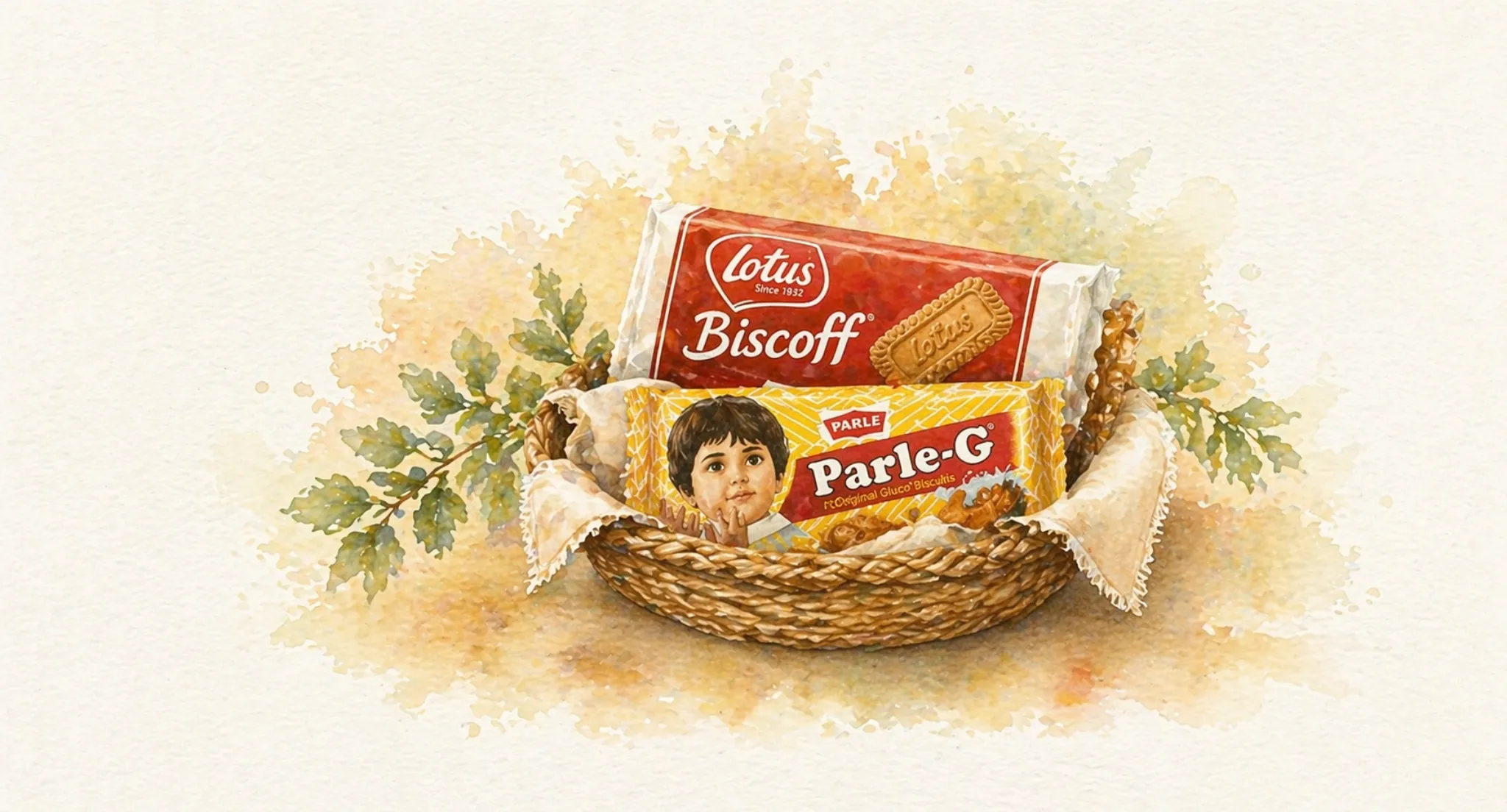
Picture this: You walk into a café and order a Biscoff cheesecake. That sweet, spicy, caramelised flavour hits your taste buds - layers of gooey cream cheese, crunchy biscuit crumbs, and that signature cinnamon taste. It's nothing like a Gulab Jamun or even your regular chocolate sundae. Yet, Indians have fallen for it. Millions share Biscoff recipes online. Every café in tier-1 cities now serves it.
So when Lotus Bakeries, the Belgian confectioneries giant, announced they're bringing their famous Biscoff biscuit to India - at ₹10 per pack - it seemed like the next logical step. But here's the real question: Can a sweet, spicy Belgian biscuit replace the glucose-y goodness of Parle G in the daily chai ritual of millions of Indians?
Let's break down what Lotus is wagering on and where they might stumble.
The Indian Biscuit Market: Not Your Average Snack Category
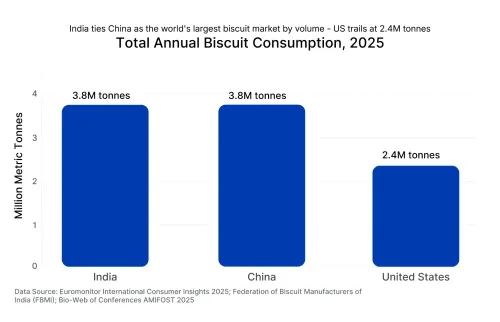
India isn't just another market for biscuits. It's one of the world's largest by consumption volume (rivaling China and well ahead of the US) with a $13.6 billion industry (2025) dominated by ITC, Parle, and Britannia.
Biscuits aren't occasional treats in India. They're everyday rituals:
- Dunked in morning chai
- Packed in kids' tiffin boxes
- Grabbed during evening tea breaks
- Munched on during train journeys
A typical household buys biscuits at the start of the week and needs to restock by the end.
To crack this market, you need rock-bottom pricing and distribution that reaches remote villages where only 500 people live. Your biscuits should be available on local trains and at railway stations where barely any trains stop.
Lotus knows this. That's why they've done something unprecedented - handed over manufacturing, distribution, and marketing to Mondelez International. This is the first time Lotus Bakeries isn't manufacturing the product themselves. Mondelez makes Cadbury, Five Star, Oreo, and Bournvita. They have the distribution muscle to reach every corner of India.
Lotus's Three-Pronged Play: Mass Market, Cafés, and Home Recipes
Lotus isn't just throwing a biscuit into the market and hoping it sticks. They're playing three different games at once.
1. Mass Market Entry: The ₹10 Wager
Lotus is launching at three price points:
- ₹10 pack (4 biscuits)
- ₹30 pack (mid-range)
- ₹80-100 pack (premium)
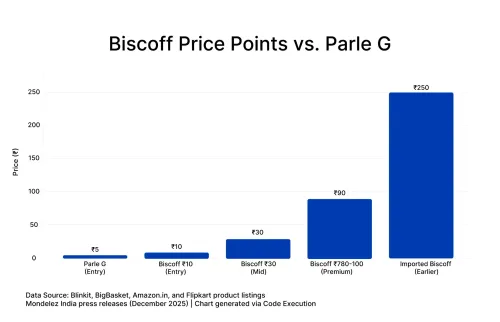
This is a sharp drop from the earlier ₹200-300 imported packs sold through select e-commerce and quick commerce platforms.
The ₹10 pack is aimed squarely at the Parle G and Marie biscuit crowd. The pitch? A new flavour option for those tired of the same old taste. If you don't like the malty sweetness of Parle G or the neutral taste of Marie, Biscoff's sweet, cinnamon, caramelised flavour could be a welcome change.
2. The Café and Restaurant Advantage
Here's where it gets interesting. Cafés and high-end restaurants have been using imported Biscoff biscuits for their cakes, cheesecakes, and milkshakes. Now, with domestically produced biscuits at lower prices, cafés can:
- Buy in bulk at lower costs
- Introduce more Biscoff-based recipes
- Expand Biscoff offerings to mid-tier cafés that couldn't afford imported biscuits
Imagine McDonald's introducing a Biscoff milkshake or cheesecake. Their primary source would be the locally available ₹10 or ₹80 packs - not expensive imports.
3. Home Recipes: The DIY Factor
Biscoff's standout feature is its versatility. You can use it in:
- No-bake desserts
- Cheesecake bases
- Milkshake toppings
- Muesli or toast spreads
As the ₹10 Biscoff becomes commonplace, households might start making Biscoff cakes at home instead of paying café prices.
Where Lotus Biscoff Could Crumble: The Taste and Chai Problem
1. The Flavour Mismatch
Indian biscuits and chocolates lean towards simpler, sweeter profiles. Even Mondelez's own products - Cadbury chocolates and Oreo cookies - are on the sweeter side. Biscoff, with its caramelised cinnamon flavour, is a departure.
The flavour isn't familiar. There's no Indian equivalent to Biscoff's taste profile. And unfamiliarity can be a dealbreaker in a market where habits run deep.
It's worth noting that Parle did try a cinnamon-flavoured biscuit called Kismi Dalchini. But it was never mass-marketed and isn't available everywhere. That's telling. If cinnamon-spiced biscuits had mass appeal in India, Parle - with its unmatched distribution and market understanding - would have made it ubiquitous. They didn't.
2. The Chai Conundrum
This is the big one.
For decades, Indians have dipped Parle G in chai. The chai-and-biscuit ritual itself is a British colonial import. Biscuits and the custom of dunking them in tea arrived with the Raj and became fixtures of middle-class households. What Parle G did was democratize it. Through rock-bottom pricing and omnipresent distribution, Parle took a habit that belonged to the colonial elite and the urban middle class and pushed it into every income bracket, every village, every railway platform.
Parle G is everywhere. Remote villages with 500 people? Check. Long-distance trains? Check. Railway stations where barely any trains stop? Check. Parle's distribution network is so deep that the biscuit has become part of India's social fabric.
More importantly, Parle G works perfectly with chai. The glucose flavour pairs beautifully with milky, sugary tea. The biscuit has structural integrity - it holds up for a few extra seconds after being dunked, giving you just enough time to lift it to your mouth before it crumbles.
Biscoff, on the other hand:
-
Is thinner and crumbles faster when dipped
-
Has a sweet, spicy taste that may not complement the milky sweetness of Indian chai
-
Doesn't have decades of chai-time association that Parle G has built through generations
You're not just competing with a biscuit. You're competing with a ritual, a memory, a muscle memory that millions of Indians have developed over their lifetimes. When someone reaches for a biscuit to dip in their evening chai, they're not thinking about flavour innovation - they're reaching for comfort and familiarity.
3. The Coffee or Chai Confusion
Here's another problem: Lotus doesn't know what it wants to be in India.
Globally, Biscoff has a clear identity. It's the cookie you get with your coffee - especially on flights. The brand is synonymous with coffee culture.
In India, Lotus is positioning Biscoff as both a chai dip and a coffee dip. This dual positioning creates confusion. Are we supposed to dip it in tea or coffee? The messaging isn't clear.
In global markets, Biscoff owns a niche - it's the premium cookie that pairs with your latte or cappuccino. In India, they're trying to be everything: a chai biscuit, a coffee biscuit, a standalone snack. That lack of focus could dilute the brand instead of strengthening it.
When a brand tries to mean everything to everyone, it often ends up meaning nothing to anyone.
4. The Regional Disconnect
Here's where the coffee-chai confusion gets worse: India isn't one market, it's many.
South India is predominantly a coffee-drinking region. But even there, people don't have a biscuit-dipping culture with coffee the way North India does with tea. Coffee in the South is enjoyed on its own - filter coffee sipped slowly, not dunked into.
North India is chai territory. But as we've established, Biscoff doesn't pair naturally with chai the way Parle G does.
So where does Biscoff fit? If it's meant to be paired with lattes and cappuccinos, that's an elite urban product consumed by a tiny fraction of Indians. Most Indians have never tasted a latte and likely never will. So why market it at ₹10 as a mass product?
There's no region-specific campaign addressing these differences. No distinct pitch for the South versus the North. The messaging feels generic - trying to appeal to everyone and risking connecting with no one.
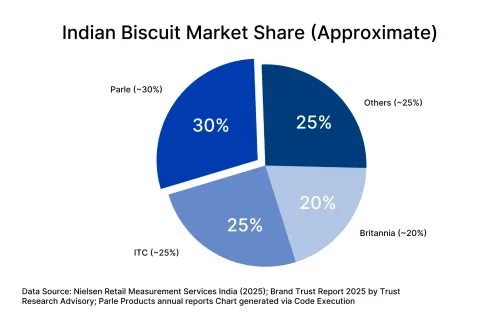
Lotus's entry is unlikely to shake up the mass market significantly - at least not immediately. Parle G, ITC, and Britannia have deep roots, decades of consumer trust, and unbeatable distribution.
But Lotus could carve out a niche:
- As a premium option for consumers looking to experiment
- In the café and dessert-making segment where it's already established
Among younger, urban consumers who've already tried Biscoff in cafés and want it at home - The bigger players might watch closely. If Biscoff gains traction in the premium-yet-accessible segment, expect ITC and Britannia to launch their own variations - cinnamon biscuits, caramelised flavours, or international-style snacks at competitive prices.
Lotus's real impact may not be in displacing Parle G but in expanding the flavour palette of Indian biscuits. It signals that there's room for experimentation beyond glucose and cream.
Key Takeaways for Readers and Investors
For Investors:
Watch Mondelez's execution. The partnership with Lotus is strategic - local manufacturing, massive distribution, and a product that's already gained cultural traction through cafés. The ₹10 price point is aggressive.
The real test: Can Biscoff create a new consumption occasion? If it remains a café ingredient and occasional treat, the mass market play won't pan out. But if it finds a foothold as a dessert-making staple or a coffee pairing (in urban centres), it could justify the investment.
Watch for repeat purchase behavior. Initial trial driven by curiosity and the ₹10 price point is one thing. Habitual consumption that displaces Parle G or Marie? That's the real hurdle. If you see Biscoff becoming part of people's weekly grocery baskets rather than a one-time purchase, that's the signal.
For International Stock Investors:
Lotus Bakeries NV (ticker: LOTB on Euronext Brussels, Europe's pan-continental stock exchange) is the parent company behind Biscoff. Founded in 1932 in Belgium, it's family-controlled, with the Boone and Stevens families holding over 60%. That means management is aligned with long-term bets, not quarterly earnings theatrics.
It's not listed on NSE or BSE, so Indian investors need access to European markets. The fundamentals: €1.36 billion in revenue in 2025 (+10% YoY), €172 million in earnings (+12.9%), ~20% EBITDA margin, and a €6.4 billion market cap. Dividend yield is 0.80%. This is a growth story, not an income play.
Here's the investment angle: the stock fell ~27% through 2025 because Biscoff was supply-constrained globally. Demand was there, production capacity wasn't. A new Thailand plant coming online in 2026 adds ~16% more Biscoff capacity: that's the unlock that makes the India push viable at scale.
Bank of America upgraded the stock to Buy with a €10,500 price target, specifically citing the Mondelez India partnership as part of the 2026 growth catalyst. The India play isn't a side experiment or a test market: it's already baked into the analyst bull case. Traction in India validates the capacity expansion bet and accelerates the revenue growth trajectory analysts are modeling.
For those buying into the thesis: watch repeat purchase behavior in the premium segment. The bull case isn't about displacing Parle G: it's about Biscoff establishing itself as a regular purchase for urban, premium consumers. That's what separates a profitable niche from a one-time novelty.
For the Industry:
Lotus's entry is a signal. International brands are eyeing India not just for volume but for value. They're willing to localize manufacturing and pricing. Expect more such moves from global FMCG players.
The Indian biscuit category might see more flavour innovation in the next few years. Whether that's good for competition or just adds noise in an already crowded market - only time will tell.
Bottom line? Lotus Biscoff has a shot at becoming a premium alternative, not a Parle G replacement. The chai-time throne is still up for grabs - but Biscoff might just be too different to sit on it.
Sources
Company Press Releases & Financial Filings
- Lotus Bakeries — 2025 Annual Results Press Release (February 2026): lotusbakeries.com
- Lotus Bakeries — 2025 Half-Year Results Press Release (August 2025): lotusbakeries.com
- Lotus Bakeries — Half-Year Report 2025: lotusbakeries.com
- Lotus Bakeries — FY 2024 Results Press Release (February 2025): lotusbakeries.com
- Lotus Bakeries — Investor Relations & Annual Reports: lotusbakeries.com/results-presentations
- Mondelez India — Press Releases (November–December 2025) on the Biscoff India launch and partnership with Lotus Bakeries
- Parle Products Pvt. Ltd. — Annual Reports and corporate filings
News & Industry Coverage
- Business Standard — "Mondelez India launches Biscoff, targets top-three global market position" (November 13, 2025): business-standard.com
- Storyboard18 — "Oreo-maker Mondelez launches Lotus Biscoff in India at Rs 10 to tap mass biscuit market" (November 13, 2025): storyboard18.com
- Social Samosa — "Mondelez and Lotus Bakeries bring Biscoff to Indian consumers" (November 13, 2025): socialsamosa.com
- Social Samosa — "Why did Mondelez bet on Lotus Biscoff? Marketing VP explains" (November 14, 2025): socialsamosa.com
- Afaqs — "Mondelez launches Biscoff cookies in India, partners with Lotus Bakeries" (November 14, 2025): afaqs.com
- The Byline — "Why Is Biscoff Suddenly ₹10 in India? Mondelez's Big Move Has Changed Everything" (December 1, 2025): thebyline.in
- ESM Magazine — "Lotus Bakeries Posts 10% Revenue Growth In FY 2025" (February 13, 2026): esmmagazine.com
Stock Market & Analyst Research
- TradingView News — "'2026 set up attractive': BofA ups Lotus Bakeries To 'buy'" (August 28, 2025) on the Bank of America upgrade and price target
- MarketScreener — Lotus Bakeries NV (LOTB) financial summary and analyst consensus: marketscreener.com
- Investing.com — Lotus Bakeries (LOTB) live stock price and analyst price targets: investing.com
- CNBC — Lotus Bakeries NV (LOTB-BE) stock quote and recent broker actions: cnbc.com
- Quartr — Lotus Bakeries (LOTB) earnings summary and outlook: quartr.com
Market Research & Industry Data
- Euromonitor International — Consumer Insights, India 2025 (biscuit category data)
- Federation of Biscuit Manufacturers of India (FBMI) — Industry data on Indian biscuit consumption volumes
- Bio-Web of Conferences — AMIFOST 2025 conference proceedings (biscuit market data, India)
- Nielsen Retail Measurement Services India — 2025 retail tracking data on biscuit category market shares
- Trust Research Advisory — Brand Trust Report 2025
Pricing & Product Listings
- Blinkit, BigBasket, Amazon.in and Flipkart product listings (verified between November and December 2025) for Lotus Biscoff and competing biscuit brand price points and pack sizes
The content in this blog is intended purely for educational purposes. Any securities or mutual funds referenced are illustrative in nature and do not constitute a recommendation or endorsement by Kotak Neo. Investors are encouraged to assess their own financial situation and seek professional advice before making any investment decisions. For compliance T&C and disclaimers, Visit https://www.kotakneo.com/disclaimer/
0 people liked this article.

Kotak Neo (Kotak Neo) is India's venerable stockbroking company with a rich legacy. It offers comprehensive investment services across asset classes, prioritising a technology-first approach for a seamless experience. Trusted by 5 million+ customers, it guides you toward financial success with ease of investment and speed of trade.
Note: The opinions expressed in this blog are personal viewpoints and should not be construed as recommendations.