What is a Sharpe Ratio And How To Calculate It?
- Updated: 22 May 2026, 5:17 PM IST
- | 9 minutes read
- 1,002
 Add Preferred News Source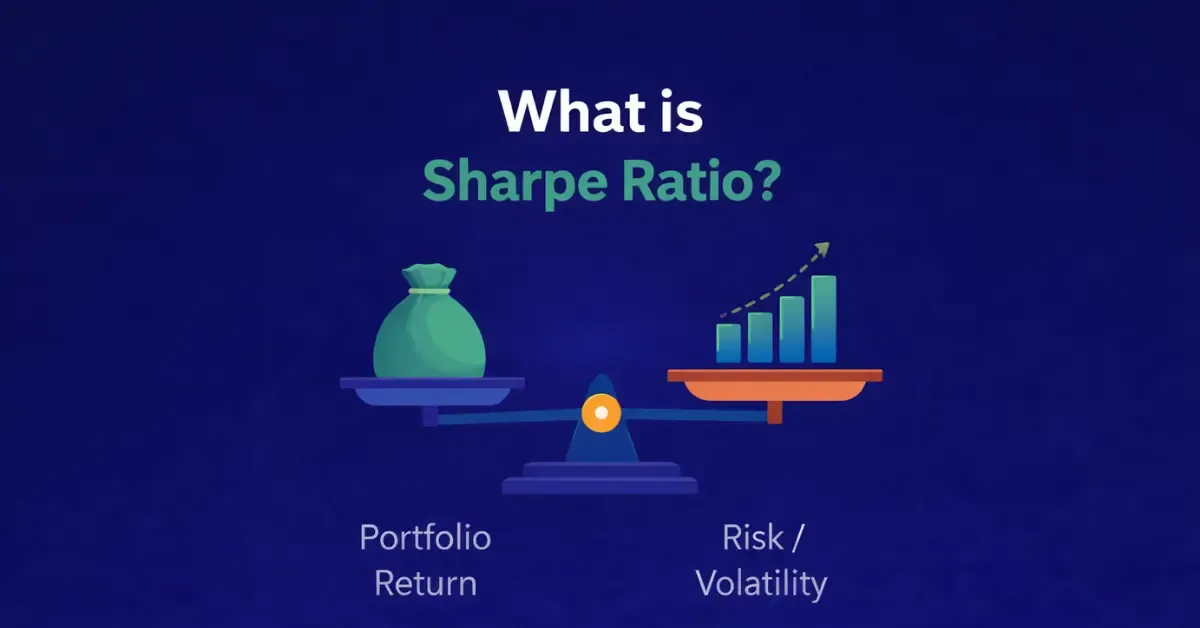
For many investors, the first filter while choosing a mutual fund is usually the advertised return. While one may think that a 15% return is objectively better than a 12% return, these headline numbers rarely give you the full picture. This is because the higher returns often come with a higher risk of volatility.
This is where the Sharpe ratio becomes relevant to the everyday investor. It is essentially a score to understand the degree of risk of volatility that comes with the higher return. While investing your hard-earned money into any mutual fund, it is worthwhile to check for this factor for a smoother investment experience.
What Is Sharpe Ratio?
The Sharpe ratio is like a filter. Some funds perform well when the market is going up, without doing much. Meanwhile, other funds are managed in a way that, even with the ups and downs of the market, they’re able to adjust and deliver the promised returns. The Sharpe ratio helps you determine which category the fund you are considering falls into. To do this, the Sharpe ratio compares the returns with a safety benchmark and then factors in the risk of volatility.
In India, we have safe places to put our money, like Post Office savings or Government bonds, where the risk is virtually zero. The Sharpe ratio calculates how much extra profit you made by entering the stock market instead, and factors in how much the market’s volatility will affect your money.
Sharpe Ratio Formula
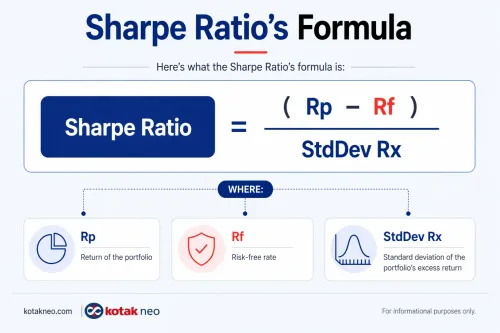
Here’s what the Sharpe ratio formula is:
Sharpe Ratio = (Rp – Rf) / StdDev Rx
where:
-
Rp = return of portfolio
-
Rf = risk-free rate
-
StdDec Rx = standard deviation of the portfolio’s excess return
To put the two components of the Sharpe ratio formula simply:
The numerator (Rp -Rf) is the extra profit you made by choosing to invest in the market instead of a risk-free asset class. It is then divided by the standard deviation, which quantifies the investment's volatility. The resulting Sharpe Ratio tells you exactly how much additional return you received for every unit of risk you took on.
How To Calculate Sharpe Ratio
If you want to calculate the Sharpe ratio for a fund you're eyeing, you’ll need three metrics.
Imagine Fund A returned 16% last year. If a safe government bond returned 6% in the same year, your extra profit is 10%. You can find the standard deviation of the fund under the fund details on the asset management company’s website.
Let’s assume Fund A has a standard deviation of 8%. So, you divide 10 by 8, and the Sharpe Ratio comes out at 1.25.
Example Of Sharpe Ratio Calculation
Let’s say you’re looking at two different portfolios to invest ₹2,00,000:
Metric | Fund A | Fund B |
|---|---|---|
Annual Return | 12% | 18% |
Risk-Free Alternative’s Return | 6% | 6% |
Standard Deviation | 4% | 12% |
Sharpe Ratio | 1.5 | 1.0 |
On paper, Fund A looks like a better choice given the 18% return. But when you look at the Sharpe Ratio, Fund B is actually more efficient. It’s giving you a more predictable and reliable growth per unit of risk. The Sharpe ratio is a good measure to assess whether the fund you are choosing matches your risk appetite or not.
What Is A Good Sharpe Ratio?
Once you’ve calculated the Sharpe ratio, the next big question is, "What number should I be looking for?" Generally, any good Sharpe ratio is above 1.0.
-
Below 1.0: You might be taking on too much risk for the amount of profit you're seeing.
-
Above 1.0: You’re being compensated well for the risk. That’s a good Sharpe ratio.
-
Above 2.0: This is a great score and signals that the manager is also protecting your money while growing it.
Importance Of Sharpe Ratio In Investing
Why is the Sharpe ratio in mutual fund research so heavily used by experts?
Risk-Adjusted Comparison: Comparing two funds based solely on nominal returns can be misleading. By accounting for risk, the Sharpe ratio standardises performance, revealing which investment provides a more efficient return per unit of volatility.
Performance Evaluation: This metric distinguishes between the value added by the manager's skill and the return derived from general market movements. A consistent Sharpe ratio across different market cycles indicates a disciplined and sustainable investment approach.
Identifying High-Quality Returns: Lower volatility often signals better-quality returns. The Sharpe ratio helps investors pick out funds that remain consistent, hovering near the mean instead of producing higher averages paired with large fluctuations.
Portfolio Construction: For effective diversification, investors should select assets that optimise the return for a specific risk threshold. The Sharpe ratio helps to balance your portfolio so that individual funds complement each other across various market conditions.
Conclusion
The Sharpe Ratio isn't a crystal ball, and it can't predict a market crash. But it is a great way to analyse the quality of returns. Before you jump into a fund because an advertisement showing 20% returns caught your attention, take a second and calculate the Sharpe ratio formula. It might just save you from a very uneven and ultimately less profitable investment journey.
Sources:
Kotak Mahindra Bank
Investopedia
FAQs On Sharpe Ratio
They both assess risk-adjusted returns, but their approach to volatility separates them. The Sharpe ratio is more conservative in nature. It labels all fluctuations as risk, regardless of direction. The Sortino ratio narrows its lens. Only downside deviation matters, and upward swings are viewed positively.
In mutual funds, the Sharpe ratio allows for a standardised "apples-to-apples" comparison. It facilitates a level playing field when comparing disparate asset classes, such as small-cap and large-cap funds, to determine which manager is generating more efficient returns per unit of risk.
The content in this blog is intended purely for educational purposes. Any securities or mutual funds referenced are illustrative in nature and do not constitute a recommendation or endorsement by Kotak Neo. Investors are encouraged to assess their own financial situation and seek professional advice before making any investment decisions. For compliance T&C and disclaimers, Visit https://www.kotakneo.com/disclaimer/
The content in this blog is intended purely for educational purposes. Any securities or mutual funds referenced are illustrative in nature and do not constitute a recommendation or endorsement by Kotak Neo. Investors are encouraged to assess their own financial situation and seek professional advice before making any investment decisions. For compliance T&C and disclaimers, Visit https://www.kotakneo.com/disclaimer
0 people liked this article.

Kotak Neo (Kotak Neo) is India's venerable stockbroking company with a rich legacy. It offers comprehensive investment services across asset classes, prioritising a technology-first approach for a seamless experience. Trusted by 5 million+ customers, it guides you toward financial success with ease of investment and speed of trade.
Note: The opinions expressed in this blog are personal viewpoints and should not be construed as recommendations.