How To Invest In Silver: Methods, Benefits, And Things to Know
- 9 minutes read
- 1,007
- Published 29 Apr 2026
Have you noticed how silver is becoming more popular among investors lately?
In 2025, inflows into silver ETFs in India crossed ₹234 billion, nearly three times higher than the previous year. That trend carried into January 2026, too, with inflows jumping by around 139% month-on-month.
So what is behind this growing interest in silver, and how do you begin if you are wondering how to invest in silver?
Different Ways To Invest In Silver In India
What has really changed is how people now look at silver. Today, it is no longer limited to something you buy and store.
There are several ways to invest in silver today, and each one works differently depending on your preference, convenience and how actively you want to manage it.
Most people still think of silver as coins or jewellery. But now, there are many more options, from owning the asset to market-linked instruments, which makes it easier for investors to find the right one for them.
To understand how to invest in silver, let us look at the different options available.
Physical Silver
This is the traditional way of investing in silver, usually through coins, bars or jewellery. For many people, it feels more reassuring since they can see and hold it.
There is also a cultural side to it in India. Buying tends to increase during festivals and special occasions. That was visible in 2025 as well, when silver was trading at around a 10% premium over international prices.
But there is another side to it. Storage and safety become challenging. It also involves making charges and brand-related premiums, which result in the asset becoming more expensive.
Silver ETFs (Exchange-Traded Funds)
Silver ETFs offer a very different route for investors who do not want the hassle of storing silver.
Instead of buying the metal itself, it allows investors to invest in a fund that tracks the price of silver. Like stocks of companies, these funds are also traded on stock exchanges.
A lot of recent activity around silver has been seen through this mode in recent times. In January 2026, inflows into silver ETFs touched nearly ₹9,463 crore, from ₹3,962 crore the previous month.
For investors who already have a demat account, this is one of the simplest ways to get started.
Silver Fund of Funds (FoF)
If you like the idea of ETFs but do not want to open a demat account or track performance regularly, Silver Fund of Funds may be the ideal starting point for you.
These funds invest in silver ETFs on the investor’s behalf and are available through the mutual fund route. Investors can invest through SIP (Systematic Investment Plans) or as a lump sum, just like any other mutual fund.
The only thing to keep in mind is cost. Since these are managed funds, they incur management costs, due to which the overall expense can be slightly higher.
Digital Silver
If you are wondering how to invest in silver with smaller amounts, digital silver can be an option.
This option lets investors buy silver online, even with small amounts. The value is backed by physical silver stored in secure vaults, so investors do not have to deal with storage issues.
It is convenient, but it is worth being cautious. Since digital silver is not fully regulated, it is worth taking a moment to understand how it works, how your silver is stored, and how easy it is to sell or convert it.
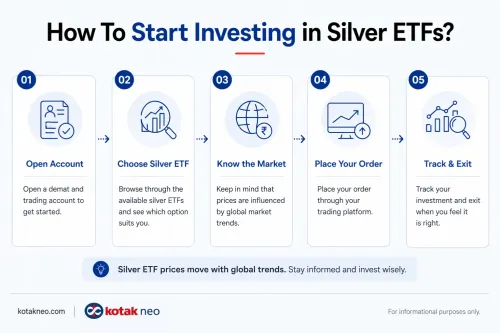
How To Start Investing In Silver ETFs
ETFs are fairly straightforward for those who are looking to invest in silver through market-linked options. They are also regulated by the Securities and Exchange Board of India (SEBI), which gives a certain level of oversight and transparency.
To start investing in silver ETFs:
-
Open a demat and trading account to get started.
-
Browse through the available silver ETFs and see which option suits you.
-
Keep in mind that prices are influenced by global market trends.
-
Place your order through your trading platform.
-
Track your investment and exit when you feel it is right.
Key Factors To Consider Before Investing
It is essential for you to think through a few practical aspects before you decide on how to invest in silver.
Market Volatility
Silver is not a slow-moving asset. In October 2025, prices rose sharply and then corrected from around ₹1.7 lakh per kg to nearly ₹1.47 lakh per kg. Movements like this are part of the picture.
This is why your time horizon matters. Prices can fluctuate significantly in the short term, so it helps to know how long you are willing to stay invested.
Costs And Premiums
If you are buying physical silver, costs can add up. Making charges, dealer margins, and premiums are all part of the equation, especially when demand is high.
With ETFs, the cost is different. You pay an expense ratio. It is usually lower, but still needs to be factored in over time.
Liquidity Needs
Think about how easily you might need access to your money.
Silver ETFs are relatively easy to buy and sell on exchanges. Physical silver, on the other hand, may take more time to liquidate depending on the situation.
Storage and Security
With physical silver, storage is something you cannot ignore. It comes with both cost and effort.
Options like ETFs and digital silver remove this concern completely, which is one of the reasons they are becoming more popular.
Taxation Basics
From a tax perspective, silver is treated as a capital asset in India, whether you invest through physical silver or financial instruments like ETFs.
Short-term capital gains are added to your income and taxed based on your slab. On the other hand, long-term capital gains are taxed at 12.5%.
If you are buying physical silver, there is one more cost to keep in mind. A 3% GST (Goods and Services Tax) is charged on the purchase value. In the case of jewellery, making charges may also attract an additional 5% GST.
Sources:
The Economic Times
Money Control
The content in this blog is intended purely for educational purposes. Any securities or mutual funds referenced are illustrative in nature and do not constitute a recommendation or endorsement by Kotak Neo. Investors are encouraged to assess their own financial situation and seek professional advice before making any investment decisions. For compliance T&C and disclaimers, Visit https://www.kotakneo.com/disclaimer/
The content in this blog is intended purely for educational purposes. Any securities or mutual funds referenced are illustrative in nature and do not constitute a recommendation or endorsement by Kotak Neo. Investors are encouraged to assess their own financial situation and seek professional advice before making any investment decisions. For compliance T&C and disclaimers, Visit https://www.kotakneo.com/disclaimer
0 people liked this article.