Gross Profit Ratio (Gross Profit Margin): Meaning, Formula, & Importance
- Updated: 22 May 2026, 5:17 PM IST
- | 9 minutes read
- 1,005
 Add Preferred News Source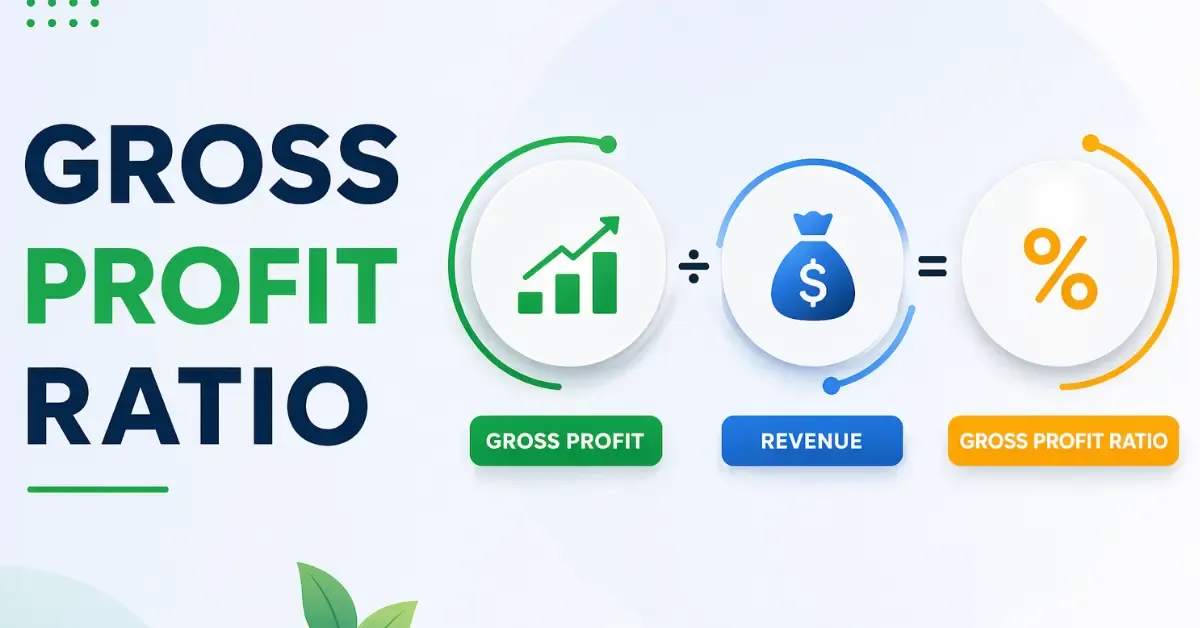
You want to invest in a company and understand its profitability before proceeding. The gross profit ratio or gross profit margin is one of the key metrics you can use to assess a company’s profitability. So, what is the gross profit ratio, its formula, and other aspects? Let us find out.
What Is Gross Profit Ratio?
Gross profit ratio, or gross profit margin ratio, is a financial metric that helps you understand the profit a business makes after covering the basic costs of making its product.
Through this ratio, you can assess the efficiency of a company's production process in using raw materials and labour.
Gross Profit Vs Gross Profit Ratio
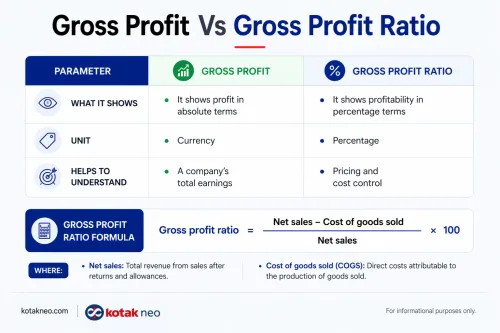
People often get confused between gross profit and gross profit ratio. Though they may look the same, there are certain differences between them. The table highlights the differences in various parameters:
Parameter | Gross Profit | Gross Profit Ratio |
|---|---|---|
What It Shows | It shows profit in absolute terms | It shows profitability in percentage terms |
Unit | Currency | Percentage |
Helps To Understand | A company’s total earnings | Pricing and cost control |
Gross Profit Ratio Formula
Let us look at the formula for the gross profit ratio you can use for calculation. The gross profit margin formula is as follows:
Gross profit ratio = (Net sales - cost of goods sold) / Net sales, where:
-
Net sales are equal to total sales minus returns, discounts, and allowances.
-
Cost of goods sold (COGS) is the direct cost a business incurs in its production process, including labour and material costs.
Here is a gross profit ratio example. Suppose a company’s net sales are ₹50 lakhs, and the COGS is ₹10 lakhs. As per the above formula, the company’s gross profit ratio comes to (₹50 lakhs - ₹10 lakhs) / ₹50 lakhs = 0.8 or 80%.
How To Calculate Gross Profit Ratio?
Here is a step-by-step process to calculate the gross profit margin ratio:
- Find Out Net Sales
Find out the company’s net sales. You can determine net sales by removing discounts and returns from a firm’s total sales. For example, if the total sales of a company are ₹1 lakh and returns and discounts comprise ₹10,000, net sales come to ₹90,000.
- Find Out COGS
Next, calculate the cost of goods sold. While calculating this, factor in the cost of raw materials and labour costs you incur while making the goods.
- Use The Gross Profit Margin Formula
Use the formula for the gross profit ratio given above to calculate the gross profit ratio. If the ratio is high, it means the business is earning strong profits, and vice versa.
Importance Of Gross Profit Ratio
Here is the importance of gross profit ratio:
- Shows The Profit Left
It tells you how much money a business keeps after covering the basic cost of making its products. Suppose a company sells something for ₹100. It costs ₹60 to make it. The remaining ₹40 is its gross profit. It tells you how much of each sale actually turns into profit.
- Check Business Health
The ratio gives a quick idea of how a business is performing. When this ratio rises, it often reflects solid cost management within the company. However, when it drops, it could signal overspending or problems with how products are priced.
- Useful For Comparison
You can use it to see how a business is doing over time, like from one month to the next or year to year. If the numbers decline, it’s usually a sign that something is not right. It can also be used to see how one business is doing compared to others in the same industry.
- Can Help Control Costs
When the cost of raw materials increases, gross profit may see a dip. In such scenarios, businesses can take appropriate action, such as finding alternative suppliers or reducing waste.
Tips To Improve Your Gross Profit Ratio
Here are some ways through which companies can increase their gross profit ratios:
- Bring Down COGS
To boost gross profit margin, companies can try to reduce the cost of making or buying the product. They can look for better deals from their suppliers. They can also cut down on unnecessary costs.
- Proper Use Of Resources
Wasted materials and unsold goods can reduce profit. By using their resources optimally and improving stock management, companies can bring down waste and boost their gross profit margins.
- Control Discounts
Offering too many discounts can reduce profits. By offering them when required, companies can manage their earnings better.
Conclusion
Gross profit ratio is a useful financial metric. It can give you vital insights into a company's financial performance and profitability. It can help you better evaluate a company and make informed decisions.
Sources:
ClearTax
Investopedia
FAQs on Gross Profit Ratio
The gross profit ratio shows the profit a business earns after subtracting the cost of goods sold. Net profit margin shows the final profit left after all expenses, including rent, salaries, and taxes.
You can calculate the gross profit ratio monthly, quarterly, or annually, depending on the business’ reporting needs. Doing so can help you track business performance and potentially spot problems early.
This might have happened if your production costs increased faster than sales. Even if you are earning more, higher expenses can reduce your profit margin.
Yes, it can be negative. If a product's production cost is higher than the selling price, the ratio can be negative. When this happens, it means the business is losing money on its sales.
The content in this blog is intended purely for educational purposes. Any securities or mutual funds referenced are illustrative in nature and do not constitute a recommendation or endorsement by Kotak Neo. Investors are encouraged to assess their own financial situation and seek professional advice before making any investment decisions. For compliance T&C and disclaimers, Visit https://www.kotakneo.com/disclaimer/
The content in this blog is intended purely for educational purposes. Any securities or mutual funds referenced are illustrative in nature and do not constitute a recommendation or endorsement by Kotak Neo. Investors are encouraged to assess their own financial situation and seek professional advice before making any investment decisions. For compliance T&C and disclaimers, Visit https://www.kotakneo.com/disclaimer
0 people liked this article.

Kotak Neo (Kotak Neo) is India's venerable stockbroking company with a rich legacy. It offers comprehensive investment services across asset classes, prioritising a technology-first approach for a seamless experience. Trusted by 5 million+ customers, it guides you toward financial success with ease of investment and speed of trade.
Note: The opinions expressed in this blog are personal viewpoints and should not be construed as recommendations.