The Invisible Industry Between Factory and Your Kirana
- Updated: 22 May 2026, 5:17 PM IST
- | 4 min read
- 13,465
 Add Preferred News Source
Mid-morning, a tempo would pull up outside the neighbourhood kirana.
Cartons came down in a rhythm the street recognised.
The shopkeeper flipped open a worn-out notebook.
It was part ledger, part memory.
Somewhere between the factory and that shelf, there was always someone you didn’t notice.
Not the brand, not the retailer.
It was the distributor, mostly invisible until now.
The Layer Nobody Notices
Every conversation today circles around Blinkit, Zepto, and Swiggy Instamart, as if India’s consumption story has been reduced to delivery times and app interfaces.
But that is only the surface.
Beneath it sits a far older system, one that quietly dealt with everything from a ₹5 shampoo sachet to a ₹500 bottle of oil across a country that does not behave like a single market.
India’s FMCG engine was never built for speed; it was built for reach.
A $288 billion market, with nearly 13 million kirana stores contributing about 90% of sales, does not run on algorithms alone.
It runs on a three-tier chain that feels almost old-world in its design: manufacturer to super stockist to distributor to retailer.
And in that chain, the distributor is not just a middleman.
He is the system.
Roughly 400,000 of them, represented by the All India Consumer Products Distributors Federation, operating on margins of 3% to 5%, extending 30 to 60 days of credit, managing warehouses, returns, field staff, and the small but critical chaos of Indian retail.
For four decades, this was how brands like ITC, Nestlé, Coca-Cola, Tata Consumer Products, Dabur, and Reliance built India-wide penetration.
It worked because it had to.
India is not a market you centralise.
It is a market you distribute.
When a New Channel Becomes the Preferred One
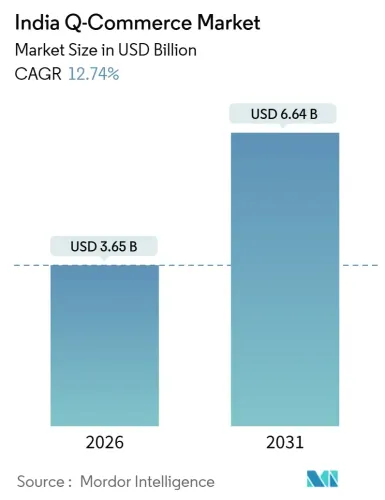
Source: Mordor Intelligence
Quick commerce did not break this system overnight.
It simply bent it in a direction it was never designed for.
What changed wasn’t just the emergence of a new channel, but who controlled it.
Distribution began shifting from territory-led relationships to platform-led access.
FMCG companies began appointing platforms as direct distributors, quietly bypassing the traditional chain.
Products started appearing cheaper on apps than in the neighbourhood store.
These discounts were not funded by efficiency, but by capital.
According to AICPDF's analysis, nearly 80% of quick commerce funding went towards customer acquisition and discounting, not infrastructure.
The Crack Appears One Layer Up
When people talk about disruption, they imagine the kirana store shutting down.
That is visible. What is less visible is what happens one layer before that.
The distributor loses volume first.
A van that once served 80 stores now serves 50.
Fixed costs remain. Margins shrink.
Credit cycles stretch as retailers, facing lower footfall, delay payments.
Territory boundaries, once sacred, blur as digital platforms sell across pin codes with no respect for geography.
It is a slow squeeze, not a sudden break.
And when you run a business on 3% to 5% margins, slow squeezes are fatal.
By October 2024, nearly 2 lakh kirana stores had shut down in a single year.
General trade Diwali sales dropped 25 to 30% between July and October.
The system is not collapsing yet, but it is certainly shifting.
Not Replacement, But Something More Complicated
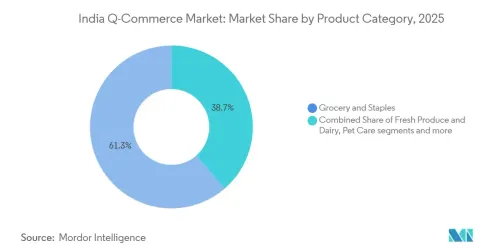
Source: Mordor Intelligence
It is tempting to think that quick commerce will replace traditional retail.
India rarely replaces systems; it layers them.
Quick commerce works in dense urban pockets where frequency is high, and logistics make sense.
It struggles in smaller towns and rural markets where demand is uneven and infrastructure is patchy.
Profitability outside metros remains a challenge.
So, what emerges is not replacement, but fragmentation.
Metro convenience goes to apps.
Monthly stocking still leans towards modern retail and e-commerce.
Trust-based purchases remain with kiranas.
Rural reach continues to depend on traditional distribution.
Which means the distributor does not disappear, but his role weakens.
And that is where the real risk lies.
The Pushback Arrives Late, But Loud
By April 2025, the discomfort turned into action.
The All India Consumer Products Distributors Federation wrote to FMCG companies with two demands that read less like negotiation and more like survival.
The first was a Market Operating Price protection clause, ensuring uniform pricing across channels, with compensation if any platform undercut prices.
The second was the right to return unsellable goods with guaranteed timelines.
These are not routine negotiations.
They are a signal that the system has shifted further than anyone intended.
By late 2025, something interesting happened.
FMCG companies began pivoting back towards general trade, not out of nostalgia, but necessity.
Because reach, once broken, is hard to rebuild.
Reading This Through an Investor’s Lens
For investors, this is not a retail story.
It is a distribution story disguised as one.
Quick commerce looks like growth, but that growth is built on discounting that may not survive pricing parity.
If FMCG companies enforce uniform pricing across channels, the very engine driving quick commerce volumes starts to stall.
Over time, this tension may begin to reflect in how margins behave across channels.
On the other side, companies with deep general trade networks and strong distributor relationships find themselves in a position of quiet strength.
ITC, Dabur, and peers that have spent decades building rural and semi-urban reach are not easily disintermediated.
The real signal will not come from headlines; it will come from earnings calls.
Watch for commentary on general trade recovery versus quick commerce growth.
That balance will tell you which layer is gaining power.
There is also a second-order effect that rarely gets discussed.
Distributors operate on credit.
When their cash flows tighten, the ripple moves into the lending ecosystem.
Rural-focused financiers such as Mahindra Finance and Shriram Finance are indirectly exposed to this stress.
Which means this is not just a consumption story, but a credit story in slow motion.
The System That Built Reach
It is easy to get carried away by speed; 10-minute delivery feels like progress.
But distribution is not about speed alone.
It is about consistency, coverage, and trust built over decades.
The invisible layer between the factory and the kirana did not emerge by accident.
It was engineered, one relationship at a time, across a country that resists uniformity.
When that layer weakens, the impact does not show up immediately.
Shelves still get stocked, and orders still get fulfilled.
But the resilience of the system begins to erode quietly.
And markets, eventually, price that erosion.
Because in India, systems don’t weaken when demand slows.
They weaken when the layer carrying it quietly stops holding.
Sources and References:
- IMARCGROUP
- IRECWIRE
- AICPDF
- ECONOMICTIMES
- MORDORINTELLIGENCE
- THEHINDUBUSINESSLINE
- MEDIANAMA
- LINKEDIN
The content in this blog is intended purely for educational purposes. Any securities or mutual funds referenced are illustrative in nature and do not constitute a recommendation or endorsement by Kotak Neo. Investors are encouraged to assess their own financial situation and seek professional advice before making any investment decisions. For compliance T&C and disclaimers, Visit https://www.kotakneo.com/disclaimer/
0 people liked this article.

Kotak Neo (Kotak Neo) is India's venerable stockbroking company with a rich legacy. It offers comprehensive investment services across asset classes, prioritising a technology-first approach for a seamless experience. Trusted by 5 million+ customers, it guides you toward financial success with ease of investment and speed of trade.
Note: The opinions expressed in this blog are personal viewpoints and should not be construed as recommendations.