What Is Growth Investing? Key Features & How It Works
- Updated: 01 Jun 2026, 1:22 PM IST
- | 4m
- 1,366
 Add Preferred News Source
In a market where some firms survive while others rapidly develop and dominate, growth investment options focus on identifying companies with strong future earnings potential. The growth investing idea is simple. Find businesses that are still early in their climb, even if the market has not fully priced in how big they can become later.
It focuses on companies with strong revenue momentum, scalable models, and the ability to capture large market opportunities. While this technique is volatile, it has the potential to generate considerable long-term wealth through compounding.
How Growth Investing Works In Real Life
Growth investing works in the following way:
Identifying High-Growth Opportunities
When looking for good growth stocks, investors seek companies with high revenue growth, rising earnings, and strong long-term prospects. These companies usually belong to industries such as technology, healthcare, and renewable energy.
Paying A Premium For Future Growth
The market usually prices growth stocks aggressively. Investors tolerate that because they expect future earnings to outpace today’s valuation by a wide margin.
Riding The Growth Phase
Once invested, the goal is to ride out the company's growth cycle as it expands, captures market share, and improves returns. The stock price tends to climb.
Ignoring Short-Term Volatility
Market swings happen all the time. For growth investors, though, the real focus stays on how good growth stocks perform over the long run rather than on short-term price movement.
Compounded Returns Over Time
With the rising earnings each year, the stock price tends to go up, which could lead to increased wealth generation for patient investors.
Key Features Of Growth Investing
The features of growth investing are as follows:
Focus On High-Growth Companies
Growth investment strategies target companies with strong potential for revenue and earnings expansion. Such companies are usually in fields such as technology or in innovation-oriented industries. It aims to invest in high-growth companies early in their lives that can deliver high value in the long run.
Reinvestment Over Dividends
Growth companies use their earnings to invest in the business rather than distribute dividends. This assists in financing growth, research and innovation. Growth stock investors are prepared to receive little to no dividend earnings in anticipation of good returns on investment in the future.
High Valuation Stocks
Growth stocks to invest in are usually valued higher than conventional stocks. The reason why investors can pay a premium is that they believe the future performance will be strong. Indicators such as price-to-earnings ratios tend to be higher, indicating a positive outlook for the company's growth.
Long-Term Investment Horizon
Growth investing is a long-term investment, and returns might not be realised immediately. People who buy these stocks usually stay invested for years. The idea is to let the investment build steadily over time instead of chasing fast profits. Short-term swings are part of the process.
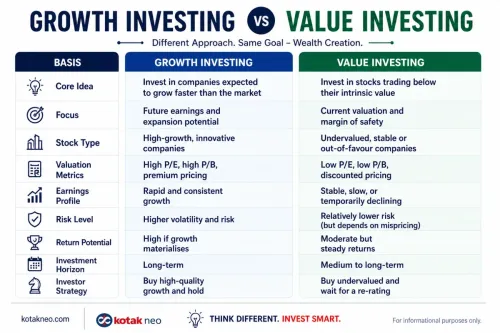
Growth Investing Vs Value Investing
The difference between them is as follows:
Basis | Growth Investing | Value Investing |
|---|---|---|
Core Idea | Invest in companies expected to grow faster than the market | Invest in stocks trading below their intrinsic value |
Focus | Future earnings and expansion potential | Current valuation and margin of safety |
Stock Type | High-growth, innovative companies | Undervalued, stable or out-of-favour companies |
Valuation Metrics | High P/E, high P/B, premium pricing | Low P/E, low P/B, discounted pricing |
Earnings Profile | Rapid and consistent growth | Stable, slow, or temporarily declining |
Risk Level | Higher volatility and risk | Relatively lower risk (but depends on mispricing) |
Return Potential | High if growth materialises | Moderate but steady returns |
Investment Horizon | Long-term | Medium to long-term |
Investor Strategy | Buy high-quality growth and hold | Buy undervalued and wait for a re-rating |
Key Metrics To Identify Growth Stocks
Growth stocks with best return are identified using financial and qualitative metrics that indicate strong future potential, consistent expansion, and competitive positioning in the market. They are as follows:
Revenue Growth Rate
Revenue growth is the percentage rise or reduction in a company's revenue over a certain time, often measured year over year or quarter over quarter.
A company’s ability to grow revenue consistently often shapes both investor confidence and future returns. It reflects whether the business can expand in a sustainable way through strong execution, effective positioning, and operational discipline.
When revenue rises steadily over time, it tends to show two things at once. The company is protecting or expanding its share of the market, and it is responding effectively to shifting demand. Their scalability and the ability to expand earnings over time attract shareholders to invest in such firms.
Earnings Per Share (EPS)
A company's EPS is calculated by dividing its net income by the number of common shares outstanding. This is known as basic EPS. Investors use earnings per share (EPS) to determine the worth of a company or its shares.
The greater the EPS, the more money a company earns per share. The more money a company earns per share, the more appealing its stock is to investors.
EPS is most useful for tracking changes in a company's financial performance over time and for comparing performance across two or more firms in the same industry.
EPS should always be calculated relative to a company's stock price and used in conjunction with other financial measures.
Return On Equity (ROE)
Return on Equity, or ROE, is a key financial metric that assesses a company's capital efficiency in relation to its shareholders' equity. It represents a company's potential to make returns from the capital invested by its shareholders.
Growth investors often want to invest in higher-ROE companies since this indicates that the business is generating value from its capital base.
Price-To-Earnings (P/E) Ratio
The price-to-earnings ratio (P/E ratio, P/E, or PER) compares a company's stock price to its earnings. Investors use it to determine the prospective worth of a stock.
If a stock's price exceeds its earnings; it may be overpriced. If a stock's price is lower than its earnings, it may be undervalued.
Investors expect strong future earnings, which is why growth stocks often trade at higher P/E ratios.
Industry Growth Potential
The expansion of a company is strongly connected with the general industry in which the company functions. Investors seek areas that have high demand in the future, like technology or renewable energy. High-growth industries provide a company with a greater chance to grow and market share in the long run.
Competitive Advantage
Competitive advantage is the potential of a company to stand in a position among its rivals, in terms of such aspects as brand strength, innovation, cost efficiency or unique products. Companies with greater strengths are more likely to sustain growth in the long run, attracting growth investors.
Tips To Get Started With Growth Investing
Here are some tips for investors who are starting with growth investing:
1. Buy Stocks With Strong RP
Stocks with strong Relative Performance often see continued momentum as institutional interest starts building. Even then, earnings growth should validate the strength so you do not chase hype-driven names.
2. Invest In Growing Companies
Look for businesses with dependable earnings, rising revenue, and expanding markets. The strongest opportunities usually sit in industries with years of runway ahead, clean energy, technology, and other long-cycle plays.
3. Diversify Your Portfolio
Stocks with high growth are usually high-risk stocks. Investors need to diversify their portfolio by sector and industry to minimise the risk of poor performance of their stocks. Diversification enables investors to have a stable portfolio and to take advantage of growth opportunities.
4. Take Long-Term View
Growth investments require patience and work best over a long duration. It is normal that a short-run price action can be volatile; however, typically, strong companies that are fundamentally good require time to compound returns. Do not react to daily price movement; invest over a long period of time and concentrate on the business performance.
5. Be Patient
Market corrections and weak stretches are part of investing in stocks. A steady approach tends to reward patient investors over time. Buying and selling too often can drive up transaction costs and drag down returns.
Conclusion
Growth investing is a strategy for investors seeking investments with high returns by focusing on companies with high future earnings potential. Although it is typically followed by paying a premium and experiencing temporary volatility, the actual advantage is that investors are able to realise the growth of earnings and the ability of compounding returns over time.
By focusing on strong fundamentals, staying patient, and maintaining a long-term perspective, investors can benefit from businesses that continue to expand and create value. When approached with discipline and the right mindset, growth investing can be a highly rewarding way to participate in the success of tomorrow’s market leaders.
Source
Investopedia
This article is for informational purposes only and does not constitute financial advice. It is not produced by the desk of the Kotak Securities Research Team, nor is it a report published by the Kotak Securities Research Team. The information presented is compiled from several secondary sources available on the internet and may change over time. Investors should conduct their own research and consult with financial professionals before making any investment decisions. Read the full disclaimer here.
Investments in the securities market are subject to market risks. Read all the related documents carefully before investing. Brokerage will not exceed the SEBI-prescribed limit. The securities are quoted as an example and not as a recommendation. SEBI Registration No-INZ000200137 Member Id NSE-08081; BSE-673; MSE-1024, MCX-56285, NCDEX-1262.
0 people liked this article.