Working Capital: Meaning, Formula, Importance & Examples
- Updated: 11 Jun 2026, 4:52 PM IST
- | 4m
- 1,003
 Add Preferred News Source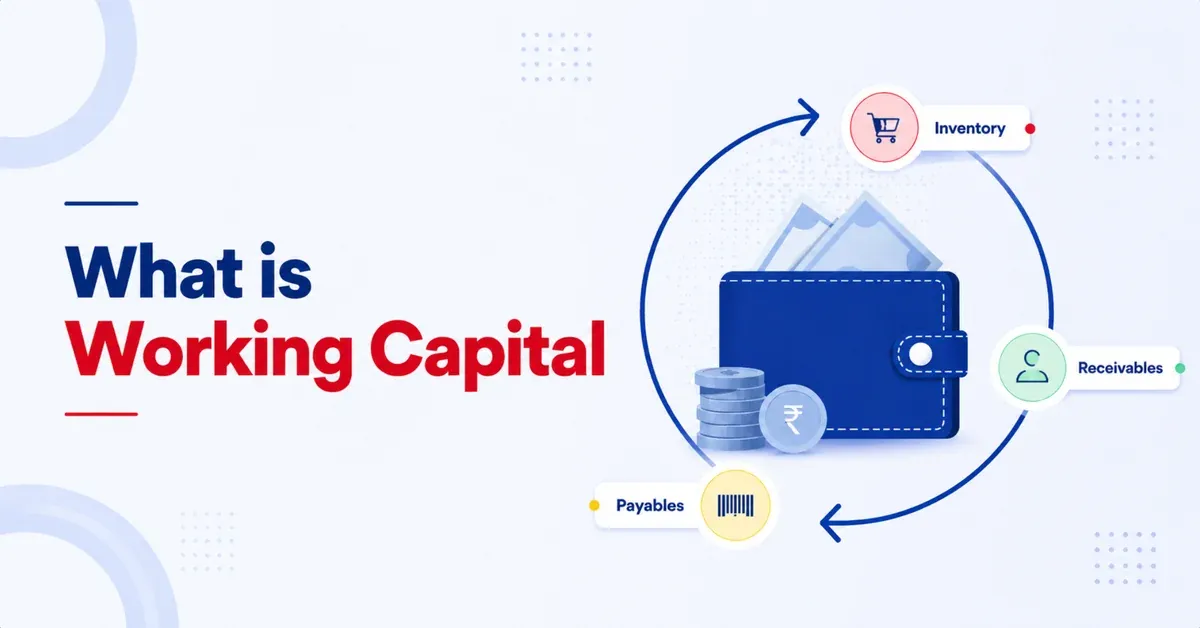
What Is Working Capital?
To operate a business properly, you require sufficient cash flow. If there is a lack of cash flow, then the business may not survive long. Here comes the role of working capital into the picture. It is an important financial metric that helps businesses manage daily operations smoothly.
Working capital represents the gap between a company’s current assets and current liabilities. It gives an idea of the firm’s short-term liquidity position and how efficiently daily operations are being handled. The figure also indicates how effectively the operating cycle is being managed.
Working capital guarantees that the company has sufficient assets to cover its short-term liabilities. It is often considered the lifeline of a business. In this blog, you will understand what working capital is.
Formula For Working Capital
Let us understand working capital calculation using the formula of working capital:
Working Capital Ratio Formula = Total Current Assets - Total Current Liabilities
Example:
Suppose that the company has current assets of ₹10,00,000 and current liabilities of ₹8,00,000.
Working Capital = ₹10,00,000 - ₹8,00,000 = ₹2,00,000
The company’s positive working capital indicates that short-term obligations are manageable. At the same time, it supports future growth initiatives.
Negative working capital is a sign that the company’s financial position needs attention. Such a situation can affect the company’s ability to operate efficiently. A need may arise for strategic adjustments to improve financial stability.
Components Of Working Capital
Here is what includes working capital:
1. Current Assets
Current assets are those assets of the company that can be converted into cash within one year. This includes:
-
Cash in the bank account
-
Cash equivalents: These are financial instruments that can be converted into cash.
-
Inventory: Goods used by the company in its business.
-
Short-term investments that can be easily liquidated.
-
Accounts receivable are the money the company is due to receive.
-
Prepaid expenses
2. Current Liabilities
Current liabilities are all financial obligations of the company that need to be paid within one year. This includes:
-
Accounts payable refers to money that a company has to pay to its suppliers
-
Short-term loans
-
Outstanding expenses (rent, salaries, utilities)
-
Bank overdrafts
-
Accrued expenses and taxes payable
Types Of Working Capital
There are several types of working capital:
1. Permanent Working Capital
This is the least amount of capital needed to run day-to-day operations smoothly, regardless of business conditions.
2. Temporary Working Capital
This refers to additional funds needed during peak periods or seasonal demand.
3. Gross Working Capital
Gross working capital means the total value of all current assets listed on the balance sheet.
4. Net Working Capital
The difference between current assets and current liabilities is known as net working capital. This figure points to the business’s actual operating capital.
5. Operating Working Capital
It refers to the capital required to fund day-to-day operations, excluding cash and short-term debt.
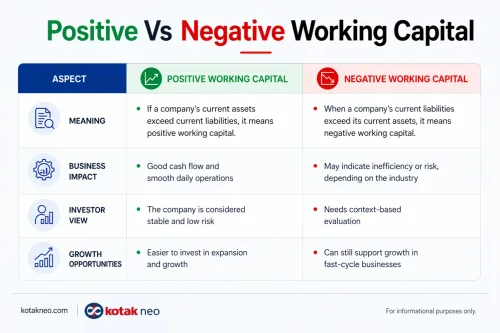
Positive Vs Negative Working Capital
Aspect | Positive Working Capital | Negative Working Capital |
|---|---|---|
Meaning | If a company’s current assets exceed current liabilities, it means positive working capital. | When a company’s current liabilities exceed its current assets, it means negative working capital. |
Business Impact | Good cash flow and smooth daily operations | May indicate inefficiency or risk, depending on the industry |
Investor View | The company is considered stable and low risk | Needs context-based evaluation |
Growth Opportunities | Easier to invest in expansion and growth | Can still support growth in fast-cycle businesses |
Examples | Manufacturing companies, service businesses | Retail chains, supermarkets, e-commerce platforms |
Conclusion
Daily operations don’t run smoothly on their own; working capital makes that happen. It covers regular payments and cushions businesses when surprise expenses show up. Without it, efficiency drops and earnings along with overall profitability can suffer.
Managing working capital means taking care of inventory, accounts receivable and accounts payable. A balanced working capital position helps with the company’s stability, expansion, and long-term sustainability.
FAQs On Working Capital
A working capital ratio between 1.2 and 2.0 is regarded as good enough. Different industries follow different standards for ideal ratios. Retail companies are one example, as they can still operate efficiently below a ratio of 1.
Working capital can be improved through proper management of inventory, reducing unnecessary spending, and accelerating receivables. Businesses can also negotiate better terms with suppliers and concentrate on increasing sales to improve cash inflow.
The content in this blog is intended purely for educational purposes. Any securities or mutual funds referenced are illustrative in nature and do not constitute a recommendation or endorsement by Kotak Neo. Investors are encouraged to assess their own financial situation and seek professional advice before making any investment decisions. For compliance T&C and disclaimers, Visit https://www.kotakneo.com/disclaimer/
0 people liked this article.

Kotak Neo (Kotak Neo) is India's venerable stockbroking company with a rich legacy. It offers comprehensive investment services across asset classes, prioritising a technology-first approach for a seamless experience. Trusted by 5 million+ customers, it guides you toward financial success with ease of investment and speed of trade.
Note: The opinions expressed in this blog are personal viewpoints and should not be construed as recommendations.