Short-Term Capital Gains (STCG): Meaning, Rules, Tax Rates & Calculation
- Updated: 22 May 2026, 5:17 PM IST
- | 4m
- 1,001
 Add Preferred News Source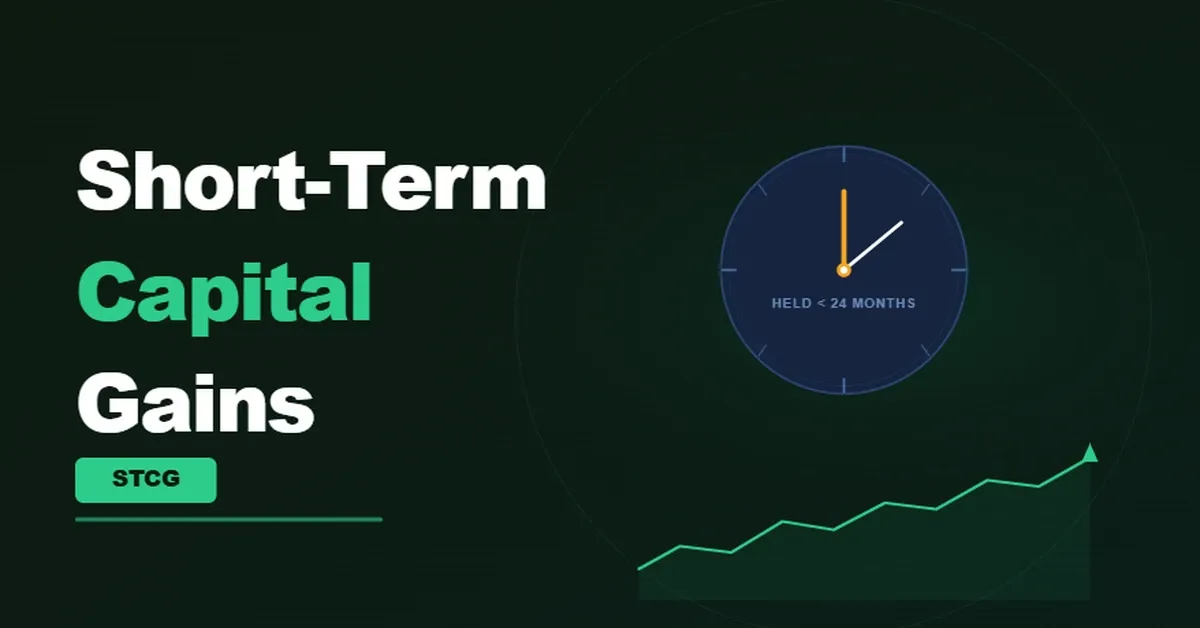
Short-term capital gains, or STCG, are simply the gains you make when you sell something within a short time of buying it. These gains come with their own short-term gains tax rules, which have changed in recent years. The STCG tax rate, especially for equity, is now higher than before. If you invest in shares, mutual funds, gold, or property, knowing how short-term capital gains work and how the short-term capital gain tax is calculated can help you avoid costly mistakes.
What Are Short-Term Capital Gains?
At its core, short-term capital gains mean one thing. You bought an asset, sold it quickly, and earned a return.
To explain short-term capital gain in plain terms, the only question that matters is how long you held the asset. If it falls within the short-term capital gain period, the income becomes short capital gain.
Take shares as an example. If you sell them within a year, the income is treated as short-term capital gains. The capital gains tax for short-term assets then depends on the type of asset and the rules attached to it.
Understanding what short-term capital gains are is important because the tax on short-term capital gains is not just higher, it also kicks in immediately in the year of sale.
Holding Period For STCG Classification
The classification depends entirely on how long you hold the asset. There is no single rule for all investments.
Equity Shares And Equity Mutual Funds
For listed equity shares and equity mutual funds, the line is drawn at 12 months. Sell within that window, and the profit becomes short-term capital gains.
These are taxed at a fixed STCG rate under Section 111A. This is where equity stands apart from most other assets.
Property, Gold, And Other Assets
For property and gold, the short-term capital gain period extends to 24 months. Sell before that, and the gain is treated as short capital gain and taxed accordingly.
Debt mutual funds follow a different path now. Under current rules, most of them fall under Section 50AA. That means the gains are treated like short-term capital gains regardless of how long you hold them, and the short-term gains tax is applied as per the slab.
Key Rules Of STCG In India
There are a few rules that directly affect how much tax you finally pay. These are not complicated, but they are easy to overlook.
Taxation Year
The STCG tax applies in the year you sell the asset. It does not matter when you bought it. The tax liability starts the moment the sale is complete.
No Indexation Benefit
There is no inflation adjustment here. Unlike long-term gains, short-term capital gains are calculated using the original purchase price. This is one reason why short-term taxes often feel heavier.
Deduction Of Expenses
You are allowed to reduce your short capital gain by subtracting expenses like brokerage or transfer charges. This step is often ignored, but it directly lowers your STCG tax.
Set-Off And Carry Forward Of Losses
If you make a loss, you are not stuck with it. Short-term capital gains and losses can be adjusted against other gains. If something is still left, it can be carried forward for up to 8 years. This helps reduce the future tax of short-term capital gains.
STCG Tax Rates In India
This is where the biggest change has happened.
The STCG tax rate for listed equity shares and equity mutual funds is now 20% for transactions after July 23 2024. This applies flat, regardless of your income.
For everything else, the treatment is different. Gains from property, gold, unlisted shares, and debt mutual funds are added to your income and taxed as per your slab. That means your short-term gains tax can go much higher depending on your income level.
There is no separate STCG exemption limit built specifically for these gains. Even if your income is relatively low, gains taxed at special rates may still be taxed. So when asking “what is tax on short-term capital gain”, the answer depends entirely on the asset.
How To Calculate Short-Term Capital Gains
The calculation itself is not complicated.
You take the sale price and subtract the purchase price along with any related expenses. That gives you your short capital gain.
There is no indexation here, so the numbers stay as they are. Once the gain is calculated, you apply the relevant STCG tax or STCG rate.
This is how the short-term capital gains tax is worked out in practice. The only place people usually go wrong is ignoring expenses or applying the wrong tax rate.
Example Of STCG Calculation
Let us explain short-term capital gains with numbers.
You buy shares for ₹1,00,000 and sell them within 6 months for ₹1,30,000. You pay ₹2,000 in brokerage.
Your STCG comes to ₹28,000.
Now apply the updated STCG tax rate of 20%. The tax becomes ₹5,600, and cess is added on top. This is the actual short-term gains tax you pay today, not the older 15% figure.
How To Report STCG In ITR
Reporting is straightforward but needs attention.
You declare short-term capital gains under the capital gains section in your Income Tax Return (ITR). The form varies depending on the income profile and is generally ITR-2 or ITR-3.
Here, you need to enter the sale value, cost of purchase, and the expenses incurred. This is the place where you can claim the set-off or carryover of losses, if you are facing losses.
Conclusion
The short-term capital gains tax rates in India are set according to the nature of the asset and the duration of the asset held by the individual. In the case of equity, the existing tax rates are at 20%, while in other cases the tax rates are set according to the income slabs of the individual. Knowing the exact STCG can help you file your ITR correctly.
Sources:
ClearTax
Kotak Neo
FAQs On Short-Term Capital Gains (STCG)
In most cases, yes. Short-term capital gains are added to your income and taxed as per slab. The exception is equity, where a fixed STCG rate of 20% applies.
Yes, they can be carried forward for up to 8 years, as long as you file your return on time.
If your total tax on short-term capital gain crosses ₹10,000 in a year, advance tax rules apply.
The difference comes down to time and tax. Short-term capital gains are taxed more heavily, while long-term gains usually get lower rates and better treatment.
The content in this blog is intended purely for educational purposes. Any securities or mutual funds referenced are illustrative in nature and do not constitute a recommendation or endorsement by Kotak Neo. Investors are encouraged to assess their own financial situation and seek professional advice before making any investment decisions. For compliance T&C and disclaimers, Visit https://www.kotakneo.com/disclaimer/
0 people liked this article.

Kotak Neo (Kotak Neo) is India's venerable stockbroking company with a rich legacy. It offers comprehensive investment services across asset classes, prioritising a technology-first approach for a seamless experience. Trusted by 5 million+ customers, it guides you toward financial success with ease of investment and speed of trade.
Note: The opinions expressed in this blog are personal viewpoints and should not be construed as recommendations.