Income Tax In India: Meaning, Types, Slabs, Calculation & Filing Guide
- Updated: 26 May 2026, 5:07 PM IST
- | 7 min read
- 1,928
 Add Preferred News Source
Managing money in India isn’t just about saving and spending wisely you also need to understand how taxes work. Most of us notice goods and services tax (GST) when we shop or pay for services, but the tax on what we earn is a different story altogether.
What Is Income Tax?
Income tax is the money you pay to the government based on how much you earn in a year. Put simply, the higher your income, the more tax you’re expected to pay.
This system is designed to be fair. Someone earning a higher salary contributes more, while those earning less pay a smaller share.
Income Tax Slabs In India
India currently offers two different paths for taxpayers. You can choose between the New Tax Regime and the Old Tax Regime. Each has its own set of rules and benefits.
New Tax Regime (Default)
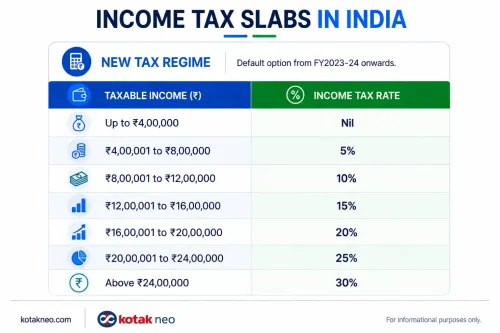
The new tax regime is now the default option from FY 2023-24 onwards. It offers lower tax rates but removes most deductions and exemptions. The new income tax slab structure for FY 2025-26 (AY 2026-27) is designed to be simple. For instance, there is no tax on income up to ₹4 lakh. The rates then climb in steps of 5%, 10%, 15%, and so on. Many find the new regime tax slab attractive because it requires less paperwork and leaves more liquid cash in their hands throughout the year.
Income Tax Slabs | Income Tax Rates |
|---|---|
Up to ₹4,00,000 | Nil |
₹4,00,001 to ₹8,00,000 | 5% |
₹8,00,001 to ₹12,00,000 | 10% |
₹12,00,001 to ₹16,00,000 | 15% |
₹16,00,001 to ₹20,00,000 | 20% |
₹20,00,001 to ₹24,00,000 | 25% |
Above ₹24 lakh | 30% |
Old Tax Regime
The Old Tax Regime has higher tax rates but allows you to reduce your taxable income through various investments. If you have a home loan, life insurance, or contribute to a Public Provident Fund (PPF), this regime might save you more money. It rewards those who save and invest for the long term. You get to subtract these investments from your total earnings before the tax is calculated.
Income Tax Slabs | Tax Rate |
|---|---|
Up to ₹2,50,000 | Nil |
₹2,50,001 to ₹5,00,000 | 5% |
₹5,00,001 to ₹10,00,000 | 20% |
Above ₹10,00,000 | 30% |
How To Calculate Income Tax?
Calculating your tax isn't as scary as it looks. First, you add up money from all sources: salary, house rent, business income, capital gains and other income. This is your Gross Total Income. Next, if you are in the Old Regime, subtract your exemptions and deductions. The remaining amount is your taxable income. You then apply the relevant slab rates to this amount. Finally, add a 4% health and education cess to the calculated tax.
Deductions And Exemptions
Deductions are like "discounts" on your tax bill. They are the government's way of encouraging you to save for your future or take care of your health. They help you reduce your taxable income. Exemptions are the part of income that the government doesn’t count when calculating your tax.
Deductions Under The Income Tax Act
If you’ve opted for the old tax regime, these sections can help you reduce your taxable income.
Section 80C:
This is the most popular section. You can claim a deduction of up to ₹1.5 lakh by investing in instruments like PPF, ELSS mutual funds, or paying LIC premiums. Even your children's school tuition fees count here.
Section 80CCD(1B):
This offers an extra deduction of ₹50,000 for investments in the National Pension System (NPS). This is over and above the ₹1.5 lakh limit of Section 80C.
Section 80CCD(2):
This relates to the employer's contribution to your NPS account. It is a great way for salaried professionals to lower their tax burden without spending extra from their own take-home pay.
Section 80D
Health is wealth, and the income tax department agrees. You can claim deductions for medical insurance premiums for yourself, your spouse, and your children. There is also an additional limit for premiums paid for senior citizen parents.
Section 80E
If you took a loan for higher studies, the interest you pay is fully deductible for up to eight years. There is no upper limit on the interest amount you can claim.
Section 24
Homeowners can breathe a sigh of relief here. You can claim a deduction of up to ₹2 lakh on the interest paid for a home loan for a self-occupied property.
Section 80TTA and Section 80TTB
80TTA allows individuals to claim up to ₹10,000 on interest earned from savings accounts. For senior citizens, Section 80TTB is even better, offering a limit of ₹50,000 on interest from both savings and fixed deposits.
Documents Required For ITR Filing
These are the documents usually required for ITR filing:
- PAN and Aadhaar Card
- Form 16 (from your employer)
- Form 16A
- Form 26AS (to check tax already paid)
- Bank statements and interest certificates
- Investment proofs (if using the Old Regime)
- Annual Information Statement (AIS)
Due Date For Filing ITR
For most individual taxpayers, the deadline for e-filing is 31 July of every year. If you miss this date, you can still file a belated return, but you will have to pay a late fee. Also, you might lose the chance to carry forward certain losses to future years.
Income Tax Payment
Tax Deducted At Source (TDS)
Tax deduction at source is when someone paying you (like your employer or your bank) takes a portion of the money and sends it directly to the government on your behalf. It’s like paying your tax in small installments. When you file your ITR, you can claim credit for this TDS so that you don't pay the same tax twice.
Advance Tax
If your total tax liability for the year is more than ₹10,000 after TDS, you must pay advance tax. This is paid in four instalments throughout the year (June, September, December, and March).
Self-Assessment Tax
After considering TDS and advance tax, if you still owe the government money, you pay it as self-assessment tax. This is usually done just before you file your final return.
E-Payment Of Taxes
You can make your income tax payment online through the official portal. The process is simple and takes only a few minutes. Options like net banking, debit cards, and UPI are commonly used to make payments.
Refund
If you paid more tax than what you actually owed, you are eligible for a refund. The department will send this money back to your pre-validated bank account. You can track your refund status on the e-filing website.
Important Income Tax Terms You Should Know
Financial Year (FY)
This is the 12-month period starting from 1 April and ending on 31 March. This is the period for which you actually file your ITR.
Assessment Year (AY)
This is the year immediately following the Financial Year. It is the period during which the income earned in the FY is reviewed and taxed. If the FY is 2025-26, the AY is 2026-27.
PAN & TAN
PAN is your permanent account number for all tax purposes. TAN is a number for those who are responsible for deducting tax at source (TDS).
Importance Of Paying Income Tax
Paying tax is not just a legal duty; it is a contribution to the nation. Your taxes fund the army, build metro rails, and provide subsidies for the poor. Moreover, having a clean tax record is essential when applying for visas or bank loans.
Tax-Saving Schemes
If you want to save tax while building wealth, look at these schemes:
- Public Provident Fund (PPF)
- Equity Linked Savings Scheme (ELSS)
- National Savings Certificate (NSC)
- Sukanya Samriddhi Yojana
Sources:
Cleartax
Income Tax Department
FAQs On Income Tax In India
Any individual whose total income exceeds the basic exemption limit (₹2.5 lakh or ₹4 lakh, depending on the regime) must file a return.
It is always the Financial Year, which runs from 1 April to 31 March.
No, only those whose tax liability (after TDS) is more than ₹10,000 need to pay advance tax. Senior citizens who don't have business income are exempt from this.
If you have many investments like a home loan and insurance, the old regime might be better. If you want simplicity and don't invest much, the new regime usually wins.
You may face heavy penalties, interest on unpaid tax, and even a notice from the department. It also makes it hard to get loans in the future.
Salaried individuals can switch every year. However, those with business income can usually switch only once in their lifetime.
The Old Regime has higher rates but many deductions. The New Regime has lower rates, but it severely limits deductions.
5 Income Tax Saving Instruments
Kotak Neo
•3m 06s
The content in this blog is intended purely for educational purposes. Any securities or mutual funds referenced are illustrative in nature and do not constitute a recommendation or endorsement by Kotak Neo. Investors are encouraged to assess their own financial situation and seek professional advice before making any investment decisions. For compliance T&C and disclaimers, Visit https://www.kotakneo.com/disclaimer/
0 people liked this article.

Kotak Neo (Kotak Neo) is India's venerable stockbroking company with a rich legacy. It offers comprehensive investment services across asset classes, prioritising a technology-first approach for a seamless experience. Trusted by 5 million+ customers, it guides you toward financial success with ease of investment and speed of trade.
Note: The opinions expressed in this blog are personal viewpoints and should not be construed as recommendations.