Specialised Investment Funds (SIFs): Meaning, Features, Benefits And How They Work
- Updated: 22 May 2026, 5:17 PM IST
- | 4m
- 1,002
 Add Preferred News Source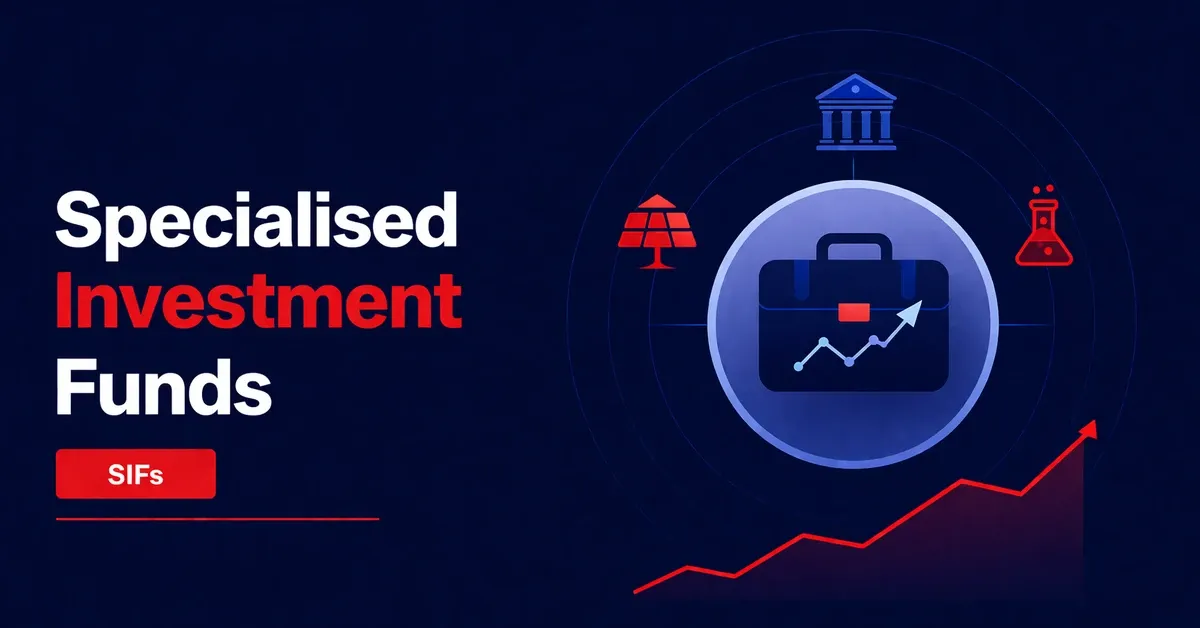
Imagine this. You and your friends decide to host a small party. While some suggest budget restaurants, others are keen on high-end dining. As the discussion moves on, one of you suggests a restaurant that seamlessly balances both choices. In investments, Specialised Investment Funds (SIFs) serve the same purpose. Read on to know what is SIF and its various aspects.
What Are Specialised Investment Funds?
SIFs are a type of investment option available in India that sit between regular Mutual Funds (MFs) and high-end Portfolio Management Services (PMS). SIF investment gives you access to special strategies at a cost lower than that of a PMS. It is a mid-level investment vehicle that is not as rigid as MFs and not as exclusive and high-ticket as PMS.
The Securities and Exchange Board of India (SEBI) introduced the SIF framework on 1 April 2025. Managed by professional fund managers, SIFs allow you to invest your money in more focused themes, including private credit, structured debt, or thematic equity.
How Do SIFs Work?
Now that you know what SIFs are, let us understand their working process. In an SIF investment, you join a pool of money collected from different investors. Professional fund managers manage this pool. They decide where they want to invest this money.
The focus is to invest the money in focused and more sophisticated strategies that are generally not present in traditional mutual funds. The returns depend on the performance of the chosen strategy or theme. As they are more specialised, they carry a higher element of risk.
Key Features Of SIFs
Advanced Investment Strategies
SIF investment allows you to leverage advanced investment strategies such as private credit, renewable energy, etc. Thus, you can benefit from these emerging themes.
Higher Flexibility Than Mutual Funds
SIFs give fund managers greater flexibility in how they invest your money. Unlike traditional mutual funds that follow a certain investment mandate, fund managers can adjust their approach based on market changes.
SEBI Regulation And Transparency
SEBI regulates SIFs. It means they work within a defined framework laid down by SEBI to protect investors. As an investor, you get updates on how your money is managed.
Minimum Investment Requirement
The minimum ticket size for SIF investment is ₹10 lakh. The amount is higher than MFs but lower than PMS, which requires a minimum investment of ₹50 lakh.
Lower Liquidity Compared To MFs
Open-ended MFs allow you to redeem units easily on any business day. However, SIFs have limited liquidity compared to MFs. The redemption frequency may vary as per strategy. For example, redemption in hybrid long-short funds may be allowed only twice a week or less.
Types Of SIF Strategies
There are broadly three types of SIF strategies, namely:
Equity-Oriented Strategies
The equity-oriented SIF strategy comprises three funds (see table):
Equity Long-Short Fund | Here, the fund invests at least 80% of its money in equities. At the same time, the fund can take short positions. However, it can be only up to 25% of its portfolio. That too, without any hedge. | |
|---|---|---|
Equity Ex-Top 100 Long-Short Fund | Here, the fund invests at least 65% of the fund’s money in stocks outside the top 100 companies by market value. At the same time, the fund can take short positions. However, this is limited to 25%, and it cannot be done in large-cap stocks. | |
Sector Rotation Long-Short Fund | The fund invests a minimum of 80% in equities across four sectors (max). |
Debt-Oriented Strategies
The debt-oriented strategy comprises two funds, the long-short fund and the sector long-short fund. The long-short fund takes both long and short positions. On the other hand, a sector long-short fund invests in debt instruments issued by at least two sectors. However, the exposure to one sector must not exceed 75% of the scheme’s assets.
Hybrid Strategies
The hybrid strategy comprises two funds, an active asset allocator long-short fund and a hybrid long-short fund. The active asset allocator long-short fund invests dynamically across equity, debt, derivatives, etc. On the other hand, the hybrid long-short fund invests a minimum of 25% each in equity and debt instruments.
Benefits Of Investing In SIFs
- Exposure To New Themes
With SIFs, you get exposure to new and emerging themes. These are generally not present in traditional investment avenues.
- Chances Of Higher Returns
As SIFs invest in emerging themes, you can potentially earn higher returns on your investment. This, of course, if the theme performs well.
Risks And Limitations Of SIFs
- High Risk
As SIFs invest in new and emerging themes, they carry a significantly higher risk. If the theme fails to perform well, you may suffer losses.
- Not Easy To Understand
SIFs may be a little complex to understand given their structure. You need a good understanding of markets and to read the scheme-related documents carefully to understand what exactly you are investing in.
- Limited Track Record
SIFs are relatively new investment option, with the framework introduced in 2025. Therefore, they have a limited track record when it comes to analysing their performance. Investors cannot gauge their long-term performance, particularly in a bear market.
- Concentration Risk
This is another significant risk associated with SIFs. As they focus on certain specialised themes, the performance depends heavily on the performance of that theme. Your investments are not diversified across sectors, unlike mutual funds.
Who Should Invest In SIFs?
SIFs are better suited for investors having a medium-to-long-term outlook. This is because of their liquidity constraints. Also, investors with a large investible surplus, already having a diversified portfolio, and looking for a layer of specialisation can invest in them.
Also, those having prior experience with mutual fund investments, with a good market knowledge, and looking to explore beyond traditional investment options can invest in SIFs.
Conclusion
Indian markets have matured over time with evolving investors’ expectations. Several high-net-worth individuals seek greater control over their investments, sans the complexity of PMS. SIFs aim to bridge this gap with their structure and investment approach.
Sources:
The Economic Times
Moneycontrol
NISM
Value Research
Kotak Neo
FAQs On Specialised Investment Funds
You can invest in SIFs through Asset Management Companies (AMCs). Many AMCs have launched their own SIFs in which you can invest. Complete Know Your Customer (KYC) norms, meet the minimum investment requirement, and choose a strategy that fits your needs.
SIFs are not necessarily safer than mutual funds. As they follow a more focused and sophisticated strategy, they are subject to higher risks and sharper ups and downs in the market.
Equity-oriented SIFs attract a 12.5% Long-Term Capital Gains Tax (LTCG). Others, where equity holdings are less than 65% and the holding period is more than 24 months, also attract a 12.5% LTCG tax rate. Debt-oriented SIFs are taxed as per your tax slab. Short-term gains are taxed at either your slab rate or at 20%, depending on the asset class and the holding period.
They can. However, SIFs are more suitable for investors who have a better understanding of markets. Beginners may find them more complex to understand.
The content in this blog is intended purely for educational purposes. Any securities or mutual funds referenced are illustrative in nature and do not constitute a recommendation or endorsement by Kotak Neo. Investors are encouraged to assess their own financial situation and seek professional advice before making any investment decisions. For compliance T&C and disclaimers, Visit https://www.kotakneo.com/disclaimer/
0 people liked this article.

Kotak Neo (Kotak Neo) is India's venerable stockbroking company with a rich legacy. It offers comprehensive investment services across asset classes, prioritising a technology-first approach for a seamless experience. Trusted by 5 million+ customers, it guides you toward financial success with ease of investment and speed of trade.
Note: The opinions expressed in this blog are personal viewpoints and should not be construed as recommendations.