India’s Tax-To-GDP Ratio: Key Insights And Trends
- Updated: 25 May 2026, 6:04 PM IST
- | 6 min read
- 1,006
 Add Preferred News Source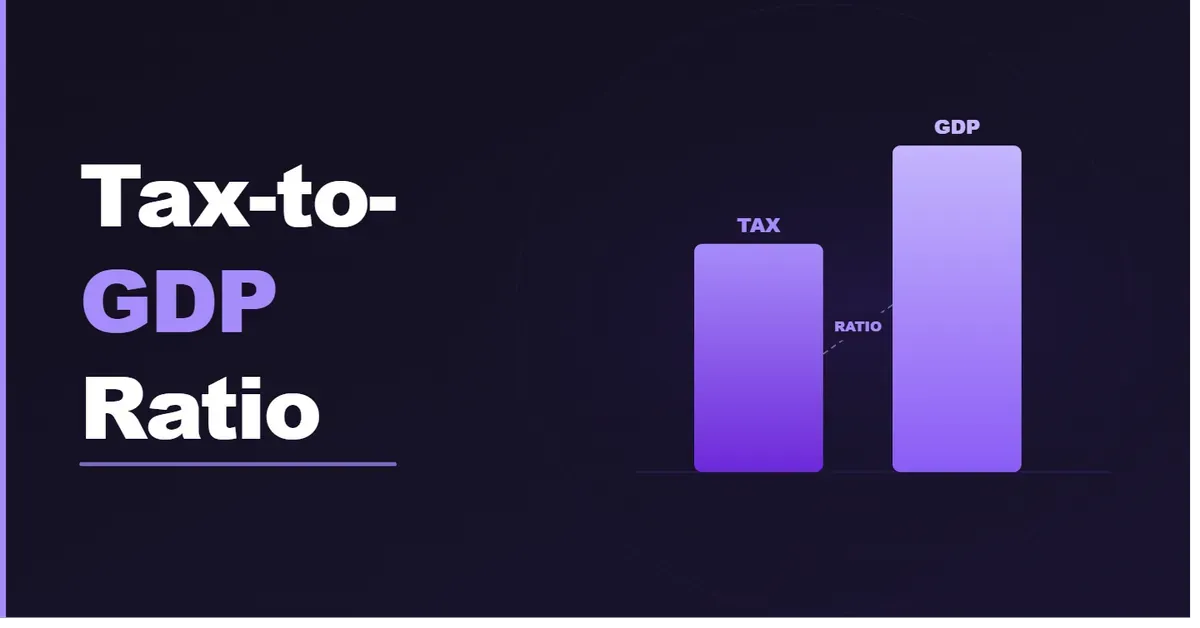
Think of a housing society where residents’ chip in for upkeep. When those contributions fall short, things start falling apart elevators stop working, the security guard disappears, and the common areas turn shabby.
The problem is not the number of people living there, it is how much each person puts in. A country's tax-to-GDP ratio works the same way. So, what exactly is this ratio, and how has India been doing on this front? Let us take a closer look
What Is the Tax-To-GDP Ratio?
Simply put, the tax-to-GDP ratio tells you how much tax a country collects compared to the size of its economy. It is one of the clearest ways to judge whether a government is generating enough revenue relative to what the country produces. The ratio also shows how serious a nation is about taxation and makes it easier to compare one country's tax effort against another's. Here is the formula behind it:
Tax-to-GDP Ratio = A country's tax revenue / Its GDP
When this ratio stays at a healthy level, it usually points to a stable economy with a reasonably fair distribution of the tax burden
Tax-To-GDP Ratio In India
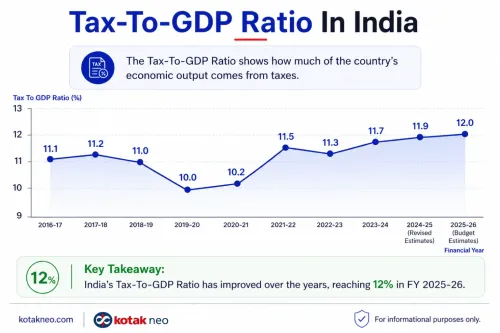
For most of the past decade, India's tax-to-GDP ratio has stayed in the 11%-12% range not a dramatic swing either way. This period also saw some significant tax overhauls, most notably the rollout of the Goods and Services Tax (GST) and a revised income tax structure. The numbers below capture how the ratio has moved year by year:
Financial Year | Tax To GDP Ratio |
|---|---|
2016-17 | 11.1 |
2017-18 | 11.2 |
2018-19 | 11 |
2019-20 | 10 |
2020-21 | 10.2 |
2021-22 | 11.5 |
2022-23 | 11.3 |
2023-24 | 11.7 |
2024-25 (Revised Estimates) | 11.9 |
2025-26 (Budget Estimates) | 12 |
Types Of Taxes In Tax-To-GDP Ratio
When we talk about India’s tax-to-GDP ratio, it’s essentially split across two broad categories of taxation:
-
Direct Tax To GDP Ratio
This component tracks how much the government collects from direct taxes, personal income tax and corporate tax as a share of GDP. In FY 2024-25, this figure came in at 6.8%-7.1%, a step up from 6.6% the previous year, indicating that direct tax collections have been gradually picking up.
-
Indirect Tax Contribution
On the other hand, indirect taxes, GST, fuel levies, and other similar charges make up the remaining portion. In FY 2024-25, this stood at 4.9%, noticeably lower than 6.86% in FY 2023-24. That dip partly reflects the rationalisation of GST rates over the years.
Reasons For Low Tax-To-GDP Ratio In India
Government data puts India’s tax-to-GDP ratio at around 12% for FY26 (budget estimate), India is still well behind what most developed economies manage. A few structural factors explain why:
- An Informal Economy
A large portion of India's workforce operates outside the formal system small traders, daily wage earners, and street vendors who rarely maintain income records. Without proper documentation, the tax department cannot track or collect from them, leaving a significant pool of income entirely outside the tax net.
- Low Income Levels
A large section of India’s population earns below the threshold where income tax kicks in. With so many people falling outside the taxable bracket, overall collections naturally stay limited.
- Low Tax Awareness
Tax literacy in India, particularly in smaller towns and rural areas, remains patchy. Many people don’t fully understand how the system works or why filing taxes matters and without that awareness, voluntary compliance stays low.
Importance Of Tax-To-GDP Ratio
The ratio isn’t just several economists’ track. It has real-world implications:
- Helps In Smooth Running Of The Country
When more tax flows in relative to GDP, the government has greater financial headroom. Roads get built, salaries get paid, and public institutions function without constant resource crunches.
- Helps Improve Public Services
Hospitals, schools, railways all of it runs on tax money. A stronger ratio means the government can do more than just maintain these services; it can upgrade them.
- Reduce Borrowing
Healthy tax revenues reduce a country's dependence on borrowing. Governments that do not collect enough tax tend to borrow more and that debt compounds over time, with interest payments eating into future budgets.
Conclusion
The tax-to-GDP ratio is a number worth watching closely. India's ratio has come a long way, but there is still ground to cover. At 12%, the country is moving in the right direction - but bridging the gap with wealthier nations will require sustained reforms, stronger compliance infrastructure, and much greater public awareness. More than most indicators, this one tells you how solid a country's fiscal foundations are.
Sources:
The Economic Times
ClearTax
Data GOV
TaxGuru
FAQs On Tax To GDP Ratio In India
As per Union Budget India’s tax-to-GDP ratio for FY 2025-26 is pegged at 12%. That’s still modest by global standards, but it reflects steady improvement over the past few years.
There’s quite a gap. The USA collects taxes worth about 25.6% of its GDP; Germany is at 38%. India, at 12%, is still some distance away though its economic structure and development stage are very different from those countries.
Bringing more people and businesses into the formal tax fold would help the most. Alongside that, simplifying the filing process and running targeted awareness campaigns especially in semi-urban and rural areas could meaningfully nudge compliance upward.
The content in this blog is intended purely for educational purposes. Any securities or mutual funds referenced are illustrative in nature and do not constitute a recommendation or endorsement by Kotak Neo. Investors are encouraged to assess their own financial situation and seek professional advice before making any investment decisions. For compliance T&C and disclaimers, Visit https://www.kotakneo.com/disclaimer
0 people liked this article.

Kotak Neo (Kotak Neo) is India's venerable stockbroking company with a rich legacy. It offers comprehensive investment services across asset classes, prioritising a technology-first approach for a seamless experience. Trusted by 5 million+ customers, it guides you toward financial success with ease of investment and speed of trade.
Note: The opinions expressed in this blog are personal viewpoints and should not be construed as recommendations.