India Built the Pipes. Now Comes the Hard Part.
- Updated: 22 May 2026, 5:17 PM IST
- | 6 min read
- 7,703
 Add Preferred News Source
Somewhere in rural India, a woman no longer walks forty minutes to the well before sunrise.
There is a tap now, just outside her door, installed two years ago under a government scheme she cannot name but is quietly grateful for.
Some mornings, water comes. Some mornings, it does not.
This is not a complaint.
It is simply the texture of a revolution that moved faster than the systems meant to sustain it.
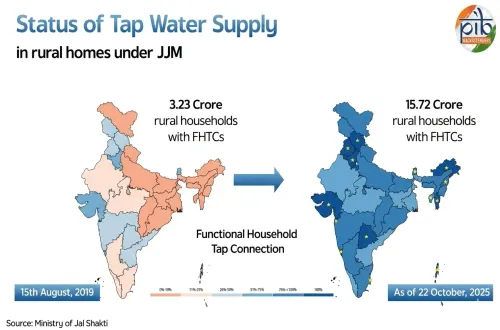
In six years, India connected over 12.58 crore rural households to tap water; one of the fastest infrastructure expansions any country has attempted.
The dashboards in Delhi show 81.71% coverage as of March 2026, up from 16.7% in 2019.
The pipe exists. The water, sometimes, does not.
The Build-Out That Worked
Source: PIB, Government of India
The scale of Jal Jeevan Mission is not easy to dismiss.
A central outlay of ₹2.08 lakh crore, infrastructure rolled out across nearly every district in the country, and a defined service benchmark of 55 litres per capita per day.
The system was designed like a corporate rollout with real-time monitoring, weekly reviews, decentralised execution through Gram Panchayats.
The quieter metric is the one that deserves more attention.
The World Health Organisation estimates that universal tap access could save 5.5 crore hours daily that were earlier spent collecting water — three-quarters of it borne by women.
That is not just infrastructure.
That is productivity, and dignity, unlocked at scale.
From an investor's lens, this phase was classic capex: pipes, pumps, contractors, and EPC players.
Outcomes tangible, visible, and relatively easy to measure.
But infrastructure stories always have a second act.
When the Tap Arrives But Trust Doesn't
Somewhere between connection and consumption, the story begins to fray.
Around 84% of households now have access to tap water, yet only about 80% of them believe the quantity is sufficient for daily needs.
The gap is not dramatic, but it is persistent enough to matter.
The bigger issue is not whether water reaches the home.
It is whether it is trusted once it gets there.
Only 41.7% of households treat their water, and within that, just 28.3% rely on filtration or boiling.
Which means a large portion of households are either consuming untreated water or quietly opting out of the tap altogether.
Then comes quality.
Around 1.2% of tested rural water samples are unfit for consumption, often due to groundwater contaminants like fluoride or arsenic.
On paper, that looks like a small number.
In reality, it feeds a much larger perception problem.
Because trust in water is not built on averages, it is built on exceptions.
And once doubt creeps in, behaviour changes faster than policy can respond.
The Summer Test
It is May, and temperatures are already brushing past 45°C in parts of India.
This is peak demand season, when water stops being a utility and starts behaving like a commodity.
Packaged water companies are already flagging “unprecedented and continuous” raw material cost increases.
They are signalling price hikes just as demand hits its annual high.
Which tells you something subtle but important: the cost of water is no longer just about supply.
It is about trust, packaging, and delivery.
At the same time, the government’s own numbers reveal an uncomfortable paradox.
The Jal Jeevan Mission had a budget estimate of ₹67,000 crore for 2025-26.
Revised spending came in at just ₹17,000 crore.
A programme that allocates ₹67,000 crore and spends ₹17,000 crore is not facing a funding problem.
It is facing an execution problem, and execution gaps are where private markets quietly step in.
The Trust Economy Builds Itself
Source: Mordor Intelligence
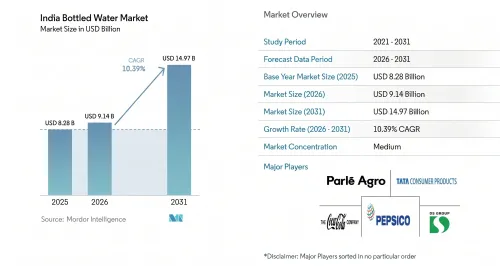
The bottled water industry in India is now a $8.28 billion market, expected to touch $14.97 billion by 2031, growing at roughly 10.39% CAGR.
That is not a luxury category; it is a mass behaviour.
About 85% of this market is driven by low-cost packaged water, which tells you that even price-sensitive consumers are willing to pay for perceived safety.
The pricing ladder itself reads like a map of trust.
A ₹2 pouch for basic access, a ₹20 bottle for convenience, a ₹100 premium label for assurance, and a ₹50 jar refill for daily use.
Same water, but different levels of confidence.
With over 6,000 distributors ensuring reach, companies like Bisleri have built scale through distribution.
But the more interesting development is what happens when the largest balance sheet in the country enters this space.
Reliance’s Campa Sure launched with aggressive pricing, ₹5 for 250 ml and ₹15 for a litre, undercutting incumbents by 20% to 30%.
This is not just a pricing move, but a statement.
If the tap cannot guarantee reliability, the market will.
Owning Water at Home
Source: Fortune Business Insights
The second layer of this story is not outside the house. It is inside it.
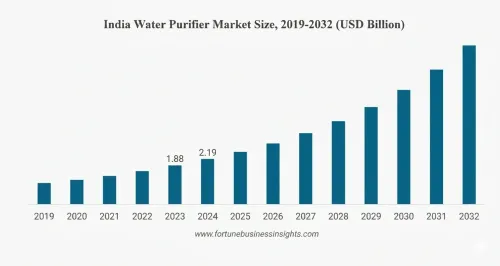
The water purifier market stood at $2.54 billion in 2025 and is projected to reach $7.72 billion by 2032, growing at over 17% CAGR.
That kind of growth does not come from aspiration; it comes from anxiety.
Brands like Kent and Aquaguard have turned distrust into a business model.
A one-time purchase of ₹8,000 to ₹25,000, followed by annual maintenance.
These brands are not selling a product.
They are selling a subscription to peace of mind.
And then there are water ATMs and local suppliers, offering purified water at ₹1 to ₹5 per litre, filling the affordability gap that neither the tap nor premium brands can address.
What you are seeing here is not fragmentation, but segmentation.
Each layer is monetising a different version of the same question.
Can I trust this water?
Policy Acknowledges the Gap
Jal Jeevan Mission 2.0 feels like a quiet admission.
The deadline has been extended to 2028, and the focus has shifted from building pipes to ensuring service.
The new framework emphasises quality monitoring, performance standards, and long-term operations and maintenance.
The total outlay now stretches to about ₹8.69 lakh crore.
Do not mistake it for a construction story; it is a service delivery story.
And service delivery is where recurring service relationships begin to take shape.
Where Capital Tends to Flow Next
The first phase of this story rewarded those who built the infrastructure.
That chapter is largely written.
The next one belongs to those who maintain it, monitor it, and make it trustworthy through service contracts, quality sensors, or simply a ₹20 bottle delivered reliably to your doorstep.
These are not construction plays. They are behavioural ones.
And behavioural shifts, once they take hold, tend to be far more durable than any pipeline.
India’s water revolution is real.
The pipes are in place, and the coverage numbers are hard to argue with.
But somewhere between access and assurance lies the actual market.
One that does not show up in government dashboards, but reveals itself in bottled water sales, purifier installations, and pricing power during peak summer.
Infrastructure can deliver access. But trust behaves differently.
It builds slowly, breaks quickly, and once lost, rarely returns through policy alone.
For investors, that gap between the two is not a problem to solve; it is a theme to watch.
Sources and References:
- PIB
- THEWIRE
- INDIAWATERPORTAL
- TIMESOFINDIA
- THEHINDU
- MORDORINTELLIGENCE
- WIKIPEDIA
- BUSINESSSTANDARD
- FORTUNEBUSINESSINSIGHTS
- TNPSCTHERVUPETTAGAM
- EACPM
- MONGABAY
- IWAPONLINE
The content in this blog is intended purely for educational purposes. Any securities or mutual funds referenced are illustrative in nature and do not constitute a recommendation or endorsement by Kotak Neo. Investors are encouraged to assess their own financial situation and seek professional advice before making any investment decisions. For compliance T&C and disclaimers, Visit https://www.kotakneo.com/disclaimer/
0 people liked this article.

Kotak Neo (Kotak Neo) is India's venerable stockbroking company with a rich legacy. It offers comprehensive investment services across asset classes, prioritising a technology-first approach for a seamless experience. Trusted by 5 million+ customers, it guides you toward financial success with ease of investment and speed of trade.
Note: The opinions expressed in this blog are personal viewpoints and should not be construed as recommendations.