A ₹1,420 Crore Economy Nobody Is Investing In
- Updated: 22 May 2026, 5:17 PM IST
- | 6 min read
- 7,846
 Add Preferred News Source
There is something unique about the way Indians travel.
It begins not with a booking, but with a pull that no algorithm quite explains.
Across India, hundreds of millions of people travel every year to the same destinations.
Not because an app recommended them, not because a sale was on but because they always have.
The most consistent travel demand in this country does not come from leisure.
It comes from pilgrimage corridors.
And around those corridors, quietly, a substantial economy has taken shape.
The Economy That Does Not Advertise
Tirupati receives between 80,000 and 100,000 visitors every single day.
Not on festival days. Not during peak season.
Every day, without a single marketing rupee spent, without a loyalty programme, without a seasonal sale.
That kind of footfall does not arrive by accident.
It arrives by habit which is generational, calendar-driven, and largely indifferent to economic cycles.
And Tirupati is not an outlier. It is a pattern.
Religious tourism accounts for over 60% of all domestic travel in India.
The majority of movement in this country is not aspiration. It is habit, ritual, and return.
Pause on that for a moment.
The largest segment of India's tourism economy does not behave like tourism at all.
It behaves like a utility with demand that is regular, location-specific, and largely indifferent to price or season.
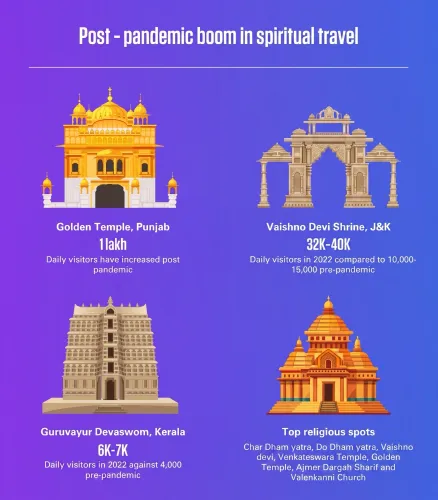
Source: KPMG
A Demand Curve That Does Not Break
If you were to map the structural characteristics of pilgrimage travel without naming it, the picture would look unusual.
Demand that holds steady through economic downturns.
Repeat visitors who need no reminder. Destinations with natural geographic captivity.
Spend that is voluntary but consistent.
Few consumer travel segments behave this way.
Which is why downturns do not hit this segment the way they hit others.
If anything, they deepen engagement.
The act of travelling to a shrine is rarely discretionary in the traditional sense.
It is emotional, cultural, and often cyclical within families.
That is what makes this economy structurally different from leisure travel.
It is not chasing aspiration; it is anchored in habit.
When Infrastructure Meets Demand
Source: KPMG
Now imagine what happens when you add infrastructure to that kind of demand.
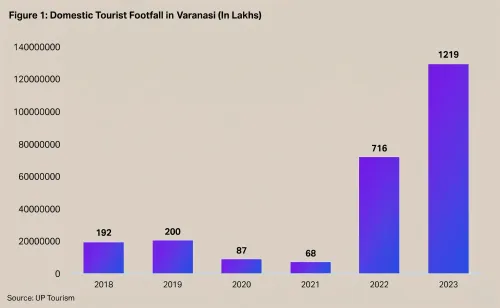
In Varanasi, the Kashi Vishwanath corridor did not create new devotees.
It removed the friction that stopped existing ones from coming.
Visitor numbers went from 6.8 million to 72 million in three years.
Not because belief changed, but because access did.
Ayodhya told the same story at a different scale.
Again, not a new category, just a newly unlocked one.
This is what makes pilgrimage infrastructure unique.
It does not create demand; it releases it.
And the government seems to have recognised this.
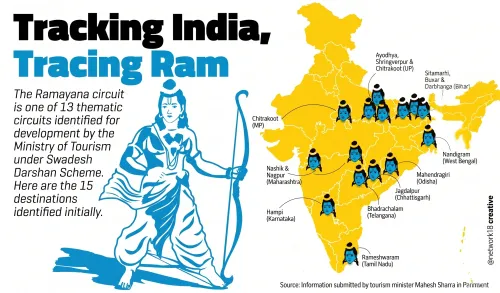
The PRASAD Scheme and multiple circuit-based investments, including Ramayana and Buddhist circuits, are not just tourism projects.
They are demand multipliers spread across geography.
Each road, each corridor, each railway line effectively converts latent demand into active footfall.
Source: MoneyControl
The Roads That Lead to Revenue
Take the Char Dham Highway Project.
A ₹12,000 crore investment spanning 889 kilometres, targeted for completion by the end of 2026, with 75% already complete.
At one level, it is a highway.
At another, it is a permanent improvement to the economic reach of every dhaba, hotel, taxi operator, and small business along that route.
Pilgrimage infrastructure has this quiet multiplier effect.
It does not show up as a single revenue line; it spreads across sectors.
And then there are moments when this multiplier becomes impossible to ignore.
When Faith Becomes Scale
The Maha Kumbh Mela 2025 drew 660 million visitors, making it the largest human gathering in recorded history.
That is not a tourism event; that is a temporary economic city.
Prayagraj did not just host pilgrims.
It absorbed and transformed an entire economic cycle within a limited time frame.
Hospitality, transport, retail, logistics, all operating at a scale that most cities never experience.
And yet, when markets discuss consumption, this entire layer is often missing.
The Quiet Growth Nobody Tracks
Digital platforms have started to pick up what traditional analysis missed.
MakeMyTrip reported a 19% rise in pilgrimage travel in 2025, with growth appearing not just in the well-known shrines but across smaller, lesser-visited destinations.
The direction is consistent: higher frequency, longer stays, and a quiet shift toward more organised, higher-value travel.
These numbers matter not because they are high, but because they are consistent with everything else.
Whether it is temple footfall, infrastructure expansion, or travel bookings, the direction is the same.
Upwards, steadily, and with a quiet shift towards more organised, higher-value consumption rather than just higher volume.
And then there is IRCTC, quietly industrialising pilgrimage travel into something that can be booked, packaged, and repeated.
With its diverse tourism segment and pilgrimage packages, the Bharat Gaurav trains, Char Dham journeys IRCTC clocked ₹745 crore in FY25, growing 7.8% year-on-year.
These are not experiments anymore, but neatly packaged routes that convert belief into bookings, again and again.
A Different Kind Of Traveller
There is a temptation to analyse this as standard tourism, but the travel patterns look different.
A leisure traveller may visit once; someone travelling to a pilgrimage corridor tends to return to the same destination, on a similar calendar, often with family.
The motivations are personal and outside the scope of this essay.
But the travel behaviour they produce is measurable, and it is distinct.
Which is why the travel corridors built around these destinations behave unlike most consumer categories.
The demand does not need to be created, reminded, or discounted into existence. It simply shows up.
And yet, none of this sits within the formal investment universe.
Where Does an Investor Even Look
This is where the story becomes interesting because the core asset, the temple, is not investable.
But everything around it is.
Start with hospitality.
Indian Hotels Company Limited has been quietly expanding into pilgrimage-heavy cities like Varanasi, Tirupati, and Amritsar through its SeleQtions and Ginger brands.
This is not incidental; it is strategic positioning around high-frequency demand zones.
Then there is IRCTC itself, which directly monetises pilgrimage circuits: structured packages, bundled services, predictable demand.
Travel operators like Thomas Cook India and SOTC have also leaned into curated pilgrimage experiences, recognising that this is not a one-off category but a recurring one.
And then there is infrastructure.
Rail Vikas Nigam Limited working on railway connectivity, National Highways Authority of India building roads that connect sacred geographies to economic circuits.
The most interesting layer, though, sits slightly below the radar.
Budget accommodation.
Platforms and chains like OYO and Treebo, still largely unlisted, are expanding into tier-2 and tier-3 pilgrimage towns where demand is surging but branded supply is limited.
This is where the mismatch between footfall and supply is most visible.
The Thought That Stays
The temples were not waiting for infrastructure.
The demand was not waiting for platforms.
Both were simply there, as they have been for centuries, absorbing whatever the economy placed around them and continuing regardless.
What has changed is legibility.
Every corridor built, every circuit packaged, every booking digitised makes this economy a little more visible to the systems that allocate capital.
The demand was never the variable. The friction was.
And when friction reduces in a market this large, things tend to move.
Not loudly, but persistently.
Sources and References:
- TELANGANAPATRIKA
- ETVBHARAT
- TIMESOFINDIA
- KPMG
- ECONOMALY
- TOURISM.GOV
- INVESTINDIA
- MONEYCONTROL
- PIB
- CONSTRUCTIONWORLD
- ECONOMICTIMES
- THEHINDU
- SCRIBD
- DDNEWS
- BUSINESSSTANDARD
- THEHINDUBUSINESSLINE
- IHCLTATA
- THOMASCOOK
The content in this blog is intended purely for educational purposes. Any securities or mutual funds referenced are illustrative in nature and do not constitute a recommendation or endorsement by Kotak Neo. Investors are encouraged to assess their own financial situation and seek professional advice before making any investment decisions. For compliance T&C and disclaimers, Visit https://www.kotakneo.com/disclaimer/
0 people liked this article.