The Rupee Is Eating India's Solar Future
- Posted: 29 May 2026, 10:34 AM IST
- | 8 min read
- 8,669
 Add Preferred News Source
In many Indian households, silver still lives a deeply cultural life.
It appears during weddings, sits inside temple lockers, arrives as Diwali gifts, and quietly accumulates over generations in steel cupboards wrapped in old newspaper.
But in 2026, silver is no longer just a household metal.
It has become one of the world’s most important industrial materials because modern solar panels depend on it.
Which is what makes India’s latest policy move unusually significant.
On 16 May, the DGFT shifted high-purity silver bars from the “Free” to the “Restricted” import category.
Importers now need government licences to bring them into India.
Three days earlier, customs duty on gold and silver had already been raised sharply from 6% to 15%.
At one level, the logic is straightforward.
India is trying to stop dollars from leaving the country at a time when the rupee is under pressure, oil prices remain elevated, and forex reserves have fallen from roughly $728.5 billion in February to nearly $691 billion in barely 10 weeks.
Which is where this stops looking like a routine import-control move and starts revealing a much larger economic contradiction.
India Is Defending The Rupee Again
The mood inside policymaking circles right now has strong 2022 energy.
Back then, during the Russia-Ukraine war, India raised import duties on gold to defend the rupee as oil prices surged and forex pressure intensified.
This time, the strategy has returned almost unchanged; only the metal has changed. And the numbers explain the urgency.
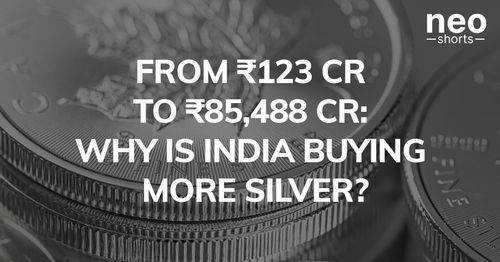
Gold imports hit a record $71.98 billion in FY2025-26.
Silver, once the quieter metal, added nearly three times what it contributed the year before, around $12 billion with import volumes rising 42% in the same period.
Together, precious metals had become a serious pressure point for India's external balance. And silver, in particular, had stopped being a side character.
At a time when crude oil prices were hovering above $100 a barrel, every dollar leaving the country mattered.
Which explains why the government moved quickly.
Every tonne of silver India does not import is theoretically one less pressure point for the RBI while defending the rupee.
The problem is that silver is no longer behaving like a luxury metal.
Silver Became Central To The Energy Transition
For decades, silver in India was viewed largely as a cultural and investment metal. Today, it is increasingly becoming industrial infrastructure.
Now it belongs to solar panels, and that shift changes everything.
Silver is a critical component in photovoltaic cells because it forms the conductive paste that collects and transfers electrons generated when sunlight hits silicon wafers.
Without silver, conventional solar panels lose efficiency.
Manufacturers have reduced the amount of silver used per panel through “thrifting”, but there is still no commercially viable substitute at scale with the same conductivity and durability profile.
Which means the world’s clean-energy future is becoming deeply dependent on a metal most people still associate with wedding trays.
The International Energy Agency’s Net Zero roadmap estimates that solar photovoltaic manufacturing alone could consume more than 30% of total annual global silver production by 2030.
Meanwhile, global silver supply has already been running in structural deficit for years. And India’s solar ambitions are enormous.
India has committed to achieving 500 GW of non-fossil fuel energy capacity by 2030, with solar expected to contribute nearly 300 GW of that target.
Installed solar capacity stood at roughly 154.24 GW by April 2026, which means India still needs to add well over 100 GW of solar infrastructure before the decade ends.
Every gigawatt means millions of new solar modules; every module needs silver.
Which means India is now restricting imports of one of the exact industrial inputs required for the energy transition meant to reduce India’s dependence on imported oil in the first place.
The short-term and long-term economic goals are pulling in opposite directions.
China And India Are Responding To Silver Very Differently
This is where the contrast becomes difficult to ignore.
China, which dominates global solar manufacturing, has been importing record quantities of silver while simultaneously tightening exports.
Effectively, it is building industrial reserves for its own manufacturing ecosystem.
India is doing the reverse.
China is accumulating silver because it sees solar manufacturing as a long-term industrial priority.
India is restricting silver because it currently sees bullion imports as a balance-of-payments pressure.
Both countries are responding rationally to their own economic realities.
The difference is that China already operates at significant manufacturing scale, while India is still trying to build that ecosystem.
For China, silver is an input supporting an existing industrial base.
For India, it has become both an industrial requirement and a macroeconomic pressure point at the same time.
They are standing on opposite sides of the same metal.
And that divergence reflects something worth watching: industrial materials that once traded purely on supply and demand are increasingly being shaped by national policy calculations.
One Policy, Two Very Different Households
The fascinating thing about economic policy in India is how it collides with wildly different parts of everyday life simultaneously.
Take two households.
One family in Jaipur is preparing for a wedding where silver jewellery, utensils, and gifting are socially expected.
Domestic silver prices are already elevated, with silver trading around ₹2.53 lakh per kg in mid-May.
Import restrictions and licensing bottlenecks may tighten supply further and push prices higher.
Another family in Surat is considering rooftop solar installation because electricity bills are becoming painful.
Their installer now faces higher procurement costs because the silver paste used in photovoltaic cells has become more expensive and potentially harder to source smoothly.
The government wants both households to behave differently.
One household is expected to consume less imported bullion.
The other is expected to accelerate renewable adoption.
But the same silver policy quietly reshapes costs for both households in completely different ways.
That is the quiet logic of macroeconomics.
One notification from Delhi travels into weddings, solar rooftops, commodity exchanges, and corporate balance sheets at the same time.
The Market Story Is Bigger Than Bullion
Most investors will initially view this as a bullion-market development.
That, however, is only the first layer of the impact.
Domestic silver pricing tends to respond quickly to import availability.
When supply tightens through licensing requirements or duty increases, the gap between domestic and international prices tends to widen.
That dynamic is already visible in how market participants are positioning.
But the more important implication lies elsewhere.
India’s domestic solar manufacturing ecosystem may now face another input-cost complication precisely when the government is aggressively trying to build local manufacturing capacity through PLI schemes, ALMM requirements, and protectionist duties on Chinese solar modules.
That contradiction is important.
The government has spent years trying to nurture domestic solar champions while simultaneously making one of its critical raw materials more difficult and expensive to import.
Companies such as Waaree Energies and Premier Energies may now have to navigate higher input costs even as policy support for domestic manufacturing continues.
The support and the pressure are arriving together.
Which creates a much more nuanced investing environment than simplistic “renewables boom” narratives suggest.
The Investor Lens Is Not About Silver Prices Alone
Investors may gradually stop thinking about silver purely as a precious metal and begin viewing it as industrial infrastructure.
That changes the framework completely.
Solar manufacturers may have to navigate greater input-cost volatility.
Jewellery companies could encounter inventory and pricing pressures in more price- sensitive segments.
Electronics and EV supply chains that use silver in connectors, semiconductors, and electrical contacts could gradually experience procurement cost increases.
Companies like Titan, Kalyan Jewellers, Dixon Technologies, Havells India, and UNO Minda may all end up feeling parts of the ripple effect differently.
At the same time, commodity exchanges such as MCX may benefit from rising volatility because periods of policy uncertainty and commodity stress typically expand derivatives trading volumes.
But the bigger macro signal investors should really watch is whether silver is merely the beginning.
Because once governments begin using import restrictions to defend currencies, markets begin watching for broader balance-of-payments measures across sectors.
If crude oil prices remain elevated and the rupee stays fragile, silver may not remain an isolated case.
India’s Energy Transition Faces A Currency Constraint
The underlying irony is difficult to miss.
India wants solar energy primarily because it reduces long-term dependence on imported fossil fuels.
The country wants cleaner energy, lower oil vulnerability, and stronger energy security.
But the same oil-driven pressure on the rupee is now forcing India to restrict imports of the metal required to build that solar future.
In trying to defend itself from imported oil today, India has made one of the key materials needed to escape imported oil tomorrow more difficult to access.
Both decisions make sense independently.
Together, they describe the exact dilemma developing economies struggle with during large industrial transitions.
The future requires investment.
The present requires survival.
And somewhere between the solar panel and the silver bar sits the rupee, absorbing pressure from both directions at once.
Sources and References:
- TIMESOFINDIA
- ECONOMICTIMES
- DAILYHUNT
- BUSINESSSTANDARD
- REUTERS
- GOLDSILVER
- POWERMIN
- PIB
- LIVEMINT
- FINANCIALEXPRESS
This article is for informational purposes only and does not constitute financial advice. It is not produced by the desk of the Kotak Securities Research Team, nor is it a report published by the Kotak Securities Research Team. The information presented is compiled from several secondary sources available on the internet and may change over time. Investors should conduct their own research and consult with financial professionals before making any investment decisions. The above images were generated using AI. Read the full disclaimer here.
Investments in securities market are subject to market risks, read all the related documents carefully before investing. Brokerage will not exceed SEBI prescribed limit. The securities are quoted as an example and not as a recommendation. SEBI Registration No-INZ000200137 Member Id NSE-08081; BSE-673; MSE-1024, MCX-56285, NCDEX-1262.
0 people liked this article.

Kotak Neo (Kotak Neo) is India's venerable stockbroking company with a rich legacy. It offers comprehensive investment services across asset classes, prioritising a technology-first approach for a seamless experience. Trusted by 5 million+ customers, it guides you toward financial success with ease of investment and speed of trade.
Note: The opinions expressed in this blog are personal viewpoints and should not be construed as recommendations.