What Is Iron Condor
- Updated: 22 May 2026, 5:10 PM IST
- | 6 min read
- 1,308
 Add Preferred News Source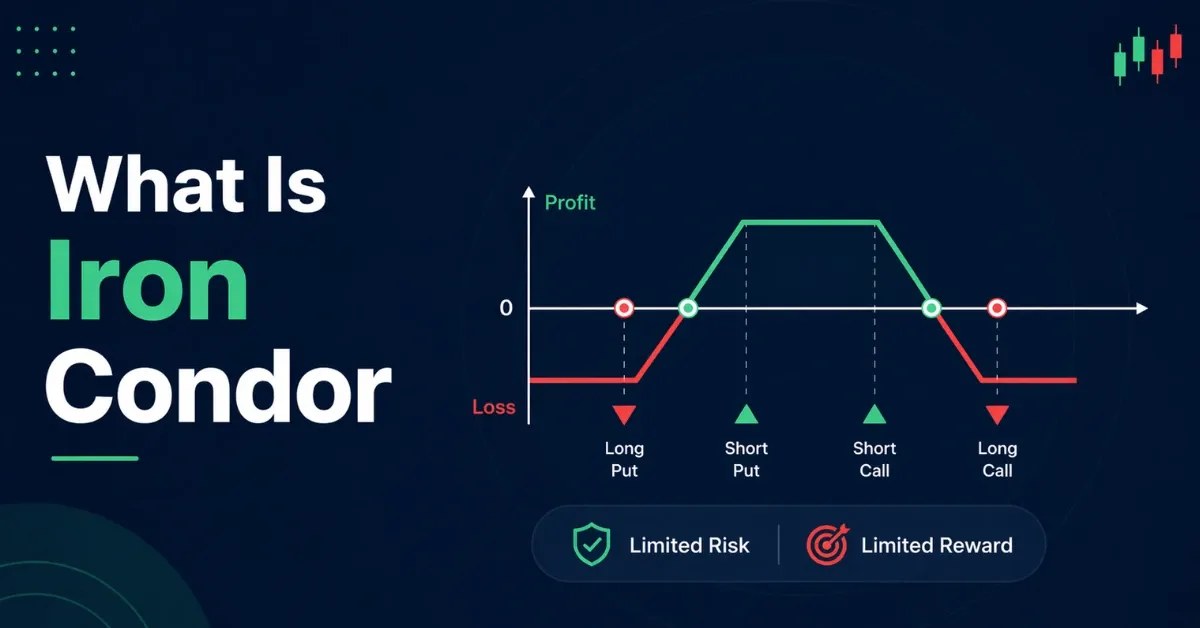
When it comes to options trading, employing the right strategy can significantly affect your potential for outcomes and risk management. One such strategy that has gained popularity among experienced traders is the Iron Condor. Designed to generate income while limiting risk, the Iron Condor strategy offers a balanced approach to options trading.
Read on to know about the Iron Condor strategy, exploring its definition, key components, implementation steps, potential advantages, and risks. Whether you are a seasoned options trader or just starting out, understanding the Iron Condor options strategy can help you refine your trading approach and improve consistency.
Iron Condor Meaning
The Iron Condor is a multi-legged options trading strategy that aims to benefit from a range-bound market, where the underlying asset's price is expected to stay within a specific range. It involves simultaneously opening four different options positions, consisting of two credit spreads a bear call spread and a bull put spread. This strategy is known for its potential to generate consistent income, as it takes advantage of time decay and limited volatility.
Key Components Of An Iron Condor Options Strategy
-
Call Credit Spread: This approach means you sell a call option at one strike price and, at the same time, buy another call option at a higher strike price. The premium you get from selling the call gives you an upfront credit. The call you buy serves as a safety net, keeping your losses in check if the price jumps. You get the most out of this when the price stays below your chosen level, but your risk is still capped if the market spikes.
-
Put Credit Spread: In this part, you sell a put option at the strike price you pick and buy another put at a lower strike. The premium received from the sold put results in an initial inflow. The lower strike put option helps contain losses if the market declines sharply. This setup is effective when prices hold above the selected level, with clearly limited downside risk.
Implementing The Iron Condor Strategy
1. Identify a Range Bound Market:
Identifying a range-bound market is a crucial step in implementing a successful Iron Condor strategy. This involves carefully analysing the price movement of an underlying asset and looking for signs of consolidation or limited volatility. Range-bound markets are characterised by periods of relatively stable prices, where the underlying asset's value tends to trade within a defined range. During such phases, the asset's price typically oscillates between a support level (lower boundary) and a resistance level (upper boundary). This lack of significant upward or downward momentum creates an opportune environment for employing the Iron Condor strategy. By understanding the characteristics of a range-bound market, you can effectively increase your chances of executing the Iron Condor strategy.
2. Determine the Range and Strike Prices:
When determining the range and strike prices for an Iron Condor option strategy, it is crucial to balance return potential with effective risk management. Selecting the appropriate strike prices will define the range within which you expect the underlying asset's price to remain.
First, analyse the underlying asset's historical price movements and technical indicators. Identify periods of consolidation or limited price volatility, as these are ideal conditions for implementing the Iron Condor strategy. Look for price ranges where the asset tends to oscillate or trade within specific boundaries.
3. Open the Positions:
Executing the Iron Condor strategy requires precision and attention to detail. Once you have identified a suitable range-bound market and determined the range and strike prices for your options trades, it is time to open the positions. This step involves simultaneously executing four distinct options trades, each carefully structured to create the Iron Condor formation.
4. Managing the Trade:
Managing the Iron Condor trade requires vigilant monitoring and timely adjustments to ensure optimal outcomes. As the underlying asset's price evolves, staying proactive and modifying when certain thresholds are approached is crucial.
Pros And Cons Of Iron Condor
Pros | Cons |
|---|---|
Risk is defined upfront | Return potential is limited |
Premium is earned at entry | Losses rise if the price moves sharply |
Works best in range-bound markets | Affected by sudden volatility spikes |
Higher chance of small returns | Needs regular monitoring |
Flexible strike selection | May require buying or selling at unfavourable prices if options are exercised |
Lower capital to naked selling | Returns are usually modest |
Example
Let us say a stock is trading at ₹20,000, and the expiry is about a month away. The view here is fairly simple. The price is not expected to move much and should stay somewhere between ₹19,800 and ₹20,200.
Based on this, an iron condor is set up.
On the downside, a ₹19,800 put is sold for ₹80, and a ₹19,600 put is bought for ₹30. On the upside, a ₹20,200 call is sold for ₹70, while a ₹20,400 call is bought for ₹20.
Put together, this brings in a total premium of ₹100.
What happens at expiry?
- Scenario 1
If the stock stays within the range, say around ₹20,000, or even slightly off at ₹20,150 or ₹19,850, nothing really changes. So, exercising options in the condor strategy becomes unnecessary. They all expire without value. The full ₹100 is retained as is.
- Scenario 2
Now, suppose the stock moves a bit beyond the range. For instance, it goes up to ₹20,300. The call side starts to hurt. There is some loss here, but the premium already collected cushions the impact.
- Scenario 3
If the move is sharper, say beyond ₹20,400 or below ₹19,600, things behave differently. The protection that was bought earlier starts doing its job. Losses still exist, but they stop increasing after a point. In other words, the downside is capped.
Final Payoff Structure
-
Between ₹19,800 – ₹20,200 → Maximum returns (full premium retained)
-
Above ₹20,200 → Loss begins on the call side (limited)
-
Below ₹19,800 → Loss begins on the put side (limited)
-
Beyond ₹20,400 or below ₹19,600 → Maximum loss (capped)
In Conclusion
The Iron Condor strategy provides options traders with a powerful tool for benefiting from range-bound markets. This strategy offers consistent income potential while defining risk levels by utilising credit spreads and capitalising on time decay. However, it is crucial to understand the strategy's nuances, risks, and proper risk management techniques. As with any trading strategy, practice, thorough analysis, and continuous learning are essential for mastering the Iron Condor and reaping its potential benefits.
FAQs
It is an options trading strategy that simultaneously sells a bear call spread and a bull put spread on the same underlying asset. It is designed to benefit from a range-bound market where the underlying asset's price is expected to remain within a specific range.
An Iron Condor works by combining two credit spreads. The bear call spread involves selling a call option at a higher strike price and simultaneously buying a call option at an even higher strike price. The bull put spread involves selling a put option at a lower strike price and buying a put option at an even lower strike price. This strategy allows traders to collect premiums while capping both the maximum loss and upside.
Managing an Iron Condor trade involves monitoring the trade closely and making adjustments as needed. You should watch for the underlying asset's price approaching the breakeven points or reaching the maximum loss thresholds. Adjustments may involve rolling the spreads to new strike prices, increasing or decreasing position size, closing the position entirely, or adjusting the width of the Iron Condor. Monitoring time decay is also essential, as it affects the trade's profitability over time.
Yes, there are alternative strategies that share similarities with the Iron Condor. These include the Iron Butterfly, which is a narrower version of the Iron Condor, and the Short Strangle, which involves selling Out-Of-The-Money (OTM) call and put options without buying protection. These strategies aim to benefit from range-bound markets but have different risk-reward profiles and adjustment techniques.
The loss is limited, which is the key advantage of this strategy. It typically shows up when the price moves beyond the outer strike prices. In simple terms, it depends on the gap between your buy and sell strikes after adjusting for the premium collected.
An iron fly is tighter. Both the call and put are sold at the same strike, so the range is narrow and the premium is higher. An iron condor, on the other hand, spreads things out. The range is wider, which lowers both the risk and the reward.
The content in this blog is intended purely for educational purposes. Any securities or mutual funds referenced are illustrative in nature and do not constitute a recommendation or endorsement by Kotak Neo. Investors are encouraged to assess their own financial situation and seek professional advice before making any investment decisions. For compliance T&C and disclaimers, Visit https://www.kotakneo.com/disclaimer/
The content in this blog is intended purely for educational purposes. Any securities or mutual funds referenced are illustrative in nature and do not constitute a recommendation or endorsement by Kotak Neo. Investors are encouraged to assess their own financial situation and seek professional advice before making any investment decisions. For compliance T&C and disclaimers, Visit https://www.kotakneo.com/disclaimer
0 people liked this article.

Kotak Neo (Kotak Neo) is India's venerable stockbroking company with a rich legacy. It offers comprehensive investment services across asset classes, prioritising a technology-first approach for a seamless experience. Trusted by 5 million+ customers, it guides you toward financial success with ease of investment and speed of trade.
Note: The opinions expressed in this blog are personal viewpoints and should not be construed as recommendations.