How To Calculate Option Premium: Formula, Steps, And Example
- Updated: 22 May 2026, 5:17 PM IST
- | 4m
- 1,672
 Add Preferred News Source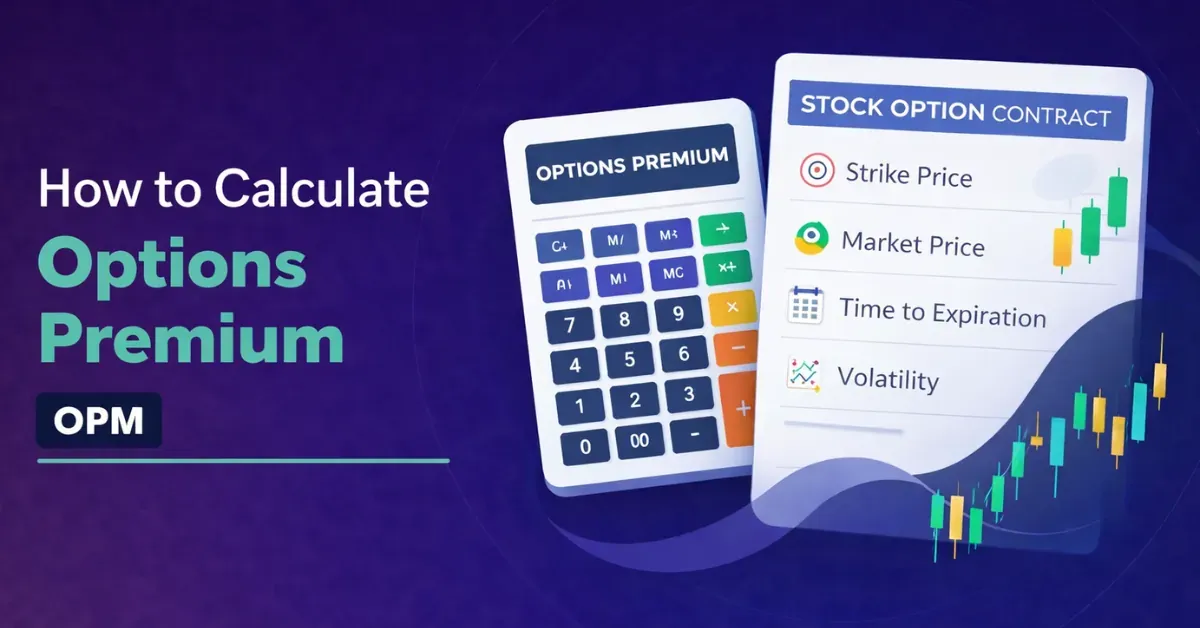
When you enter an options contract, you are not buying the asset itself. You are buying a right. The right to buy or sell an asset at a certain price if things move in your favour.
That right comes at a cost, known as the option premium. It may look like a simple price, but there is more behind it. But once you understand how to calculate option premiums, you start to see what you are actually paying for and why that price keeps changing.
What Is Option Premium Calculation?
Before we get into premium, let us quickly understand the benefit of an options contract.
While it gives you a choice to buy or sell, there is no obligation to do so. You can leave the right unused if the market is not favourable to you.
That flexibility comes at a cost. This cost is the option premium.
So when we talk about option premium calculation, we are simply trying to understand what drives this price. It is not just about where the asset is today. There are a few moving parts behind it.
Option Premium Formula
If you break it down, the premium comes from two main parts.
Option Premium = Intrinsic Value + Time Value
Think of intrinsic value as the portion you can see today. For a call option, this is the difference between the current market price and the strike price, if the market price is higher. For a put option, it works the other way around.
Time value, on the other hand, comes from what might happen next. More time usually means more room for movement.
This is also where volatility plays a role. When price movements are expected to be sharp, the chances of the option becoming profitable increase and vice versa.
Steps To Calculate Option Premium
When the market prices an option, it is not guessing. It relies on pricing models. These models take a few key inputs and combine them to arrive at a fair value. There are a few models used in practice, but the Black-Scholes model is one of the most commonly used.
- Step 1: Determine the intrinsic value
Everything begins with two numbers. The current price of the asset (S) and the strike price (K). This is what determines whether the option already has value.
For a call option: Intrinsic Value = S − K
For a put option: Intrinsic Value = K − S
If the result is negative, it is simply taken as zero. At that point, the option has no intrinsic value.
- Step 2: Add time to expiry
Now bring in the time to expiry (T). An option with more time has more room for the price to move. That possibility adds value. As time reduces, that extra cushion starts to fade.
- Step 3: Bring in volatility
Volatility (σ) is about the expected movement in the underlying asset’s price. In simple terms, it shows how much the price is likely to move.
- Step 4: Include interest rates
There is also the risk-free interest rate (r) in the mix. You may not notice it in everyday trading. But the model uses it to adjust how future values are brought back to today’s terms.
- Step 5: Put it all into the model
Once these inputs are in place, they are fed into the Black-Scholes formula.
For a call option: C = S × N(d1) − K × e^(−rT) × N(d2)
For a put option: P = K × e^(−rT) × N(−d2) − S × N(−d1)
To get there, the model uses two intermediate values: d1 = [ln(S/K) + (r + σ²/2) × T] ÷ (σ × √T) d2 = d1 − σ × √T
Here,
S is the current price of the asset K is the strike price T is time to expiry (in years) r is the risk-free interest rate (continuously compounded) σ is volatility e^(−rT) is the discount factor applied to the strike price N(d1) represents the call option’s delta, its sensitivity to the changes in the underlying asset’s price; for a put, delta = N(d1) − 1 N(d2) represents the risk-neutral probability that a call option will expire in the money; for a put, this is N(−d2)
- Step 6: Read how the premium reacts
The same model also brings in something known as Options Greeks. These are not used to calculate the price, but to understand how it changes.
-
Delta helps you see how price changes affect the premium
-
Theta shows the impact of passing time
-
Vega reflects what volatility is doing to the premium
-
Gamma looks at how Delta keeps adjusting
-
Rho connects the premium to interest rates
Example Of Option Premium Calculation
Let us take a simple example to see how an option premium is actually made up.
Assume a stock is trading at ₹1,000. You are looking at a call option with a strike price of ₹950, and the premium quoted in the market is ₹70.
Begin by calculating the intrinsic value.
Intrinsic Value = Market Price − Strike Price = ₹1,000 − ₹950 = ₹50 This portion of the premium is based on the actual price difference. What about the remaining ₹20? That part is the time value.
Time Value = Option Premium − Intrinsic Value = ₹70 − ₹50 = ₹20 This is not about where the price stands today. It is about what could still happen before expiry.
So in this case, the ₹70 premium is simply a combination of the value today and the possibility of what comes next.
Factors Affecting Option Premium Calculation
Option premium does not stay constant. It moves with the market. While the pricing model uses multiple inputs, a few factors tend to have the most visible impact.
-
Underlying asset price Premium moves because intrinsic value depends on price. If the asset moves closer to or beyond the strike, the option starts gaining real value. If it moves away, that value drops.
-
In The Money (ITM) vs Out Of The Money (OTM) An option is In The Money (ITM) when it has intrinsic value and would be profitable if exercised, while Out Of the Money (OTM) means it has no intrinsic value and would not be profitable right now.
ITM options have a portion of premium backed by real value, while OTM options depend entirely on time and expectations.
-
Time to expiry More time means more chances for the price to move in your favour. As time runs out, those chances shrink, and so does the premium.
-
Volatility Premium rises when price swings are expected to be bigger. More movement means more opportunity. If things look stable, premiums tend to stay lower.
-
Interest rates Interest rates slightly affect how future values are priced today. The impact is usually small, but it becomes more noticeable in longer-duration options.
-
Dividends (for stocks) Dividends can impact expected price levels. Since stock prices typically adjust around dividend payouts, this affects how attractive an option is, which in turn influences its premium.
Common Mistakes While Calculating Option Premium
Most people focus on the formula and overlook how premiums move in real markets. That is where mistakes tend to show up:
-
Seeing the premium as just a gap between asset and strike prices
-
Not factoring in how time reduces it
-
Missing how volatility changes things
-
Assuming that the premium will mirror the asset's price movement
-
Treating calculated values as final, ignoring demand and supply
Sources:
The Economic Times
Moneycontrol
LiveMint
FAQs On Option Premium Calculation
Option premium is influenced by the underlying asset price, time to expiry, and volatility. Interest rates and dividends can also play a role. However, their impact is usually smaller in comparison.
As expiry approaches, the time value keeps reducing. At expiry, it becomes zero. The premium then reflects only intrinsic value. If the option is out of the money, the premium drops to zero.
The premium keeps moving because the inputs behind it are always changing. A change in price, time, or volatility can shift premiums at any moment.
The content in this blog is intended purely for educational purposes. Any securities or mutual funds referenced are illustrative in nature and do not constitute a recommendation or endorsement by Kotak Neo. Investors are encouraged to assess their own financial situation and seek professional advice before making any investment decisions. For compliance T&C and disclaimers, Visit https://www.kotakneo.com/disclaimer/
0 people liked this article.

Kotak Neo (Kotak Neo) is India's venerable stockbroking company with a rich legacy. It offers comprehensive investment services across asset classes, prioritising a technology-first approach for a seamless experience. Trusted by 5 million+ customers, it guides you toward financial success with ease of investment and speed of trade.
Note: The opinions expressed in this blog are personal viewpoints and should not be construed as recommendations.