How Budget 2026 is Changing the Future of Indian Agriculture: From Makhana to Sandalwood
- Updated: 22 May 2026, 5:16 PM IST
- | 12 min read
- 1,007
 Add Preferred News Source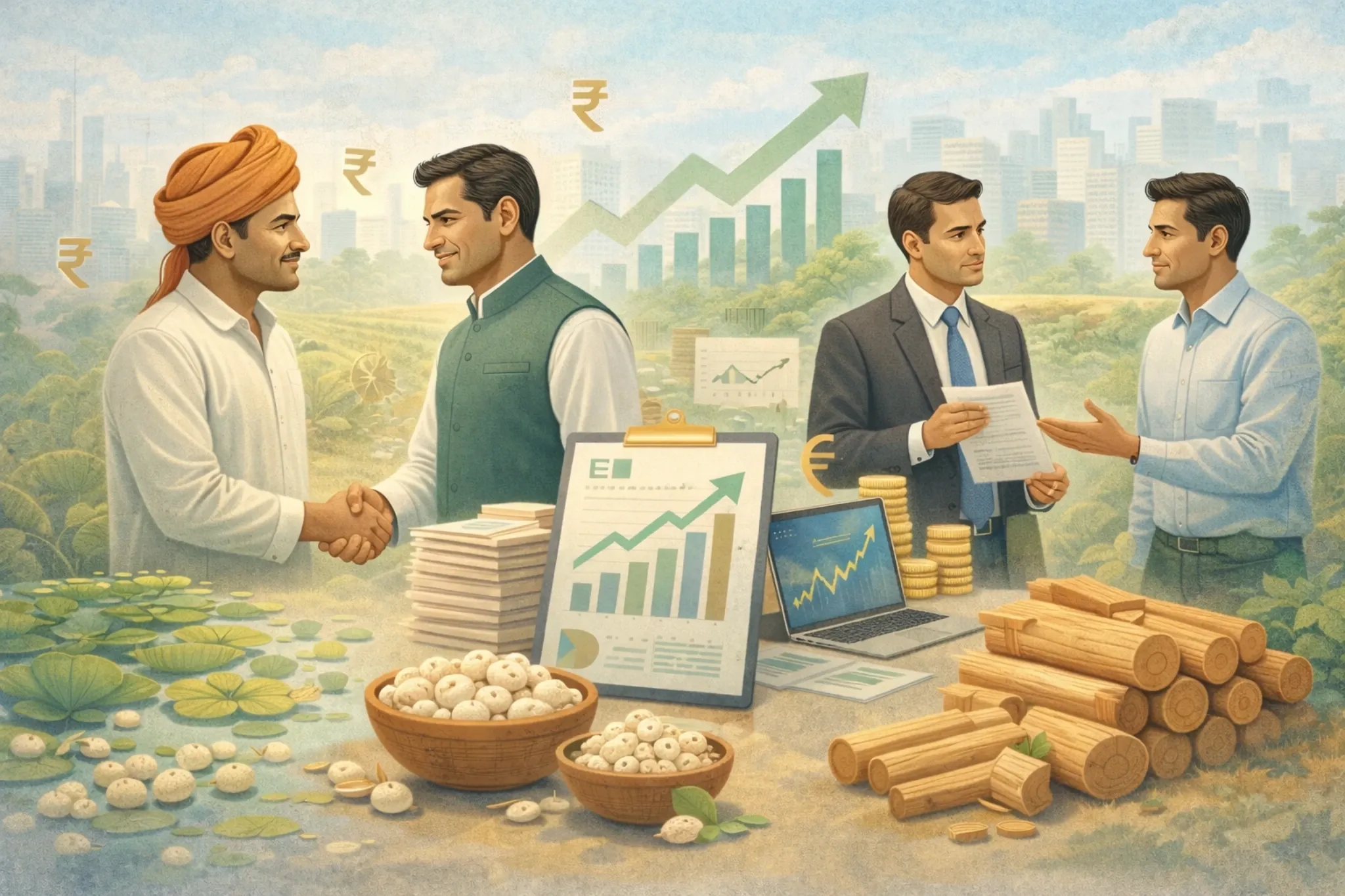
Picture this: a small farmer in Bihar, up to his knees in floodwaters, gathering what looks like regular puffed snacks. A year later, that same farmer is now part of a ₹6,000 crore industry, and his product is sold in health stores from Mumbai to Manhattan. This wasn't science fiction; it was Budget 2025's makhana moment. A simple foxnut became the face of how smart agricultural policy can make crops famous around the world.
The government has now revealed an even bigger plan for 2026. This time, though, it is not just one crop; it is a whole new era in farming. Budget 2026 has found India's hidden agricultural treasures and made a plan to turn them into economic powerhouses. These include the coconut groves of Kerala, the sandalwood forests of Karnataka, the cashew plantations of Goa, and the walnut orchards of Kashmir.
The question is whether these efforts can really change the economies of the areas where they are happening, make traditional farming methods more widespread, and make "Indian cashew" and "Indian cocoa" as well-known around the world as Champagne or Scotch. Let us take a closer look at what makes this budget different and why it might be the turning point that India's agricultural sector has been waiting for.
The Strategic Change: From Quantity to Quality
For decades, the goal of Indian agricultural policy has been to increase production volume. Increase yields by growing more wheat and rice. This approach to food security fed the country, but it also kept millions of farmers stuck in low-margin commodity markets where they are at risk of price swings and being taken advantage of by middlemen.
Budget 2026 is a big and necessary change. It is not chasing volume anymore; it is chasing rupees per acre. The finance minister's focus on "high-value agriculture" isn't just policy talk; it is a whole new way of thinking about what Indian farming can be. The budget focuses on crops like coconut, sandalwood, cocoa, cashew, and high-quality nuts. These are things that India has natural advantages in, cultural heritage in, and untapped export potential in.
Think about the numbers: India is already the world's biggest producer of coconuts, which supports 30 million jobs, including 10 million farmers. But in global markets, Indian coconut products compete on price, not prestige. The new Coconut Promotion Scheme wants to completely change that story by replacing old, low-yield trees with high-productivity ones, putting money into processing after harvest, and building brand equity for Indian coconut products in high-end international markets.
The Four Pillars of Agricultural Transformation
1. Coastal Jewels: Coconut, Cashew, and Cocoa
The coastal area from Kerala to Karnataka to Goa has always been rich in agriculture but poor in business. Three linked initiatives in the 2026 budget change that equation:
The Coconut Promotion Scheme understands that just making things isn't enough. Old, unproductive coconut palms are all over the place, taking up prime agricultural land and not making much money. The plan's intervention, which is to systematically replace old varieties with better ones, could increase yields per acre by 40% to 60% in five years. But the real magic is in the effects that come after. When the quality of the raw materials is better, it is possible to make high-end products like virgin coconut oil, coconut milk, and desiccated coconut, which cost three to four times as much as raw coconuts on the world market.
The Cashew and Cocoa Initiative is even more ambitious. Here's the thing: India imports a lot of raw cashew and cocoa even though it has the right agro-climatic zones. The goal of the dedicated program is to make "Indian Cashew" and "Indian Cocoa" into top global brands while also making India self-sufficient by 2030. Think about the possibilities: if this works, it could be like the Swiss chocolate or Belgian chocolate trend, where the place of origin becomes a sign of quality. This would let Indian producers avoid commodity pricing and get brand premiums.
Local Economic Impact: These programs directly help coastal communities that have historically had trouble finding seasonal work and making a living from farming. Coconut product processing units, cashew roasting facilities, and cocoa processing centres all offer jobs all year long. They also make skilled jobs like quality control, packaging design, and export documentation, which will create local jobs for yound educated people and keep them from moving to cities.
2. The Sandalwood Ecosystem: A Return to Heritage
Sandalwood is one of the few crops that has a lot of cultural significance. Indian sandalwood (Santalum album) has been an important part of religious ceremonies, traditional medicine, and making perfumes for hundreds of years. But India's sandalwood forests have been destroyed by decades of overharvesting, illegal logging, and policy neglect. The tree that used to represent India's rich plant life became so rare that it was heavily regulated, which ironically limited legal production.
The fact that Budget 2026 is working with state governments to "restore the glory of the Indian sandalwood ecosystem" shows a big change in policy. The government wants to make a legal, long-lasting supply chain for sandalwood by encouraging focused farming and processing after harvest. This is important because sandalwood oil can sell for ₹2–3 lakh per kilogram on the international market, which is one of the highest values per weight in agriculture.
This scaling problem is one of a kind. It takes sandalwood trees 15 to 20 years to grow up, so you need to be patient and commit to the long term. Making institutional mechanisms is the key to success. Maybe sandalwood cooperatives or producer companies could bring together small farmers, help them with technical problems, make sure quality standards are met, and connect them directly with perfume companies, pharmaceutical companies, and traditional medicine makers.
Impact on the Agri-Industry: A healthy sandalwood industry helps more than just farmers. It brings back an entire value chain, including nurseries for growing saplings, distillation units for getting oil, quality testing labs, and packaging units for finished goods. The Mysore region of Karnataka, which has a long history of sandalwood production, could see a revival of industry as processing plants move closer to production areas.
3. Mountain Gold: Walnuts, Almonds, and Pine Nuts.
The hilly areas of India, especially Kashmir, Himachal Pradesh, and Uttarakhand, have the best weather for high-quality tree nuts. But right now, India imports almost all of its almonds, pine nuts, and walnuts. This is a huge missed opportunity, both financially and strategically.
The budget's detailed plan for restoring old orchards and expanding high-density farming solves a lot of problems at once. We replace old walnut trees that don't produce much with new, high-density ones that can triple the amount of nuts they produce. Young people who might otherwise move to cities get involved in activities that add value, such as shelling, grading, packaging, and branding.
The chance to make money is huge. In urban markets, a single Kashmir walnut can sell for ₹200–300, while imported varieties sell for ₹40–50. The higher price is due to the better taste and texture, as well as the new "Kashmiri walnut" brand identity. To make this work on a larger scale, we need not only more trees but also better infrastructure after the harvest. This includes modern storage facilities to keep the trees from going bad, grading systems to make sure the quality is always the same, and direct market access to avoid having to go through many middlemen.
For areas affected by conflict, like Kashmir, these agricultural projects provide something valuable: real, high-paying job opportunities that keep young people busy with useful work. A young farmer with a 2-acre walnut orchard who makes ₹5–7 lakh a year is much less likely to be tempted by other options.
4. Northeast Treasure: Agar (Agarwood)
Agar (agarwood) may be the most interesting thing in the budget, even though it isn't as well-known as other crops. When a certain mould infects the agar tree, it makes a dark, fragrant resin that is highly valued in incense, perfume, and traditional medicine. The best quality agarwood can cost ₹1–2 lakh per kilogram, and the essential oil can cost more than ₹10 lakh per kilogram, which means it is worth more than gold.
The weather in Northeast India is great for growing agar, but the business is still small and informal. With budget support, this could change: it could provide high-quality planting material, teach people how to properly inoculate plants, build processing facilities, and set quality standards that are worth a lot of money on the world market.
The problem with scaling agar is passing on knowledge. Unlike growing regular crops, growing agar requires special skills, such as knowing when to inoculate, how to make resin, and when to harvest. To be successful, you need to set up training programs, demonstration farms, and technical support systems. But the rewards could be huge: even a few thousand hectares of productive agar plantations could bring in hundreds of crores in export revenue and create specialised jobs in a region that needs them.
The Scaling Challenge: Going from Pilot to Pan-India
The real change happens when you make your vision a reality. India has started many programs to help farmers over the years, but Budget 2026 is different because it takes a completely different approach. Three things could make this a game-changer:
First, the plan is based on an area’s advantages. These projects don't see India as one big whole; instead, they take into account the different agro-climatic conditions. Coconut for the coast, sandalwood for the peninsula, walnuts for the mountains, and agar for the Northeast. This kind of targeting makes it more likely that you'll succeed because it works with natural advantages instead of against them.
Second, there is end-to-end thinking. These are more than just subsidies for production. The focus on processing after harvest, adding value, and building a brand shows that they know that final consumer prices are more important than farm-gate prices. A coconut farmer gets ₹10–12 for each nut, but a bottle of high-quality coconut oil costs ₹400–500. Even a small part of that value difference changes the way economics works.
Third, there is the brand vision for 2030. The budget makes people responsible and focused by clearly stating the goal of turning "Indian Cashew" and "Indian Cocoa" into high-end global brands by 2030. This isn't an open-ended experiment; it is a mission with a set amount of time and measurable goals.
But there are still a lot of problems to solve. It is hard to set quality standards for thousands of small farmers. To grow in the export market, you need to be good at marketing, following the rules, and building relationships. Most importantly, success needs strong political will over time. A 15-year sandalwood plantation can't afford to change its policies every five years.
The Multiplier Effect: More than Just Farming
The best thing about these programs is that they help rural economies grow. When a coconut farmer's income doubles, it has a ripple effect:
- The shopkeeper in the area sells more things.
- The mechanic gets more work fixing farm equipment.
- The schoolteacher gets paid more often.
- A local contractor is hired to build a processing unit.
- Young people see chances at home and put off moving to the city.
Economic studies suggest that every rupee of additional agricultural income generates ₹2-3 of broader economic activity in rural areas. Applied to the scale of these interventions, potentially affecting 50-60 million people across coconut, cashew, sandalwood, nuts, and agar, we’re looking at structural transformation, not marginal improvement.
The effect on the agricultural industry needs to be looked at more closely. Processing high-value crops is more complicated than processing commodities. To make virgin oil from coconut, you need to fractionate it; to make cashew, you need to roast and grade it; to make sandalwood, you need to distil it; and to store nuts, you need to control the temperature. Each of these makes it possible for small and medium-sized processing businesses to grow in rural areas, which would create jobs all year round and skilled jobs.
Also, building a brand for export markets needs skills that aren't available in rural India right now, such as quality testing labs, packaging design studios, export documentation services, and logistics coordination. Building these skills opens up new businesses and service sectors that add to the variety of rural economies beyond just farming.
What We Learned From Makhana In 2025
The makhana program in Budget 2025 teaches us a lot. It showed what happens when the government backs a private sector that is already gaining ground.
Makhana didn't come about because of government policy; it was already a superfood that was getting a lot of attention from entrepreneurs and building export markets. The Makhana Board's job was to speed up and formalise what was already going on: setting quality standards, getting farmers to work together, helping with technology transfer, and marketing.
The crop programs in the 2026 budget are based on this. They're not trying to create demand where there isn't any; instead, they're directing the existing global demand for high-quality coconut products, premium chocolates, exotic nuts, and rare essential oils toward Indian producers. The government's job is to improve quality, make sure things are always the same, build trust in the brand, and make the infrastructure work, not to artificially boost markets.
These projects are responding to a real need in the market. They're just moving the source of the goods from Australia (macadamias), Chile (walnuts), Vietnam (cashews), or Madagascar (vanilla) to India.
The 2030 Vision: India as the Best Brand in Agriculture
Picture yourself going into a Whole Foods in New York, a Waitrose in London, or a department store in Tokyo in 2030. You can find "Indian Single-Origin Cocoa" among the high-end chocolates, and it costs about the same as Ecuadorian or Madagascar varieties. "Kashmiri Walnuts" are next to California walnuts in the nuts section. They cost 20% more. There is a luxury item called "Mysore Sandalwood Oil" on the essential oils counter. "Kerala Virgin Coconut Oil" is a high-end health product in the coconut products aisle.
This is the bold vision behind Budget 2026's plans for agriculture. It's not about competing on price or volume; it's about competing on quality, authenticity, and brand equity. It is about changing "Made in India" from a value proposition to a premium proposition.
To make this vision a reality, a lot of things need to come together: millions of small farmers need to produce consistently high-quality products, there need to be effective systems for certifying and tracking quality, there needs to be advanced international marketing, there need to be partnerships with high-end retailers for distribution, and the government needs to keep supporting the new brands through the challenges that come with building them in competitive markets.
The risks are very high. If these plans work, they could bring in tens of billions of dollars more in agricultural exports while also raising the incomes of farmers in the US. They could stop people from moving from the country to the city by making farming profitable again. They could make India known for more than just cheap bulk goods by making it a place to get high-quality agricultural products.
Conclusion: The Turning Point
Sometimes, policy changes from small steps to big ones. The makhana initiative in Budget 2025 hinted at this. Budget 2026's detailed high-value agriculture strategy proves it: India is really trying to change its place in global agricultural value chains.
These projects affect many different places, crops, and communities, from the coconut groves on the coast to the walnut orchards in the mountains, from the sandalwood forests to the agar plantations. But they all agree on one thing: the future of Indian farming isn't in making more, but in making better.
Will it work? The honest answer is that there is a better chance. To be successful, the central and state governments need to work together very well, there needs to be consistent funding across political cycles, the private sector needs to get involved, farmers need to adopt the new technology, and yes, the global market needs to be kind to them. But the goal is good, the targeting is smart, and the timing might be just right.
We will be looking at more than just agricultural output numbers as we follow these projects over the next few years. We'll be watching to see if India can turn traditional crops into high-end brands, if rural areas can become hubs for specialised industries, and if farming can go from being a way to make a living to a way to make money.
Budget 2026 has set things in motion. Now comes the hard part: taking care of them until they are ready to be picked. Based on what has happened in the past, the trip will be hard. But if the destination is even half as good as the vision says it will be, it will be worth all the work.
That farmer in Bihar, after all, only had a few puffed seeds to work with. And look where makhana is now.
Sources:
Union Budget 2025-26 Official Documents
Business Standard
India TV
The content in this blog is intended purely for educational purposes. Any securities or mutual funds referenced are illustrative in nature and do not constitute a recommendation or endorsement by Kotak Neo. Investors are encouraged to assess their own financial situation and seek professional advice before making any investment decisions. For compliance T&C and disclaimers, Visit https://www.kotakneo.com/disclaimer/
0 people liked this article.

Kotak Neo (Kotak Neo) is India's venerable stockbroking company with a rich legacy. It offers comprehensive investment services across asset classes, prioritising a technology-first approach for a seamless experience. Trusted by 5 million+ customers, it guides you toward financial success with ease of investment and speed of trade.
Note: The opinions expressed in this blog are personal viewpoints and should not be construed as recommendations.