India's Power Grid Is Getting a ₹9 Trillion Upgrade
- Updated: 22 May 2026, 7:24 PM IST
- | 5 min read
- 1,654
 Add Preferred News Source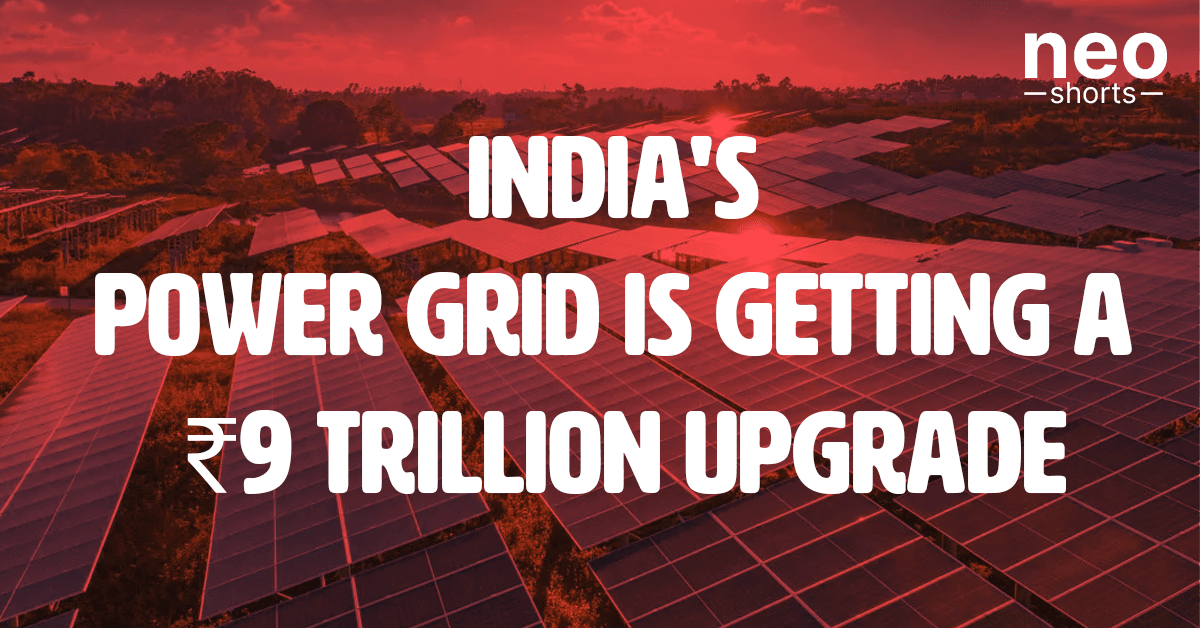
India’s renewable energy story is usually told through solar parks, wind farms, and clean power targets.
But there is another layer behind this shift.
The grid.
Generating renewable power is only one part of the challenge. That power also has to move from where it is produced to where it is consumed.
It has to reach homes, factories, cities, railways, electric vehicle charging networks, and data centres.
That is where the power equipment industry comes in.
Power equipment includes transformers, switchgear, cables, substations, and other grid infrastructure that help electricity move safely and efficiently.
Without this network, renewable capacity cannot be integrated at scale.

That is why power equipment is now becoming an important part of India’s clean energy transition.
As of June 2025, India’s installed renewable capacity stood at 226 GW. This is nearly 3 times the 76 GW level seen in 2014.
Over the next decade, India is expected to add another 470 GW of solar and wind capacity.
At the same time, power demand is also expected to grow at a CAGR of 6.4% till 2030.
So the challenge is not just adding renewable power.
It is building the grid that can carry it.
For high-voltage equipment manufacturers, this could mark the beginning of a long investment cycle.
One important part of this cycle is HVDC, or High-Voltage Direct Current transmission.
HVDC helps transmit large amounts of electricity over long distances with lower losses compared to conventional AC lines.
This matters because many renewable energy projects are located far away from major consumption centres.
As solar and wind projects move farther from cities, efficient long-distance transmission becomes more important.
India’s HVDC market is expected to grow from $15 billion in 2025 to $31 billion by 2035.
This shows how large the opportunity could become as the renewable buildout expands.
The broader transmission and distribution opportunity is also sizable.
India’s transmission and distribution revenue stood at $27.8 billion in 2024. By 2030, it is projected to reach $37.6 billion, growing at a CAGR of 5.2%.
Annual transmission capex currently stands at around $8 billion to $9 billion.
This matters because transmission projects are not built overnight.
Large-scale grid projects usually take 3 to 5 years to complete. That gives equipment manufacturers multi-year visibility on orders and execution.
The demand drivers are also spread across multiple areas.
First, renewable projects need to be connected to the grid. A lot of capacity is currently under construction, and this will require transmission lines and substations.
Second, data centres are becoming a new source of power demand.
India’s data centre capacity stood at 1.4 GW, and more than 5 GW of additional capacity is expected to become operational by 2030.
Third, railway electrification is adding to the need for reliable power infrastructure. India is running one of the world’s largest railway electrification programmes.
Fourth, EVs and industrial load growth are increasing demand in specific regions. This requires stronger local grids and more distribution equipment.
At the centre of this transmission buildout is Power Grid Corporation of India.
PGCIL’s actual capex in FY26 exceeded its own raised target and stood at ₹35,540 crore.
Over FY26 to FY28, the company has planned capex of ₹1,08,000 crore.
Its estimated business pipeline through FY32 stands at ₹3,06,600 crore. At the broader level, government-committed transmission capex till 2032 is estimated at around ₹9 trillion.
This is not discretionary spending. It is the infrastructure cost of integrating 280 GW of solar power into India’s grid by 2030.
Several other listed companies are part of this grid buildout, including Hitachi Energy
India, ABB India, Siemens Energy, CG Power, KEC International, and BHEL.
They operate across areas such as transformers, HVDC, switchgear, substations, transmission towers, EPC, cables, and power equipment.
But this opportunity also comes with risks.
Execution delays remain a key concern.
Land acquisition and right-of-way issues can slow transmission projects.
Raw material pressure is another risk. Transformers require CRGO steel and copper. Price volatility and long lead times can affect margins for equipment manufacturers.
HVDC order timing also matters. HVDC projects are large but infrequent. If awards are delayed, near-term sentiment around companies linked to this theme can be affected.
So the opportunity is large, but execution, costs, order timing, and valuations remain important factors to track.
The larger picture, however, is clear.
India is adding 470 GW of renewable capacity. Every watt of that power needs wires, transformers, substations, and transmission lines before it can reach the grid.
This is not a one-time capex cycle. It is a decade-long infrastructure buildout.
The companies building this backbone are not just supporting renewable energy. They are laying the foundation for India’s next energy era.
Sources:
The content in this blog is intended purely for educational purposes. Any securities or mutual funds referenced are illustrative in nature and do not constitute a recommendation or endorsement by Kotak Neo. Investors are encouraged to assess their own financial situation and seek professional advice before making any investment decisions. For compliance T&C and disclaimers, Visit https://www.kotakneo.com/disclaimer/
0 people liked this article.

Kotak Neo (Kotak Neo) is India's venerable stockbroking company with a rich legacy. It offers comprehensive investment services across asset classes, prioritising a technology-first approach for a seamless experience. Trusted by 5 million+ customers, it guides you toward financial success with ease of investment and speed of trade.
Note: The opinions expressed in this blog are personal viewpoints and should not be construed as recommendations.