A Kingdom Built on One Fruit, and That Fruit Is Failing
- Updated: 22 May 2026, 5:17 PM IST
- | 15 min read
- 1,356
 Add Preferred News Source
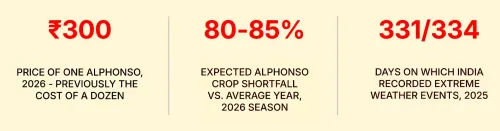
A single mango costs ₹300 this season. Three years ago, you could buy an entire box of two dozen mangoes for just ₹600.
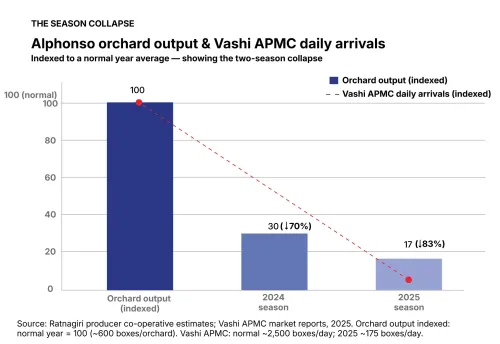
The shortage is not a rumour. Orchards that normally yield 600 boxes are producing 50. Daily arrivals of Alphonso boxes at Vashi APMC (which handles roughly 60% of the region's mango trade) have crashed from a normal 2,000 to 3,000 boxes a day to around 150 to 200. Counterfeit mangoes have flooded Crawford Market and Colaba. The farmers are protesting. The government has convened a cabinet sub-committee.
For consumers, this is a price shock. For investors, it is something more specific: a supply chain that was quietly and efficiently serving a large domestic market and a growing export economy (in fresh fruit, processed pulp, pickles, concentrates, and FMCG drinks) is now under a pressure it has never faced before. The companies exposed here are not small. The crop they depend on is not recovering on its own.
To understand what is breaking, you need to understand what was working, and for how long. The mango economy in India is older, larger, and more interconnected than most people realise. It functioned, without interruption, on one assumption: that the Konkan coast would reliably produce the Alphonso every April.
That assumption is no longer safe. What is happening to the Alphonso this season, and the one before it, is the first real stress test of a system that was never designed to be tested.
The Economy Built Around It
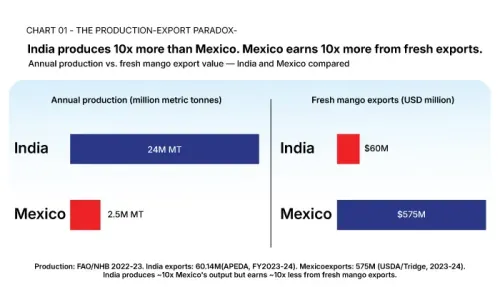
India is the world's largest mango producer, responsible for over 40% of global output, around 24 million metric tonnes in a normal year. Almost all of it stays home.
This is not an accident or a failure. It is the design of an economy that has worked, on its own terms, for decades. India has 1.4 billion people who love mangoes deeply, seasonally, and in large quantities. For many of them, the first mango of the season is not a purchase: it is a homecoming. The domestic market has always been large enough to absorb the fresh produce as fast as it arrives. Farmers sell at the local mandi. Wholesalers move it to city markets. Consumers buy it, eat it, and wait for next year. The system is simple, direct, and has required none of the infrastructure that fresh fruit exports typically demand: no cold chain (the refrigerated storage and transport network that keeps perishable produce alive from farm to foreign supermarket), no phytosanitary certification (the official health inspection that verifies fruit is free of pests and diseases, required by most importing countries before a shipment is allowed to enter), no vapour heat treatment centres (specialised facilities that use pressurised hot steam to kill any insects or larvae inside the fruit, a mandatory requirement for exporting mangoes to Japan, the US, the UK, and the EU), and no traceability documentation (the paper trail that records exactly which farm, which batch, and which date a fruit came from, so any contamination can be traced back to source).
Meanwhile, a parallel economy grew up alongside the fresh market: quietly, without fanfare, and without needing any of those things either. India's FMCG companies built a processed mango pipeline that is now a significant export industry in its own right. Mango-flavoured beverages sold across the world. Mango pickle, exported by dozens of brands to the Indian diaspora in the UK, the US, the Gulf, and Southeast Asia. Mango pulp, concentrate, and puree, shipped in bulk to food manufacturers globally. The names behind this trade are household ones: Hindustan Unilever (NSE: HINDUNILVR), ITC (NSE: ITC), Dabur India (NSE: DABUR), Marico (NSE: MARICO), and Parle Agro all have products anchored to the mango supply chain, from processed pulp and pickles to ready-to-drink beverages.
This pipeline did not require the infrastructure that fresh fruit exports demand. Pulp survives longer. Concentrate tolerates temperature variation. Pickle is shelf-stable for months. The FMCG companies built processing facilities, established supply chains to mandis and small farmers, and created a functioning export business around the mango without ever needing to solve the fresh fruit problem.
The result was a mango economy that served everyone adequately. Farmers sold fresh fruit locally. Processors bought lower-grade fruit cheaply and added value. FMCG companies exported shelf-stable products globally. Consumers at home enjoyed the fresh thing in season.
There was never a forcing function to build fresh export infrastructure: no equivalent of the pressure that drove Mexico to invest. Mexico is the world's largest mango exporter by value, shipping $600 million worth of mangoes annually, 80 million boxes to the US alone in 2024. Mexico built that industry because it had to. Its domestic market was never large enough to absorb its production. India never faced that choice. The domestic market was always there. So the cold chain was never built at farm level. The six vapour heat treatment centres were never expanded. The system worked. Until the crop itself began to fail.
And at the centre of that system, the crop on which everything else rests, are India's mangoes: dozens of varieties grown across the country, but held together in reputation and in value by the one variety that defines what an Indian mango can be, grown in a single geography, dependent on a climate that is no longer behaving as it should.
The Fruit and the Soil
The Alphonso mango (the Hapus) does not grow everywhere. It grows in one specific geography on earth: the Konkan coast of Maharashtra, in the districts of Ratnagiri, Devgad, Sindhudurg, and Raigad. The reason it grows there, and nowhere else with quite the same result, is the soil beneath it.
The Konkan sits on a bed of red laterite rock: iron and aluminium-rich, porous, and slightly acidic. Unlike the soft, fertile soil found in most agricultural regions, laterite forces mango tree roots to work harder to extract nutrients and water. That stress is not a flaw. It is the mechanism. The tree, struggling to draw what it needs from resistant ground, concentrates its sugars more intensely. The result is a fruit with higher Brix levels (the measure of sugar concentration in fruit juice: a higher number means a sweeter, richer taste), a denser and non-fibrous pulp, and an aroma so pronounced that a single box of ripe Hapus can fill a room before it is opened.
Add to this the Arabian Sea. The coastal breeze carries traces of salt and minerals that settle into the soil and onto the leaves of the trees, contributing to the development of complex aromatic compounds (terpenes) that give the Alphonso its famous fragrance. Then add the Konkan's specific seasonal rhythm: heavy monsoon rainfall just after harvest, cool nights and warm dry days through December and January for flowering, and a dry summer heat from February to May that concentrates the developing fruit's sugars in the final weeks before picking.
This is terroir (the French term for the way a specific combination of soil, climate, and geography shapes the character of what grows there) in its most precise sense. The Portuguese, who named the variety after Afonso de Albuquerque in the 16th century, first cultivated it in Goa. But the fruit found its true expression on the Konkan coast, where the combination of laterite soil, sea mineral, and microclimate produced something that could not be replicated anywhere else. India recognised this in law with a Geographical Indication tag: only mangoes grown in the designated Ratnagiri and Devgad regions can legally carry the name, Hapus or Alphonso.
A GI tag, in its best form, is a description of irreplaceability. The Hapus is irreplaceable.
That irreplaceability is also a vulnerability. The same narrow conditions that make the Alphonso extraordinary (the precise temperature band, the specific seasonal rhythm, the particular interplay of moisture and dry heat) are exactly the conditions that a changing climate is dismantling.
A Climate in Acceleration
The two bad seasons that have devastated the Hapus are not isolated local events. They sit inside a documented global acceleration.
India recorded extreme weather on 331 of 334 days in 2025. Maharashtra and Goa experienced the country's first ever heatwave in the January to February winter period. The IMD confirmed February 2025 as the hottest February on record. That heatwave arrived precisely during the Alphonso's critical flowering window.
The Konkan's climate is not shifting gradually. It is lurching.
Two Seasons, One Pattern
Total Alphonso production this year is expected to fall by 80 to 85% compared to an average year. The cooperative association president in Ratnagiri put it simply: "The flowers simply did not hold."
The immediate cause was a cold wave in December that disrupted pollination, followed by persistent cloud cover and humidity that damaged the flowering stage (the mohar, the bloom) at its most critical moment. The season before this one saw a 70% crop drop. That time, the cause was the opposite: unseasonably warm nights through winter that never sent the temperature signal the trees needed to flower at all.
Two consecutive seasons. Two opposite weather events. The same result: near-total crop failure.
The mechanism connecting them is the Alphonso's extreme climatic sensitivity. The tree requires cool nights and warm days in December and January, a specific and narrow band of conditions, to trigger flowering. That band is being eroded from both sides simultaneously. When winters are too warm, flowering fails to trigger. When a sharp cold snap is followed by unusual humidity, the flowers form but do not hold.
There are subtler effects too. Rising temperatures during flowering cause male flowers to severely outnumber hermaphrodite flowers, distorting the ratio required for pollination and fruit set. Heat also triggers increased production of abscisic acid in the tree, causing premature fruit drop. And where heat denatures the enzyme responsible for ripening, the result is spongy tissue: fruit that looks perfect from the outside and is inedible inside. Alphonso mangoes are more vulnerable to spongy tissue than any other major variety.
Compounding the weather damage this season was a thrips and hopper infestation of unusual severity. Both pests are familiar to Konkan farmers. They attack tender flower bundles every season and farmers routinely manage them. What was not routine was the virulence of this year's attack. Farmers describe the panicles turning crisp black as the insects sucked the sap from flowers already weakened by the climatic disruption. A tree stressed by poor flowering conditions has less resistance to pest pressure. The two forces, climatic and biological, did not arrive separately. They arrived together, and each made the other worse.
"Mangoes grew in abundance then. We had plenty for neighbours, relatives, ourselves, and still enough for selling locally. Temperatures here were never so high. At that time, we only heard about the term 'global warming', but now we're witnessing it first-hand."
— Farmer, Kasal village, Sindhudurg district
The Duplicity Problem
When the Hapus crop fails at this scale two years running, the damage does not stay at the farm gate.
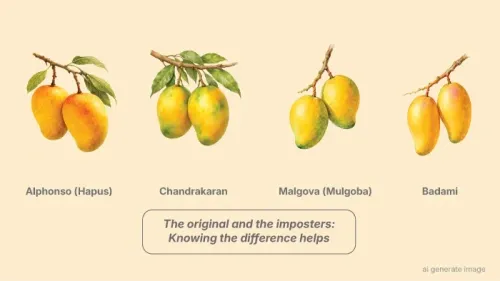
The fresh market feels it immediately and visibly. Counterfeit mangoes (the Karnataka Badami variety, sometimes called the "poor man's Alphonso," sold under the Ratnagiri name) have flooded Mumbai's markets, alongside varieties from Kerala and Tamil Nadu. The scale of substitution is not trivial: of the 17,000 boxes that arrived at Vashi APMC on a recent day, only 6,325 were genuine Konkan Hapus. The remaining 10,675 were southern varieties filling the gap. The GI tag that was supposed to protect the Hapus's premium is being systematically abused precisely because genuine supply has collapsed.
The Threat Downstream
The more consequential and less-reported threat is what happens further down the supply chain. The mango processing industry is not monolithic. Beverage brands using Totapuri (grown in Andhra Pradesh and Karnataka, largely insulated from Konkan climate stress) are not directly exposed. But FMCG companies whose products depend explicitly on Alphonso pulp face a different calculation entirely. These are not companies using any available mango. They have built their brand identity and taste profile around the Alphonso specifically. When two consecutive seasons produce 15 to 30% of normal Alphonso output, those companies face a choice with no good answer: pay dramatically higher prices for insufficient raw material, substitute a cheaper variety and hope consumers do not notice, or quietly walk back the Alphonso claim altogether. None of these options is without cost, whether financial, reputational, or both.
The playbook exists, but no Indian FMCG company has yet deployed it at meaningful scale for the Alphonso. Globally, companies facing exactly this problem have responded by getting upstream. Hindustan Unilever, in collaboration with IDH and Sahyadri Farmers Producer Company, already supports around 3,000 tomato farmers in Maharashtra with regenerative agriculture practices: tailored training, model farms, and peer learning that restore soil health, reduce input costs, raise yields, and build climate resilience. The same logic applies directly to mango. HUL has demonstrated it knows how to do this in Maharashtra. It has not yet done it for the Alphonso supply chain.
The Konkan farmers who grow the Alphonso are not just suppliers. They are the supply chain.
What Remains
The Alphonso is not finished. The terroir that produces it (the red laterite soil, the Arabian Sea minerals, the Konkan microclimate) has not disappeared. What has disappeared is the climatic predictability that the fruit's flowering cycle depends on. Those are not the same thing.
Bad years have always happened. What is new is their frequency, their severity, and the fact that they are now arriving from both ends of the climate envelope: a winter too warm one year, a cold snap followed by unusual humidity the next. The Hapus cannot adapt to that volatility on its own. But the system around it can.
For the first time, the interests of the smallholder farmer, the exporter, and the FMCG company are pointing in the same direction. Two consecutive seasons of near-total failure have done what decades of export targets could not: made the cost of underinvestment visible to every part of the chain simultaneously.
The Hapus will survive bad years. It has survived them before. The question is whether the farming community around it is resilient enough to survive them too, and whether the companies and institutions that depend on that community are willing to help build that resilience before a third bad season makes the question academic.
The reign of the King has not ended. But the floor is giving way, and no one has picked up a hammer.
Sources
- PuneNow
- Freshplaza
- Mongabay India / Scroll
- Tridge Weekly Mango Update
- Down To Earth
- India Water Portal
- NASA
- WMO State of the Global Climate 2024
- Copernicus C3S
- EMEX
- APEDA
- alphonsomangoes.online
- konkanestates.com
The content in this blog is intended purely for educational purposes. Any securities or mutual funds referenced are illustrative in nature and do not constitute a recommendation or endorsement by Kotak Neo. Investors are encouraged to assess their own financial situation and seek professional advice before making any investment decisions. For compliance T&C and disclaimers, Visit https://www.kotakneo.com/disclaimer/
0 people liked this article.

Kotak Neo (Kotak Neo) is India's venerable stockbroking company with a rich legacy. It offers comprehensive investment services across asset classes, prioritising a technology-first approach for a seamless experience. Trusted by 5 million+ customers, it guides you toward financial success with ease of investment and speed of trade.
Note: The opinions expressed in this blog are personal viewpoints and should not be construed as recommendations.