What Is A Chit Fund? Meaning, How It Works, Benefits & Risks
- Updated: 22 May 2026, 5:17 PM IST
- | 6 min read
- 1,001
 Add Preferred News Source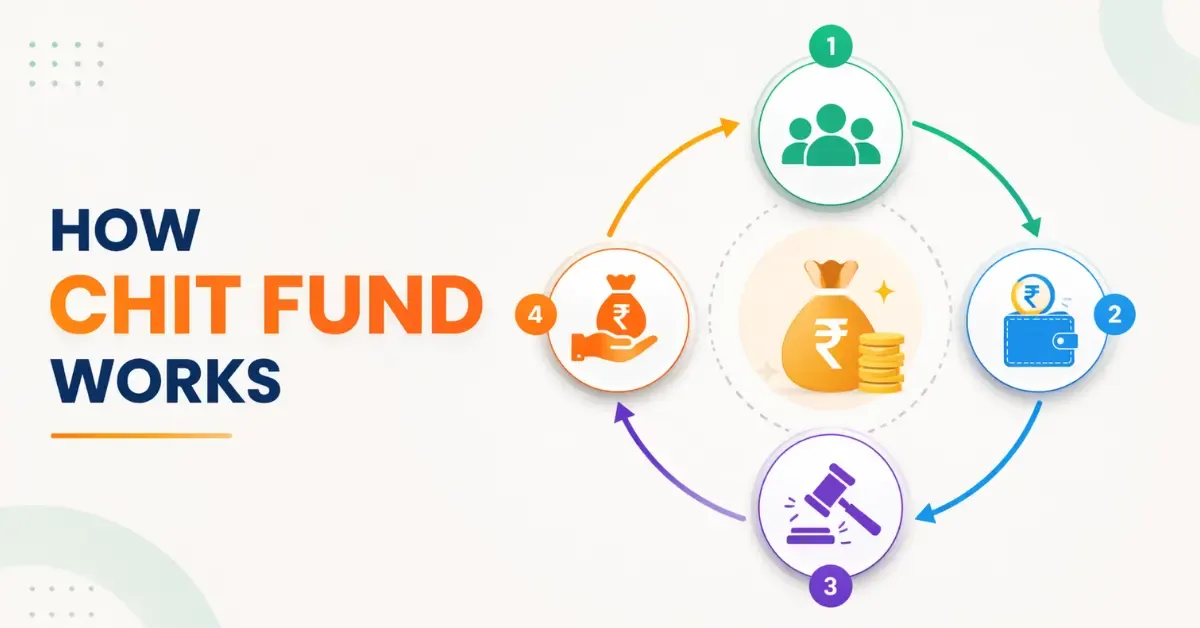
In India, people tend to look for simple ways to save regularly whilst retaining easy access to funds whenever needed. In such conversations, chit funds frequently come up. For decades, countless people have relied on chit funds for financial security, owing to their dual function as both a savings and borrowing instrument.
Despite the trust they command, chit funds are not without their share of questions, what exactly they are, how they work, and, most importantly, whether they are safe. This guide walks you through how chit funds work, clearly outlining their meaning, functioning, associated risks, and all other necessary information.
What Is A Chit Fund?
A chit fund is a savings and borrowing arrangement run among a group of people. Each member contributes a fixed amount every month for a set period.
In simple terms, it works like a pool of money. Every month, one member gets access to the pooled amount. This cycle continues until each member of the group has received their share.
Every chit fund is managed by a foreman, who can either be a company or a single person. A foreman’s job is to manage collections, auctions, and payouts.
A chit fund is, therefore, a blend of disciplined saving and ready access to funds when required. It is commonly used by small business owners and households.
How Chit Fund Works
Here is a step-by-step breakdown of how chit funds work. The process begins by forming a group with a fixed number of members. Each member agrees to contribute a set amount every month. The total contribution becomes the chit value.
Every month, the pooled amount is given to one member, who is usually chosen through a bidding process or auction.
Understanding Chit Fund Auctions
-
All members bid for the pooled amount (₹0-20% of the pool)
-
The member who offers the highest discount receives the fund, less their discount.
-
The dividend is calculated after deducting the foreman’s commission (capped at 5% according to the Chit Funds Act, 1982).
-
Every member receives the dividend equally.
Let’s understand this with an example.
Suppose the total pool value is ₹1 lakh, and a member bids with a ₹10,000 discount, they receive ₹90,000. The remaining discount of ₹10,000 minus the foreman’s commission (capped at 5%), is distributed equally amongst the other members as a dividend.
Each member gets a chance to take the lump sum once during the cycle. Until then, they continue contributing monthly.
Types Of Chit Funds
Chit funds are mainly divided based on who manages them.
Government Chit Funds
These chit funds are registered with the state. Since they are controlled by state laws, they adhere to strict rules and guidelines. They are therefore considered the most reliable type of chit funds.
Due to their regular audits and compliance checks, government chit funds have better transparency than private ones.
Private Chit Funds
As the name suggests, private chit funds are managed by companies or independent individuals. These funds are very popular in local communities and markets.
While most are legitimate, some private chit funds operate in questionable ways. Trust levels on private chit funds vary from operator to operator. Anyone considering joining a chit fund should verify the operator’s registration and track record.
Chit Fund Rules And Regulations
The Chit Funds Act, 1982 is the law that regulates the chit funds operating in India. This act lays out the framework governing how chit funds must function across the country.
Here are some key chit fund rules and regulations:
-
Every chit fund must be registered with the state authority
-
The foreman must clearly define the duration, contribution amount, commission, and other key terms.
-
The foreman’s commission is capped at 5% of the chit amount as per the guidelines of the Reserve Bank of India (RBI).
-
Proper records of members and transactions must be maintained. All auctions must be conducted fairly and transparently
While the general rules are laid down nationally, there are some states that have their own rules to strengthen oversight. To reduce the risk of fraud, always verify that the chit fund is legally registered.
Benefits Of Chit Funds
There are notable advantages to investing in chit funds, particularly for regular contributors.
-
Disciplined saving: Regular monthly contributions build a consistent savings habit.
-
Access to a lump sum: Members gain access to a large sum when needed.
-
Minimal formality: Unlike bank loans, there is no heavy paperwork.
-
Benefit of dividends: Irrespective of whether they win the pool or not, members always get a share of the discounts offered during bidding
Chit funds are also a great borrowing source for people who may not have easy access to formal credit.
Risks Associated With Chit Funds
It is worth addressing one of the most common concerns about chit funds. There are risks associated with them. Some of them are as follows:
-
Member dropout: A member may take the payout and subsequently cease contributing
-
Operator reliability: Poor management or unregistered operations can lead to significant issues
-
Continued contributions: Members are still required to contribute monthly even after receiving the lump sum
-
Variable returns: Earnings depend on the outcome of each auction and are therefore never fixed.
"It is advisable to verify the operator, the membership, and the fund's performance history before committing. This due diligence can prevent considerable difficulty down the line.
Understanding Chit Fund With An Example
Consider a scenario in which 20 members of a community have joined a chit fund. Each contributes ₹5,000 per month. The total monthly pool becomes ₹1 lakh.
In the first month, members bid for the amount. One member offers a discount of ₹15,000.
They receive 85,000. After deducting the foreman's commission of ₹750 (5% of the pool), ₹14,250 is distributed amongst the remaining 19 members. This process repeats every month. Each member gets the pooled amount once during the 20-month cycle.
Conclusion
A chit fund can be effective for those seeking a combination of regular savings and periodic access to funds. Still, it's worth understanding how a chit fund works and practicing caution before investing. Knowing the rules, verifying registration, and trusting the operator are all essential before committing funds. A well-managed chit fund can be a valuable financial tool, provided it is chosen carefully and approached with discipline.
Sources:
Delhi Government Chit Fund Portal
Reserve Bank of India
ClearTax
FAQs On Chit Fund
Registered chit funds are considered safe. If a chit fund is enrolled with the state authority and operate under the Chit Funds Act, 1982, there is a reasonable level of protection in place. Government-run chit funds tend to be the safest because they are audited regularly. That said, not every chit fund out there plays by the rules. Unregistered schemes are where most problems arise, so the first thing you should do before joining any chit fund is verify its registration. That one step eliminates a large portion of the risk
The answer depends on one's priorities. If predictability matters most to you, an FD wins; you know exactly what you are getting back. Chit funds, on the other hand, offer something an FD cannot: access to a large sum before the saving cycle is complete. The trade-off is that your returns are not fixed and depend heavily on how bidding plays out each month. Neither is universally better. The choice ultimately comes down to whether one priorities certainty or flexibility.
Early withdrawal is not possible in the way it would be with a savings account. Members cannot simply exit mid-cycle. However, you can bid for the pool in the early months of the cycle; if your bid is accepted, you get the lump sum sooner than your turn would have come. Just keep in mind that bidding early usually means accepting a higher discount, so you will receive less than the full pool value.
A few things can go wrong. Members dropping out mid-cycles is probably the most common issue. Once someone collects the pool and stops paying, it creates a shortfall for everyone else. Beyond that, poor management and outright fraud are real concerns, particularly with unregistered operators. Returns are also unpredictable since they depend on the bidding process each month. None of this renders chit funds inherently dangerous, but entering without adequate research exposes one to unnecessary risk.
The content in this blog is intended purely for educational purposes. Any securities or mutual funds referenced are illustrative in nature and do not constitute a recommendation or endorsement by Kotak Neo. Investors are encouraged to assess their own financial situation and seek professional advice before making any investment decisions. For compliance T&C and disclaimers, Visit https://www.kotakneo.com/disclaimer/
The content in this blog is intended purely for educational purposes. Any securities or mutual funds referenced are illustrative in nature and do not constitute a recommendation or endorsement by Kotak Neo. Investors are encouraged to assess their own financial situation and seek professional advice before making any investment decisions. For compliance T&C and disclaimers, Visit https://www.kotakneo.com/disclaimer
0 people liked this article.

Kotak Neo (Kotak Neo) is India's venerable stockbroking company with a rich legacy. It offers comprehensive investment services across asset classes, prioritising a technology-first approach for a seamless experience. Trusted by 5 million+ customers, it guides you toward financial success with ease of investment and speed of trade.
Note: The opinions expressed in this blog are personal viewpoints and should not be construed as recommendations.