Terminal Value: Meaning, Formula, Methods & Calculation
- Updated: 22 May 2026, 5:17 PM IST
- | 4m
- 1,004
 Add Preferred News Source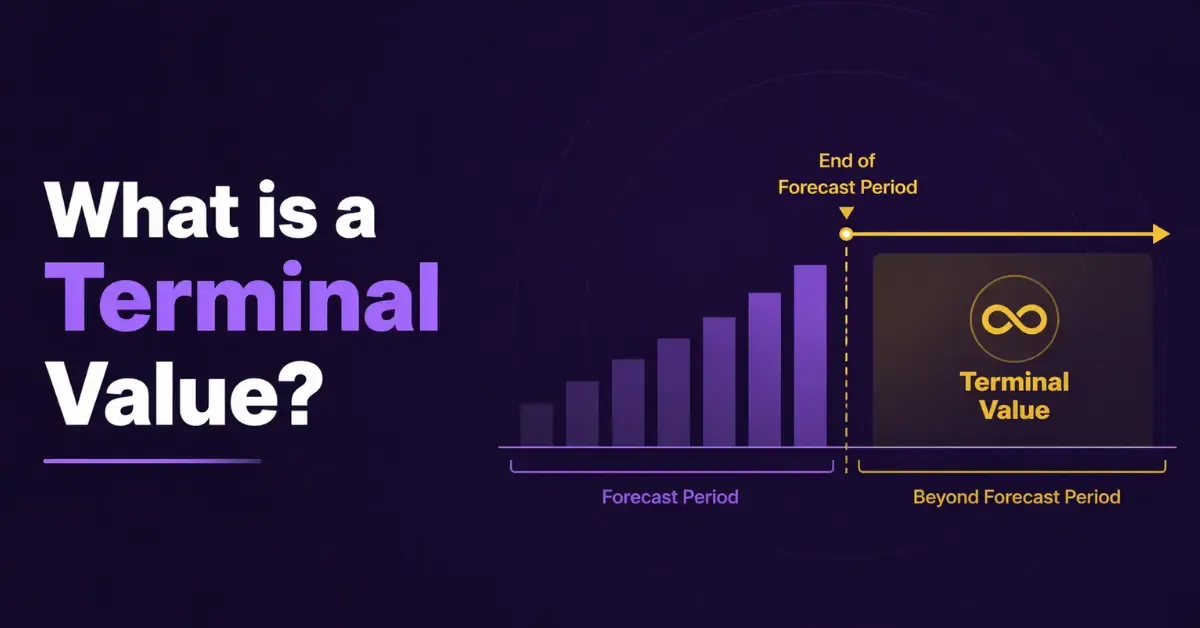
When people value a business, they focus on what it may earn over a set future period. That part is planned out. But the future is uncertain, and outcomes rarely match expectations. So the question remains, what happens after that forecast ends?
This is where terminal value matters. It helps complete the picture. Read on to understand what it means and why it is important.
What Is A Terminal Value?
Terminal value represents the estimated value of a business at the end of the forecast period. Beyond a certain point, it becomes challenging to project the cash flow of a business. Hence, instead of guessing each year, analysts use the terminal value. In several cases, it forms a large part of a company's total valuation.
Terminal Value Formula
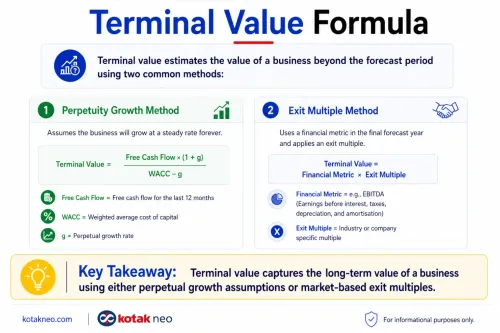
The terminal value formula depends on the method used to calculate it. The first formula is from the perpetuity growth method. This method assumes that the business will grow at a steady rate forever. The formula is:
Terminal Value = (Free Cash Flow x (1 + g)) / (WACC – g), where:
-
Free cash flow equals the free cash flow for the last 12 months
-
WACC is the weighted average cost of capital
-
g is the perpetual growth rate
The second terminal value formula comes from the exit multiple model. The formula for this model multiplies a certain financial metric (e.g., earnings before interest, taxes, depreciation, and amortisation or EBITDA) in the final year of the forecast by an exit multiple assumption. So the formula under this model is:
Terminal Value = Financial Metric X Exit Multiple
Methods Of Calculating Terminal Value
There are two methods of calculating terminal value:
Perpetuity Growth Method
This method assumes the business will keep growing at a constant rate forever. It works well for stable companies with predictable growth. The growth rate is usually low and close to the economy’s growth rate.
It is simple and widely used. However, choosing the right growth rate is very important. A small change in this rate can affect the final value quite significantly.
Exit Multiple Method
This method assumes that one can determine an entity's value at the end of the projected period based on present public market valuations of comparable firms.
For instance, if similar companies are valued at 10 times their earnings, the same multiple can be used to calculate terminal value.
How To Calculate Terminal Value?
To calculate terminal value, you first need to estimate future cash flows over a few years. This is called the forecast period. After that, apply one of the two terminal value calculation methods mentioned above.
If you use the perpetuity growth method, factor in last year’s cash flow. Then apply the formula using a growth rate and a discount rate. However, it is essential to ensure that the growth rate is realistic.
On the other hand, for the exit multiple method, first identify a suitable financial metric. Then find a proper multiple based on similar companies.
Once you calculate the terminal value, you discount it back to the present value. This step is important because money in the future is worth less than money today.
Importance Of Terminal Value In Valuation
Here is how the terminal value plays a vital role in valuation:
- Helps Evaluate Long-Term Value
Terminal value helps find out a business’s value beyond the forecast period. Without it, future cash flows would be ignored, making the valuation less complete.
- A Significant Part Of Total Value
Often the terminal value makes up a big part of the final valuation. Hence, small changes in assumptions can strongly impact the end result.
- Simplifies The Valuation Process
It is not easy to predict cash flows for many years. Terminal value reduces this complexity by giving one final estimate. This keeps the process simple and manageable.
Example Of Terminal Value Calculation
Assume a firm's final year cash flow stands at ₹100. Its perpetual growth rate is 3%. The WACC is 10%. If you use the perpetuity growth method:
Terminal Value = 100 × (1 + 0.03) ÷ (0.10 − 0.03) = ₹1,471.43
It means the business is expected to be worth around ₹1,471 at the end of the forecast period.
Using the exit multiple method, if the company has an EBITDA of ₹100 and is valued at a multiple of 10. Then,
Terminal Value = 100 × 10 = ₹1,000
While the results are different, they help you estimate the future value in their own ways.
Terminal Vs Instrumental Values
People often confuse terminal and instrumental values. Though they may look the same on the surface, they differ in several aspects.
Aspect | Terminal Value | Instrumental Value |
|---|---|---|
Meaning | Refers to the estimated value of a business at the end of the forecast period. | Refers to the value of something based on its usefulness in achieving a goal. |
Use In Finance | Used in business valuation | Not used in business valuation |
Focus | Outcome or the end result | Usefulness to achieve an outcome |
Conclusion
A vital component of financial analysis and modelling, terminal value can give you insights into a company's long-term performance and profitability. If the value is negative, it may indicate declining cash flows over time. On the other hand, if positive, it may signal long-term value creation for its investors.
Sources:
Corporate Finance Institute
Wall Street Prep
FAQs On Terminal Value
A good rate is typically between 2% to 4%. It reflects a realistic and sustainable growth rate.
Terminal value generally comprises a large part of a company's total valuation. It can even be more than half of the final value. Hence, small changes in growth rate can significantly affect the overall result.
Not really. It is primarily used in discounted cash flow (DCF) models to estimate value beyond the forecast period. Other methods depend on current market data and do not need a terminal value.
The content in this blog is intended purely for educational purposes. Any securities or mutual funds referenced are illustrative in nature and do not constitute a recommendation or endorsement by Kotak Neo. Investors are encouraged to assess their own financial situation and seek professional advice before making any investment decisions. For compliance T&C and disclaimers, Visit https://www.kotakneo.com/disclaimer/
0 people liked this article.

Kotak Neo (Kotak Neo) is India's venerable stockbroking company with a rich legacy. It offers comprehensive investment services across asset classes, prioritising a technology-first approach for a seamless experience. Trusted by 5 million+ customers, it guides you toward financial success with ease of investment and speed of trade.
Note: The opinions expressed in this blog are personal viewpoints and should not be construed as recommendations.