DSCR Explained: Meaning, Formula & Calculation
- Updated: 03 Jun 2026, 6:13 AM IST
- | 4m
- 1,104
 Add Preferred News Source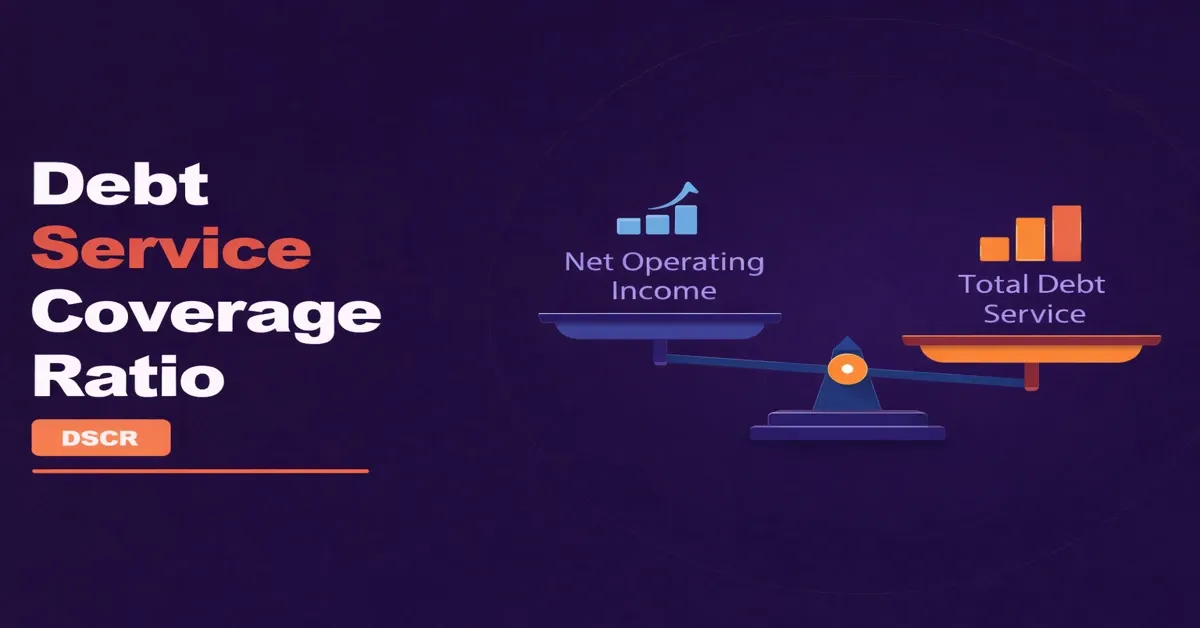
When companies ask for loans, lenders want to know they’ll get their money back. That’s where the Debt Service Coverage Ratio, or DSCR, comes in. It’s one of the main numbers banks, NBFCs, investors, and other lenders look at to decide if a company can actually handle its debt.
Basically, DSCR tells you if a company makes enough money to cover what it owes. In this blog, let’s talk about DSCR. What it really is, how to figure it out, and what you need for the calculation.
What Is DSCR?
DSCR stands for Debt Service Coverage Ratio. It’s basically a way to see if a company brings in enough operating income (think EBITDA or any cash the business has on hand to pay debts) to cover everything it owes each period, both the interest and the actual loan payments. Lenders and investors look at DSCR to figure out if a company can really handle its debt load, or if it’s stretching itself too thin.
-
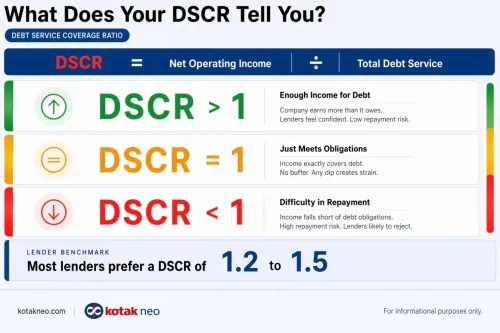
DSCR > 1: Enough income for debt
-
DSCR = 1: Just meets obligations
-
DSCR < 1: Difficulty in repayment
In practice, lenders usually prefer a DSCR of at least 1.2 to 1.5, depending on the industry and risk profile.
DSCR Formula And Components
DSCR Formula
The following is the DSCR formula:
DSCR = Net Operating Income / Total Debt Service
Total Debt Service refers to all current loan obligations covering both the interest charged and the principal that must be repaid.
Note: In some sectors like real estate, Net Operating Income (NOI) is used instead of EBITDA.
Key Components
1. Net Operating Income (NOI)
This represents earnings derived from core operations, once expenses like salaries, utilities, and maintenance have been deducted. It does not account for interest or taxes. Non-operating components are left out as well. And, if needed, adjustments may be made for non-cash items or items of a one-time nature.
2. Total Debt Service (TDS)
This includes all necessary debt payments such as: -
-
Principal repayments
-
Interest repayments
-
Lease payments or obligations
How To Calculate DSCR (Step-By-Step)
Here are the steps that you need to follow to calculate the debt service coverage ratio:
- Step 1: Calculate Operating Income
Determine operating income using EBITDA or adjusted cash flow, rather than just basic revenue minus expenses.
- Step 2: Calculate Total Debt Service
Add all debt obligations, including scheduled principal and interest payments.
- Step 3: Apply The Formula
Use the DSCR formula:
DSCR = Operating Income / Total Debt Service
- Step 4: Interpret The Result
A DSCR above 1 suggests the company is in a comfortable position to handle its debt repayments, whereas a DSCR below 1 points toward possible strain when it comes to meeting those obligations.
Example Of DSCR Calculation
Here is an example for a better understanding of DSCR.
-
Let’s say the firm earns ₹5,00,000 as Net Operating Income.
-
Its debt servicing requirement, however, is ₹4,00,000.
-
Hence, DSCR = 5,00,000 / 4,00,000.
The company generates about 1.25 times its operating income when compared to its debt obligations. There is, in addition, a 25% buffer over what it owes. This reflects a healthy DSCR.
Factors Affecting DSCR
Here are certain factors that affect the debt coverage ratio:
- Revenue Fluctuations
Increases and decreases in sales affect operating income. This can either increase DSCR or lower DSCR.
- Operating Expenses
An increase in operating expenses will lower the net income. This has a negative impact on DSCR.
- Interest Rates
If the interest rates are high, then debt servicing costs increase. This can reduce the DSCR.
- Debt Level
If the company has more debt, then it results in higher debt obligations. This can affect the DSCR.
- Economic Conditions
Improved cost management and efficiency can result in better profits and improve DSCR.
Conclusion
The Debt Service Coverage Ratio (DSCR) matters because it shows whether a company can actually pay off its debts. Lenders and investors rely on it to see if a business has enough cash flow to cover its loans, not just to check if it’s financially healthy overall.
A higher DSCR shows the company earns enough, with comfortable margins, to handle its debt obligations. A lower DSCR, on the other hand, points toward possible repayment risk. When its calculation is done correctly, and the right income measures are used, businesses gain clarity. Add practical benchmarks into the mix, and financial management becomes sharper, more controlled, and ultimately more supportive of stronger creditworthiness.
The content in this blog is intended purely for educational purposes. Any securities or mutual funds referenced are illustrative in nature and do not constitute a recommendation or endorsement by Kotak Neo. Investors are encouraged to assess their own financial situation and seek professional advice before making any investment decisions. For compliance T&C and disclaimers, visit https://www.kotakneo.com/disclaimer/
0 people liked this article.