Types Of IPO
- Updated: 26 May 2026, 5:10 PM IST
- | 3 min read
- 2,233
 Add Preferred News Source
An Initial Public Offering, or IPO, is when a private company offers its shares to the public for the first time. This is the stage where a company moves from being privately owned to being listed on a stock exchange.
Through an IPO, the company allows investors to buy a stake in its business. In return, it can raise capital for expansion, reduce debt, or provide an exit to early investors.
Once listed, the company’s shares can be freely traded in the stock market, and its performance becomes visible to the public.
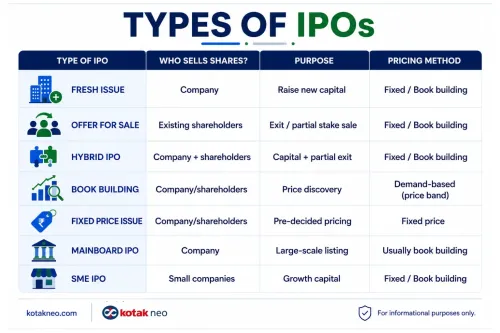
There are different types of initial public offerings (IPOs), and each IPO type tells you something important about the company’s intent. The type of IPO essentially boils down to a simple idea: how a company raises money and how it prices its shares.
Let us dissect the terms needed to understand an IPO.
Fresh Issue
A fresh issue is when a company creates new shares and sells them to the public for the first time.
- The money goes directly to the company
- Used for business growth, expansion, or paying off loans
- Existing owners’ share gets diluted
This is the most straightforward IPO type. The company is raising money for itself.
Companies generally mention how they plan to use the funds in the Red Herring Prospectus before the IPO opens. It could be setting up a new plant, entering a new market, or reducing debt. If a large portion of the IPO is a fresh issue, it usually signals that the company is focused on growth rather than providing an exit to early investors.
Offer For Sale (OFS)
Offer for Sale refers to selling of shares by existing stockholders to the general public.
- New shares will not be issued
- Money will not be raised for the company
- Promoters and investors cut down on their shareholding
Therefore, the higher the Offer for Sale portion in an IPO, the greater the likelihood that there might be partial exits by stockholders in the company.
That said, this is not always a negative sign. Sometimes, early investors who have invested for years simply want to book profits. The key is to look at how much stake they are selling and whether they are still holding a meaningful portion after the IPO.
Hybrid IPOs
Some IPOs combine both:
- Fresh issue
- Offer of sale
This is called a hybrid IPO.
- Part of the money goes to the company
- Part goes to existing shareholders
It is quite common and gives a mix of growth funding and investor exit.
When analysing such IPOs, it helps to look at the split between the two. A higher fresh issue component may indicate future expansion plans, while a higher offer of sale portion may suggest more investor exit activity.
Book Building Issue
A book building issue is where the price is decided during the IPO process.
- There is a price range instead of one fixed price
- Investors place bids within that range
- Final price depends on demand
- Demand is updated daily based on subscription levels
This is the most common IPO type today because it lets the market decide the price.
You will often hear terms like “oversubscribed” during this process. That simply means demand is higher than the number of shares available. Strong demand in a book building issue can indicate positive sentiment, but it does not guarantee post-listing performance.
Fixed Price Issue
A fixed price issue is much simpler.
- The company sets one price in advance after consultation with its investment bankers
- Investors apply at that price
- Demand is known only after the IPO closes
Compared to a book building issue, this method is easier to understand but less flexible.
Because the price is fixed, investors have to decide without knowing real-time demand. This makes it slightly less transparent. That is one of the reasons why fixed price issue IPOs are less common today.
Mainboard IPO
A mainboard IPO is for larger, well-established companies.
- Listed on major exchanges like the National Stock Exchange and the Bombay Stock Exchange
- Typically involves standard lot sizes, resulting in a lower minimum investment compared to SME IPOs
- More visibility and usually more stable companies
Both institutional and retail investors usually participate in mainboard IPOs.
Because of stricter regulations and disclosures, mainboard IPOs tend to have more publicly available information. This makes it easier for investors to analyse the company before applying.
SME IPO
An SME IPO is for smaller companies.
- Listed on specialised platforms such as NSE Emerge and BSE SME
- Higher minimum investment due to larger lot sizes
- Higher risk, but also higher growth potential
If you are looking at early-stage businesses, this IPO type is where they show up.
Liquidity can be lower in SME IPOs, which means buying and selling shares after listing may not always be easy. So while the upside can be attractive, investors need to be comfortable with the risks involved.
Conclusion
There are multiple types of IPO, but you do not need to overcomplicate it. Start by asking two simple questions:
- Is the company raising money or are investors selling?
- Is the price fixed or decided by demand?
Once you understand these basics, all types of initial public offerings become much easier to identify.
Over time, as you explore more IPOs, you will also start recognising patterns across different IPO type structures. That is when evaluating an IPO becomes less about theory and more about practical judgement.
The content in this blog is intended purely for educational purposes. Any securities or mutual funds referenced are illustrative in nature and do not constitute a recommendation or endorsement by Kotak Neo. Investors are encouraged to assess their own financial situation and seek professional advice before making any investment decisions. For compliance T&C and disclaimers, Visit https://www.kotakneo.com/disclaimer/
0 people liked this article.

Kotak Neo (Kotak Neo) is India's venerable stockbroking company with a rich legacy. It offers comprehensive investment services across asset classes, prioritising a technology-first approach for a seamless experience. Trusted by 5 million+ customers, it guides you toward financial success with ease of investment and speed of trade.
Note: The opinions expressed in this blog are personal viewpoints and should not be construed as recommendations.