What Is A Prospectus; Meaning, Types, Contents And Importance
- Updated: 11 Jun 2026, 5:12 PM IST
- | 4m
- 1,013
 Add Preferred News Source
What Is A Prospectus?
A prospectus is a legal requirement as per compliance, but it is also useful for investors. A company that decides to raise funds through the general public must share all important information about the offer, which is done through a prospectus.
Investors must know what a prospectus is, as it gives them complete information about the company’s financial position, what they are investing in, possible risks, and probable returns. In fact, investors should also know about the types of prospectus as it will help them to make important investment decisions.
Meaning Of Prospectus
A prospectus is a legal document issued by a company to the general public before it makes any new security offering, such as stocks, bonds, or units of mutual funds. This document includes important details like the offering price, risks involved in the investment, purpose of raising funds, and how the funds are going to be utilised, but the type of prospectus depends on its purpose.
A prospectus primarily aims to provide transparent, standardised disclosures to help investors make investment decisions.
Types Of Prospectus
The company issues different types of prospectuses depending on the purpose. Here are some of the most common types:
1. Red Herring Prospectus (RHP)
When a company decides to go public, one of the first things it has to do is file a Draft Red Herring Prospectus, commonly called a DRHP, with SEBI. Think of it as a formal introduction. The document lays out the company's business model, financial history, and the risks investors should be aware of before putting their money in.
SEBI reviews the DRHP carefully. Once it clears that review, the document transitions into what is known as the Red Herring Prospectus, or RHP, the version that goes out to the public during the IPO. At this point, the price band may or may not be finalised. That detail, along with the exact number of shares on offer, gets locked in only after the bidding process wraps up.
2. Shelf Prospectus
Not every company needs to raise capital all at once. For those that prefer a staged approach, a shelf prospectus lets them file once and issue securities across multiple tranches under that single document, valid across all issuances under Section 31 of the Companies Act, 2013. Before each tranche, though, the company must file an Information Memorandum disclosing any material changes since the original filing. A standing approval, but with periodic check-ins.
3. Mutual Fund Prospectus
When an AMC launches a new scheme, it issues a mutual fund prospectus covering the fund's objectives, investment approach, and associated risks. SEBI, however, requires this information to be split across three documents: the Scheme Information Document (SID), which details the fund's strategy and structure; the Statement of Additional Information (SAI), covering legal and operational specifics; and the Key Information Memorandum (KIM), a concise summary for quick reference. The SID released before any major New Fund Offer is the most common real-world example of this.
Why Does A Prospectus Matter To Investors?
A prospectus is not just a legal document; it provides investors with comprehensive disclosures (but not absolute certainty) about the company. With that, investors can better judge both the company’s credibility and whether the investment itself makes sense.
It brings attention to key details about how the company is managed, its financial condition, the direction it plans to take, and the risks that might come along with it. Once investors go through the document, they’re in a much better position to make decisions that are thoughtful and grounded, instead of just following market hype.
Moreover, the prospectus falls under the regulatory authority of the Securities and Exchange Board of India (SEBI). Companies are, therefore, under a legal obligation to provide information that is both accurate and complete, in accordance with the SEBI (ICDR) Regulations, 2018 (as amended) as well as the Companies Act, 2013. Any misstatement or omission may attract penalties. This framework ultimately serves to protect investors.
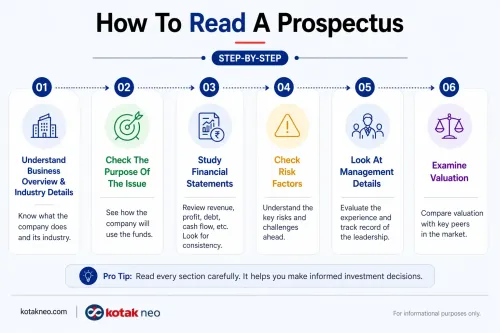
How To Read A Prospectus (Step‑By‑Step)
Here is how you can read a prospectus:
-
Understand Business Overview And Industry Details
Gain knowledge about what the company does and its industry. Check if the business model is easy to understand or not.
-
Check The Purpose Of The Issue
It matters how the company intends to deploy the funds it brings in. Maybe expansion, maybe debt obligations, or just working capital needs.
-
Study Financial Statements
Check the company’s revenue, profit, debt level, cash flow, etc. Look for consistency rather than rapid growth.
-
Check Risk Factors
This section requires close attention. They are the probable challenges the company is going to face.
-
Look At Management Details
Check the experience and track record of the leadership team of the company.
-
Examine Valuation
In the case of an IPO, you can use valuation figures to compare the company with its key peers in the market.
It is also worth reviewing promoter shareholding, along with lock-in periods. Litigation disclosures in particular can offer deeper insight.
Common Mistakes Investors Make With Prospectus
Investors make these mistakes with the prospectus:
-
Ignoring the prospectus and getting influenced by market hype
-
Overlooking the risk section, which contains critical warnings
-
Not analysing financial data in detail and relying only on summaries
-
Failing to understand how funds will be utilised
-
Ignoring peer comparison and key ratios such as ROE and ROCE
-
Not checking promoter pledging, governance issues, or related-party transactions
Conclusion
A prospectus plays a crucial role for investors. It allows them to examine a company closely through officially disclosed information, offering a thorough understanding of the investment and supporting well-informed decisions.
By carefully reviewing the prospectus, investors can understand the risks and opportunities involved. Neglecting it can quietly derail investment decisions. Using it with intent, on the other hand, brings structure, and decisions backed by real analysis.
FAQs On Prospectus
A prospectus serves as a detailed legal document, issued to invite the public to invest in securities like shares, bonds, or mutual funds. The term “offer document,” however, is wider in scope, it covers not just a prospectus, but also a red herring prospectus and other related materials used for inviting investment.
Public offerings typically require a prospectus; this includes IPOs, bonds, and mutual funds. For private placements or similar investment routes, other documents are used instead, such as PAS-4 offer letters.
A company’s prospectus can be found on its official website. It is also published on stock exchange portals and made available through regulatory bodies such as SEBI. In many cases, merchant banker websites and registrar platforms connected to the issue carry it as well.
The content in this blog is intended purely for educational purposes. Any securities or mutual funds referenced are illustrative in nature and do not constitute a recommendation or endorsement by Kotak Neo. Investors are encouraged to assess their own financial situation and seek professional advice before making any investment decisions. For compliance T&C and disclaimers, Visit https://www.kotakneo.com/disclaimer/
0 people liked this article.

Kotak Neo (Kotak Neo) is India's venerable stockbroking company with a rich legacy. It offers comprehensive investment services across asset classes, prioritising a technology-first approach for a seamless experience. Trusted by 5 million+ customers, it guides you toward financial success with ease of investment and speed of trade.
Note: The opinions expressed in this blog are personal viewpoints and should not be construed as recommendations.