BMW Industries Partners With IOCL For PNG Supply To Bokaro Steel Facility
 Add Preferred News Source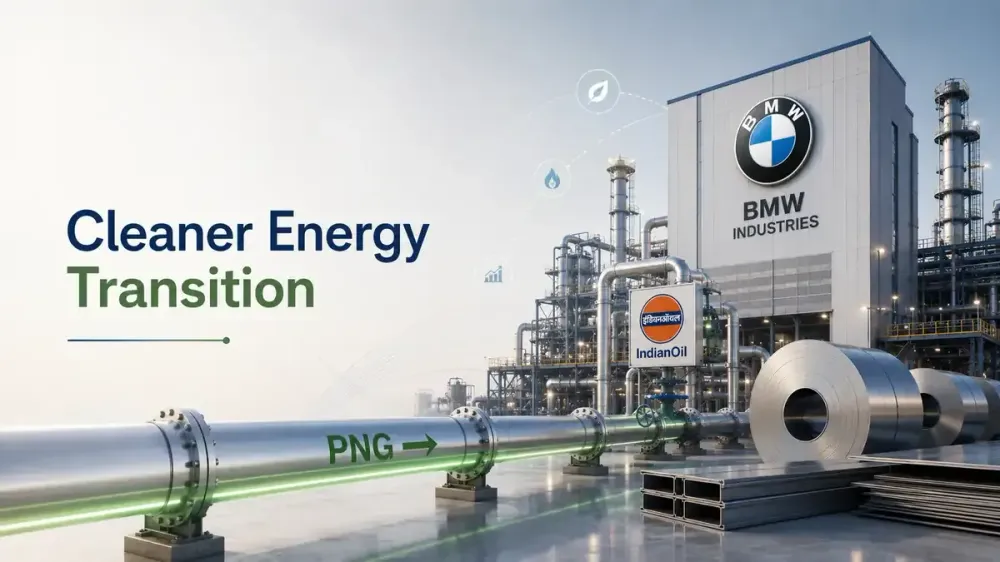
BMW Industries partnered with Indian Oil to supply PNG to its ₹803-crore Bokaro steel complex. The 1.04-million-tonne capacity project strengthens cleaner energy use and supports the company’s transition into higher-margin value-added steel manufacturing.
In the latest turn of events, indigenous steel manufacturer BMW Industries Ltd has partnered with the Indian Oil Corporation Ltd (IOC) to secure piped natural gas (PNG) supply for its upcoming downstream steel complex in Bokaro, Jharkhand. The Bokaro project forms a central part of BMW Industries’ transition from a steel service centre to a producer of value-added coated steel products. This brings investors to question: How does this agreement support BMW Industries’ expansion and operational strategy?
Company Overview
BMW Industries was established in 1981. It is headquartered in Kolkata and currently operates primarily as a steel service centre providing processing services for major steel producers. The Bokaro project marks a structural shift toward manufacturing its own value-added steel products.
Q3 Performance Highlight
Metric: | Q3FY26 | Growth (YoY) | Growth (QoQ) |
|---|---|---|---|
Operating Income: | ₹162.16 crores | 9.90% | 11.90% |
Operating EBITDA: | ₹38.55 crores | 6.80% | - |
EBITDA Margin: | 23.80% | - | - |
Profit After Tax: | ₹17.61 crores | - | 16.30% |
Why Did BMW Industries Partner With IOC For PNG Supply?
The PNG supply agreement strengthens the energy infrastructure of the Bokaro project ahead of commissioning. Natural gas provides consistent thermal output required for steel processing operations such as annealing, galvanising and coating. Plus, these gases produce lower carbon emissions and reduce particulate pollution during industrial combustion.
This shift has now become a noticeable trend within India’s manufacturing sector toward a more sustainable approach.
What Is The Scale Of BMW Industries’ Bokaro Steel Project?
The Bokaro facility is a ₹803-crore greenfield downstream steel project, representing the company’s largest capacity expansion.
The complex will include multiple processing lines with the following annual production capacities:
-
300,000 tonnes of cold rolled full hard (CRFH) coils and sheets
-
540,000 tonnes of galvanised coils and sheets
-
200,000 tonnes of colour-coated coils and sheets
Combined, the facility will have a total processing capacity of 1.04 million tonnes per year of value-added steel products.
The company raised a debt of ₹500 crore from a consortium of lenders led by State Bank of India, along with HDFC Bank and Yes Bank. The remaining capital expenditure will be funded through internal accruals.
Also Read - TCS Exploring Partnerships With Global Tech Firms For AI Data Centres In India
What Does This Mean For Investors?
-
Shift To Higher-Value Products: The plant will manufacture galvanised and colour-coated steel, which generally has higher margins. Thus, improving overall profitability of the company.
-
Long-Term Growth Positioning: If the Bokaro facility ramps up successfully from FY27 onwards, BMW Industries could transition from a steel service provider to a large downstream steel manufacturer. Thus, expanding its role in India’s steel value chain.
Sources:
Fortune India
CNBCTV18
This article is for informational purposes only and should not be considered investment advice from Kotak Neo. For compliance T&C and disclaimers, Visit https://www.kotakneo.com/disclaimer/
This article is for informational purposes only and should not be considered investment advice from Kotak Neo. For compliance T&C and disclaimers, Visit www.kotakneo.com/disclaimer
Right Tools, Rich Insights