Reliance Drops 3.30%; Market Cap Falls Below ₹18 Lakh Cr
 Add Preferred News Source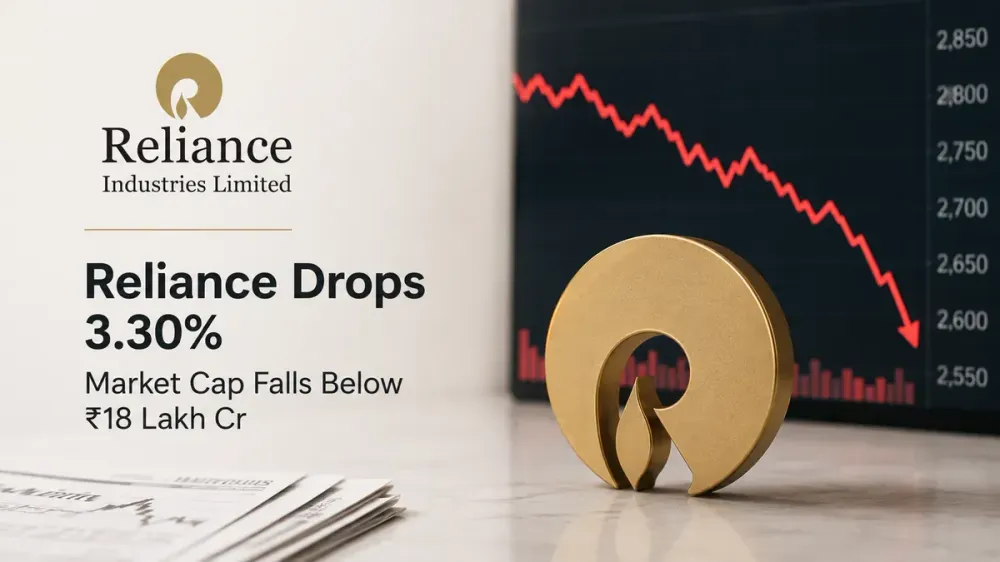
Reliance shares fell over 3% to ₹1,306 on 6 April 2026, wiping ₹80,000 crore in value as the market cap dropped below ₹18 lakh crore to ₹17.65 lakh crore.
On 6 April 2026, Reliance Industries' stock fell more than 3% throughout the session due to strong selling pressure. In only two days, Reliance Industries shares fell by over 6%, erasing more than ₹1 lakh crore from the company's total market cap.
The Reliance Industries shares dropped as much as 3.30% to ₹1,306 on the BSE. The fall erased over ₹80,000 crore in market value, pulling the company’s market capitalisation below ₹18 lakh crore to roughly ₹17.65 lakh crore.
The decline also had a broader impact. Reliance, which carries a weight of 8.87% in the Nifty 50, was the top drag on the index. The Nifty slipped nearly 0.7% during the session, even as some other stocks held steady.
The recent fall adds to a weak trend. The stock has declined more than 8% over the past two weeks.
Why Did Reliance Share Price Fall Sharply?
The US-Iran conflict has disrupted crude shipping routes, including the Strait of Hormuz, a major route through which a large share of global oil supply moves.
As a result, oil prices have moved up. The energy market has also turned more volatile in recent weeks. For a company like Reliance, which has a large oil-to-chemicals business, such disruptions can affect costs and margins.
There is also a domestic policy angle. The government has reintroduced export duties on diesel and aviation turbine fuel (ATF). These are set at ₹21.50 per litre for diesel and ₹29.50 per litre for ATF.
Even though the levy does not apply to Reliance’s SEZ refinery due to earlier rulings, the move has still affected sentiment around refining margins.
Brokerage estimates also point to pressure on the oil-to-chemicals segment. Higher input costs have added to the pressure. Freight and insurance expenses have moved up, and changes in fuel mix have also played a role.
There has been no company-specific announcement linked to the fall. This suggests the move is largely driven by external factors.
What Do Current Technical Indicators Indicate?
Shares of Reliance Industries are trading around their 200-week moving average and the annual pivot support near ₹1,260, making this area an important benchmark and support for traders.
If this level does not hold, the next downside levels could be around ₹1,250 and then closer to ₹1,200.
On the upside, the stock faces resistance at ₹1,360. A move above this band will be needed for any meaningful recovery.
Some momentum indicators are close to oversold territory. That can sometimes bring short-term buying, but the overall trend still looks weak.
Also Read - Gold and Silver Prices Drop on MCX in Early Deals; Recovery in Progress
How Does This Affect The Market?
In the indices, Reliance has a substantial weight. That was visible during the session, as Reliance was the main factor pulling the Nifty lower.
For now, markets will track a few key factors. Global crude trends, policy changes and the company’s upcoming quarterly results are likely to guide the next move.
Sources:
Mint
Business Today
This article is for informational purposes only and should not be considered investment advice from Kotak Neo. For compliance T&C and disclaimers, Visit www.kotakneo.com/disclaimer
Right Tools, Rich Insights