Government Amends Pricing Rules For Low-Grade Iron Ore To Boost Efficiency
 Add Preferred News Source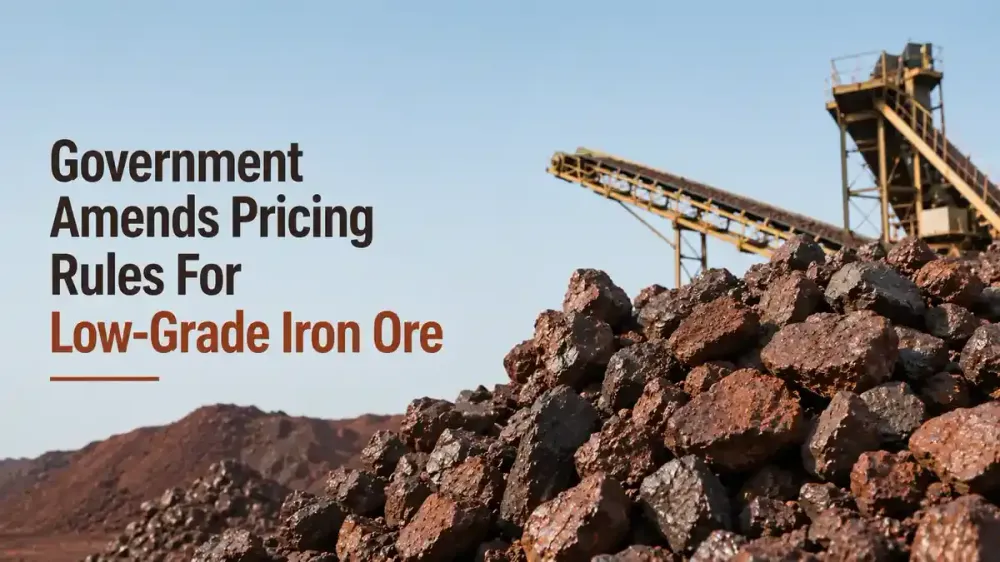
The government has revised pricing norms for low-grade iron ore to improve utilisation and reduce wastage. The shift is to facilitate the supply of steel and enhance the sustainability of long-term resources.
The government has revised the regulations to come up with a pricing system for low-grade iron ore in an effort to enhance the exploitation of such reserves.
The reform is meant to cut down on wastage, enhance the supply of the steel industry and facilitate long-term conservation of minerals.
The notification of the amendment was made under the Minerals (Other than Atomic and Hydrocarbons Energy Minerals) Concession Rules, 2026.
What Has Changed In The Pricing Framework?
The new rules establish a systematic way of calculating the prices of iron ore with lower iron content.
The amendment sets a clear way to price iron ore with less than 45% iron (Fe). It also covers Banded Haematite Quartzite (BHQ) and Banded Haematite Jasper (BHJ).
These are low-grade iron-bearing rocks from very old geological periods. Earlier, companies treated them as waste or not worth mining.
For ore with iron (Fe) content between 35% and below 45%, the average sale price (ASP) will be fixed at 75% of the ASP of higher-grade ore (45–51%).
For ore with Fe content below 35%, the ASP will be set at 50% of the same benchmark.
Why Was This Amendment Needed?
Earlier, low-grade iron ore did not have a separate pricing structure. Prices stayed linked to higher-grade ore. That meant royalties and levies also stayed high. Mining low-grade ore simply did not make sense.
Things have changed now. Better processing methods can upgrade these ores. They can now be used in steel production. Such operations are likely to become financially feasible under the new framework.
The shift will increase active utilisation of low-grade iron ore. This could help address the depletion of high-grade reserves and ensure a more stable supply of raw materials for the steel industry.
It also encourages better and more scientific mining and enhances the overall resource utilisation. The policy can make India self-reliant in iron ore in the long run.
Also Read - Stock Market Update 15 April 2026: Sensex, Nifty50 Soar Amid Renewed Hopes For Peace Talks
What Does This Mean For Investors?
The policy has the potential to boost the profitability of mining firms like NMDC to extract the low-quality ore.
The steel firms can also enjoy better access to raw material and less reliance on the higher-grade reserves.
Investors should track how quickly companies adopt beneficiation technologies and whether the move translates into higher production and margins.
Sources:
Business Standard
The Economic Times
This article is for informational purposes only and should not be considered investment advice from Kotak Neo. For compliance T&C and disclaimers, Visit www.kotakneo.com/disclaimer
Right Tools, Rich Insights