Debt Funds Explained: Meaning, Types, Benefits & How They Work
- Updated: 22 May 2026, 5:55 PM IST
- | 4 min read
- 1,645
 Add Preferred News Source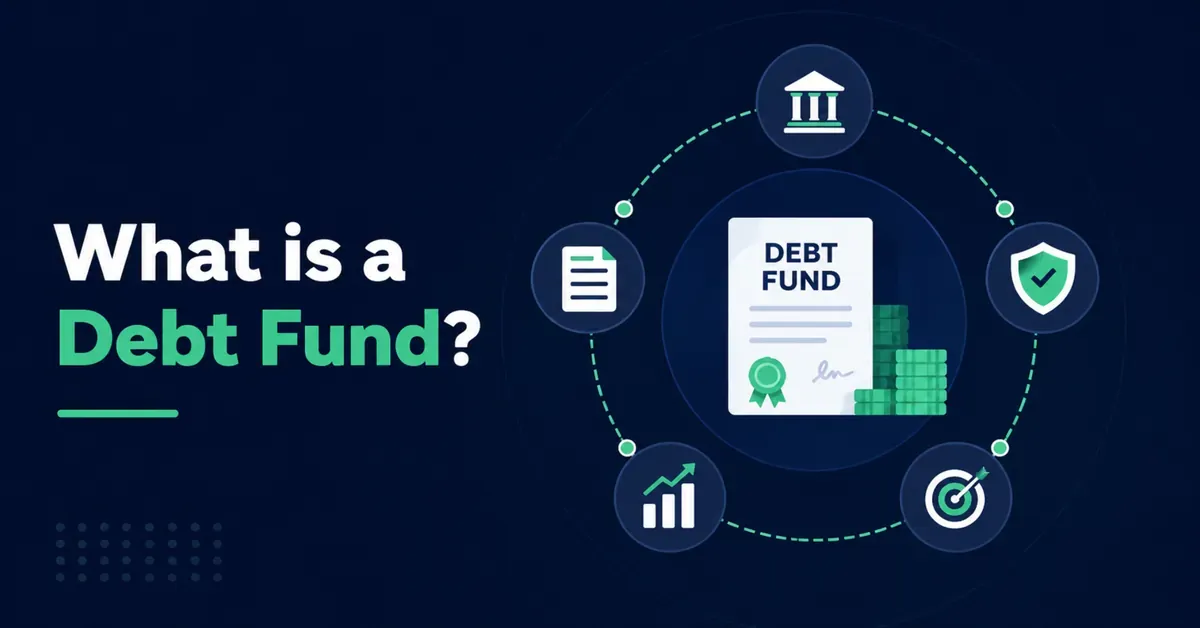
When it comes to investing, not everyone is looking for high-risk, high-reward opportunities. Many investors simply want stability, predictable returns, and a safer place to park their money. That’s where debt funds come in.
this article examines how debt funds work and where they fit within an overall investment plan.
What Are Debt Funds?
A debt fund is similar to a mutual fund, but instead of investing in the stock market, it lends money. This money is lent to governments, banks, or companies in exchange for bonds and treasury bills. In return, you will earn interest.
Whilst equity funds are oriented towards growth, debt funds are designed for stability.
These funds are typically for people who don’t want to worry about the stock market’s ups and downs but still want their money to earn a little more than it would in a savings account.
If you're trying to understand what a debt fund is with an example, think of it like this: when you invest, your money could be used to buy a government bond that pays interest over time.
How Debt Funds Work
When you invest in a debt fund, your money is pooled with others. A fund manager then spreads it across different fixed-income instruments.
These instruments pay interest over time. That’s one part of your return. The other part comes from changes in bond prices.
Now here’s the catch. Unlike a fixed deposit, however, nothing is locked in. That’s why returns are relatively stable, but not fixed.
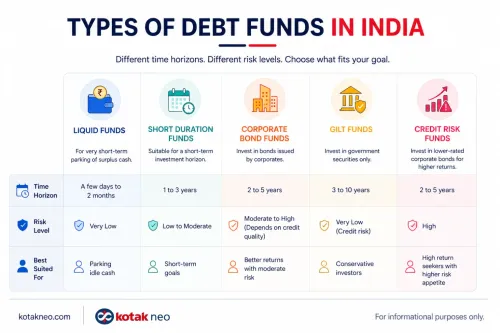
Types Of Debt Funds In India
Not all debt funds behave the same way. The differences mostly come down to time horizon and risk.
Liquid Funds
These are for very short-term parking. A few days, a few weeks, maybe a couple of months. People often use them instead of leaving idle cash in a bank account.
Short Duration Funds
These sit slightly higher on the risk-return scale. Typically suited for a 1 to 3-year horizon.
Corporate Bond Funds
These invest in company-issued bonds. If the companies are financially strong, the risk stays contained. If not, things can get tricky.
Gilt Funds
These invest only in government securities. Default risk is almost negligible, but returns can fluctuate because of interest rate movements.
Credit Risk Funds
These seek higher returns by investing in lower-rated companies.That extra return comes with a very real possibility of default.
Benefits Of Investing In Debt Funds
Debt funds don’t try to impress you with high returns. That’s not their role.
What debt funds offer instead:
-
Relatively stable performance
-
Easy access to your money when you need it
-
A way to generate income on a regular basis, depending on your chosen option
-
A means of balancing your portfolio if equity exposure is high
-
Flexibility across a range of investment time horizons
For many investors, they act as a parking space while they figure out their next move.
Risks Associated With Debt Funds
While it’s easy to assume these are completely safe, interest rate changes can impact returns more than people expect. When rates go up, bond prices usually fall.
Then there’s credit risk. If a company fails to repay what it owes, the fund takes a hit.
Liquidity can also become an issue in stressed markets, though this doesn’t happen often. So yes, the risk is lower than equity, but it’s still very much there.
Who Should Invest In Debt Funds?
Debt funds make sense when your priority is not aggressive growth.
They tend to work well for:
-
People who want to protect what they already have
-
Investors looking for steady, predictable returns
-
Short to medium-term goals where equity risk feels unnecessary
-
Anyone trying to reduce overall portfolio volatility
They’re also commonly used as a temporary holding space before moving into other investments.
Tips Before Investing In Debt Funds
-
If your time horizon is short, don’t stretch into long-duration funds just for slightly higher returns.
-
Look at what the fund actually holds. Higher returns often mean lower credit quality.
-
Costs matter too. A high expense ratio quietly eats into returns over time.
-
And always check exit loads if you think you might withdraw early.
Taxation Of Debt Funds In India
For investments made after 1 April 2023, debt funds lost their earlier tax advantage.
There’s no long-term vs short-term distinction anymore. Whatever gains you make are added to your income and taxed as per your slab. So if you’re in a higher tax bracket, your actual returns shrink faster than you might expect.
Older investments still follow the earlier rules, where holding beyond three years allowed indexation and a lower effective tax rate.
Also worth noting, there’s still no TDS deducted for resident investors.
Conclusion
Debt funds are not exciting, and that’s exactly the point. They are built for consistency, not surprises. For many investors, that makes them useful, especially when markets feel uncertain.
But with taxation no longer offering the same benefits, the decision now comes down to one thing-
Do the post-tax returns, given your time horizon and risk comfort, still make sense for you?
Sources
Investopedia
ClearTax
The content in this blog is intended purely for educational purposes. Any securities or mutual funds referenced are illustrative in nature and do not constitute a recommendation or endorsement by Kotak Neo. Investors are encouraged to assess their own financial situation and seek professional advice before making any investment decisions. For compliance T&C and disclaimers, Visit https://www.kotakneo.com/disclaimer/
0 people liked this article.

Kotak Neo (Kotak Neo) is India's venerable stockbroking company with a rich legacy. It offers comprehensive investment services across asset classes, prioritising a technology-first approach for a seamless experience. Trusted by 5 million+ customers, it guides you toward financial success with ease of investment and speed of trade.
Note: The opinions expressed in this blog are personal viewpoints and should not be construed as recommendations.