Government Securities (G-Secs)
G-Secs or government securities are long-term debt instruments issued by the central government. You invest money, and the government pays you fixed interest every 6 months. At maturity, you get your principal investment back.
Announcement
RBI announces a G-Sec with details like tenure, interest rate, and auction date.

Let's Learn How Do G-Secs Work with an Example.
Step 1. A G-Sec is Announced:
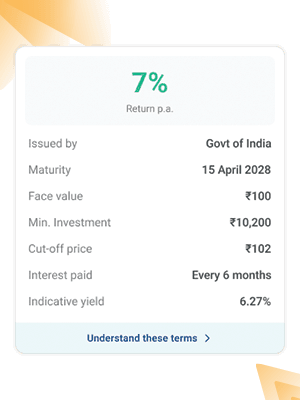
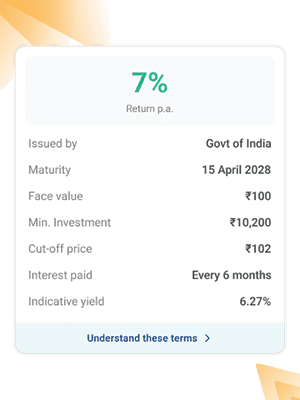
The RBI announces a government G-sec, 2028 (Tenure of 3 years) with interest rate of 7% and cut-off price of ₹102
Step 2. You Place an Order:
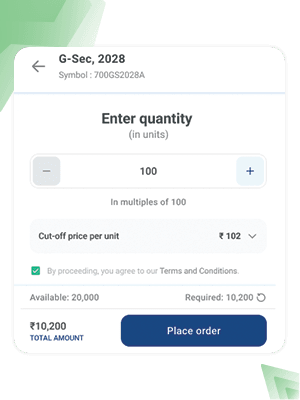
You choose to invest — e.g., 100 units at cut-off price
- ₹10,200 (₹102 x 100) is blocked.
- This is the maximum you’ll pay; the actual price could be lower.
Step 3. Auction & Allotment:
What Happens After You Bid?
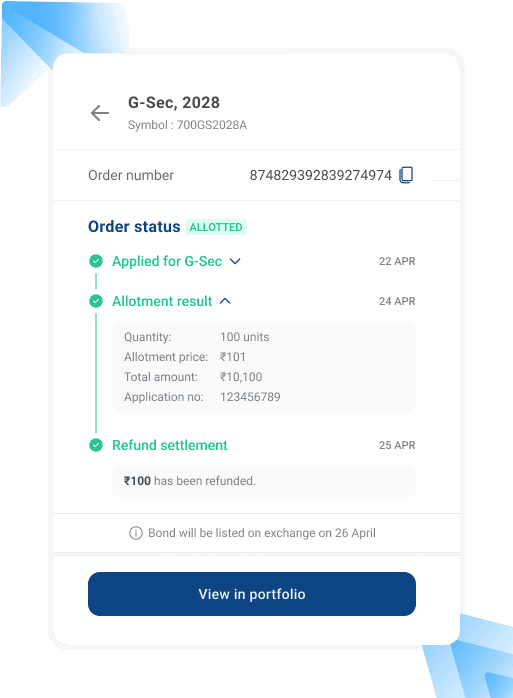
- Once bidding ends, a final price is decided (e.g., ₹101).
- You’re allotted 100 units at this final price.
- Since you had paid ₹10,200 in advance and only ₹10,100 is needed, ₹100 is refunded to your bank account.
- The allotted units are credited to your demat account automatically.
Step 4. What happens after allotment:
You Start Receiving Interest.
G-Secs pay fixed interest twice a year. You earn on the face value (usually ₹100), not on your purchase price.
- Coupon Rate: 7% annually → 3.5% semi-annually
- Face Value : ₹100
- Tenure: 3 years (6 interest payouts)
0 – 6 Months | 3.50% | ₹350 |
6 – 12 Months | 3.50% | ₹350 |
1 – 1.5 Years | 3.50% | ₹350 |
1.5 – 2 Years | 3.50% | ₹350 |
2 – 2.5 Years | 3.50% | ₹350 |
2.5 – 3 Years | 3.50% | ₹350 |
Total Interest earning ₹2,100
The interest is credited to your bank account automatically every 6 months.
Step 5: What Happens at Maturity? (End of Year 3):
a. Principal Repaid:
You receive ₹10,000 (₹100 × 100 units), as bonds are redeemed at face value, not at your purchase price of ₹101.
b. Final Interest Credit:
The last ₹350 interest (if not already paid) is deposited into your bank account.
c. Your Total Returns:
- Total Invested: ₹10,100
- Interest Earned: ₹2,100
- Principal Returned: ₹10,000
- Net Earnings: ₹2,000
You don’t need to hold G-Secs until maturity.
- Sell anytime on the exchange via your demat account
- Sale value will depend on market demand and prevailing interest rates
- You may receive more (premium) or less (discount) than what you paid
Tip: While early exit is allowed, G-Sec prices can fluctuate, and liquidity may vary—so plan your holding period accordingly
While browsing G-Sec offers, you’ll come across certain terms—like coupon rate, face value, or cut-off price. Don’t worry if they sound technical. Here’s a quick breakdown of the key terms to help you understand what you’re investing in, without the jargon.
Issued by | G-Secs are issued by RBI on behalf of the Government of India. |
Maturity Date | The date your investment is repaid at face value, along with final interest. |
Face Value | The base value of the bond – typically ₹100 per unit. |
Cut-off Price | The final price per unit decided in auction. You might pay less than your max. |
Min. Investment | Minimum of 100 units, total depends on cut-off price (e.g., ₹102 × 100). |
Interest Paid | Interest is paid every 6 months (bi-annually) directly to your bank. |
Return p.a. | Fixed annual interest on face value (e.g., 7% per ₹100). |
Indicative Yield | Expected return based on previous auctions; actual may differ. |
Frequently Asked Questions
You need to invest in at least 100 units. The final amount depends on the cut-off price (e.g., ₹102 × 100 = ₹10,200).
Yes, G-Secs held in your demat account can be pledged to get trading margins. Click here for more details.
Yes, G-Secs are tradable on exchanges. You can exit anytime, but the sale price depends on market demand and prevailing interest rates.
No TDS is deducted. However, the interest earned is taxable as per your income slab and must be declared in your tax return.
You can view and invest in live G-Sec auctions directly through the Kotak Neo app under the “Invest/ Government Bonds” section. Click here to view gsec listings
CDSL has introduced a new transaction type called "RDG Transfer" to make moving your Government Securities (G-Secs) easier and faster.
What it does:
- Allows you to transfer G-Secs directly between your Demat account and RBI Retail Direct Gilt (RDG) account
- Works for transfers between CDSL, NSDL, and RDG accounts
- Only for your own accounts (where you remain the owner)
Why it's better: Previously, such transfers required going through a lengthy Demat/Remat process. The new facility enables direct transfers, making the process simpler and quicker.
Effective from: November 14, 2025
You can initiate RDG transfers through two methods:
Step 1 - Choose your method:
- Option A: Log in to your BO Easiest account → Go to "Transactions" menu → Select "RDG Transfer"
- Option B: Your Depository Participant (DP) can initiate through CDAS → Setup Menu → Settlement Module → Select "RDG Transfer"
Step 2 - Provide these details:
- Source BO ID (your account)
- ISIN (security code)
- Quantity
- Target RDG Account number
- Transfer Type
- Execution Date
- Reason Code
- Remarks (if any)
Important timing rules:
- Transfers initiated after 4:30 PM on weekdays will be executed the next business day
- Transfers initiated after 1:00 PM on RBI working Saturdays will be executed the next business day
- You can schedule transfers only for the next working day (no long-term future dating)
Note: All transactions need DP approval before execution.
Yes, there are a few important restrictions to keep in mind:
Account holder restrictions:
- Transfers from Demat to RDG are NOT allowed if your demat account has more than two holders
- Single and joint accounts (up to 2 holders) are permitted
Payment-related restrictions:
- Your transfer request will be rejected if you have any unpaid coupon or redemption payments pending in CDSL records
- Clear all pending payments before initiating a transfer
Sovereign Gold Bonds (SGB) restrictions:
- For Security Type 37 (SGBs), transfers to demat accounts are allowed only for eligible account categories
- Check with your DP if your account is eligible for receiving SGBs
What qualifies as own account transfer:
- Same PAN
- No change in ownership
- Transfer between your own demat account and RDG account
Yes, you will receive proper documentation and can track your transfers:
Transaction records:
-
All RDG transfer transaction details will be available in the DP97 report
-
Two types of transactions will be recorded:
     o	**DTR** (Demat to RDG) </br>
     o	**RTD** (RDG to Demat) </br>
Transfer value calculation:
-
The system automatically calculates transfer value based on:
     o	ISIN face value </br>
     o	Quantity of securities </br>
For queries or support:
- Contact CDSL Helpdesk
- Email: dprtasupport@cdslindia.com
- Phone: 022-6234-3333
Important: Your DP must approve all transactions initiated through BO Easiest login or CDAS before they are executed.