What Is Share Class & Its Types?
- Updated: 06 May 2026, 11:37 AM IST
- | 5 min read
- 4,454
 Add Preferred News Source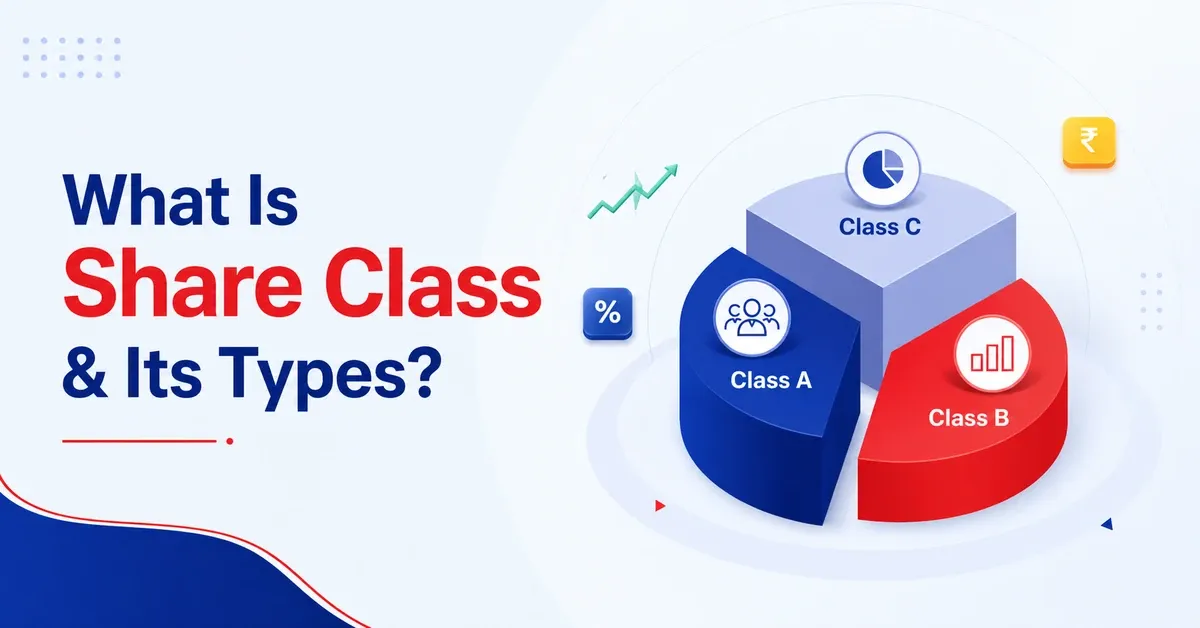
Understanding Share Class Meaning
When an investor purchases shares from a corporation, they have many rights. Share classes are in three varieties: Class A, Class B, and Class C. Multiple fees, such as front-end load, back-end load, deferred charges, 12b-1 fee, etc., are associated with each share class. Every share class has a separate cost schedule. Companies group shares for a variety of reasons. Below is a list of a handful of them.
- To assign the investor a certain degree of ownership based on the share class.
- To maintain control over the business and the board's decision-making authority.
- To determine the revenue and distribute dividends according to the share class.
- To assign and restrict voting rights according to the share classes of investors.
- To shield the business from hostile takeover offers.
Types of Shares
There are three ways for businesses to get capital. They can either borrow money from friends and family or apply for a bank loan. They choose public borrowing, the third option, when it comes to situations involving millions. That kind of money can only come from outside sources. They split the shares into three classes Class A, B, and C in order to issue them. Let's quickly examine each share class.
Class A | Common stock issued during an IPO, significant voting rights, eligible for accredited investors, entitled to vote within the company, may receive a portion of company revenues. | Highest voting rights | Front-end load may apply |
Class B | Has fewer voting rights than Class A, fewer benefits, a lower front-end load, and the potential for no back-end load if held for an extended period. | Limited voting rights | Lower front-end load, potentially no back-end load |
Class C | Suitable for short-term investments, front-end load, level load during asset management, 1% back-end load when cashed out, and no voting rights. | No voting rights | Front-end load, level load, 1% back-end load |
Benefits of Different Share Classes
The benefits of classifying share classes include the following:
- The firm gives the shareholders control, regardless of how the shares are divided. The degree to which you own and have influence over the firm is determined by these share classes. In general, this section aids in the management of rights and privileges for both the corporation and the investor.
- It assists investors in selecting an appropriate share class that fulfils their investing requirements. Class C is for short-term investors, whereas Classes A and B are for long-term investors.
- Upon the company's liquidation, the investors receive their proportionate share of the assets. The ratio at which the assets are distributed to the shareholders is determined by the corporation, in part by the form of shares. Every class also has its own rules and regulations.
- It aids in portfolio diversification for investors as well as cash generation for businesses. Thus, it's a tactic that benefits all sides equally.
- It establishes structure and hierarchy inside the business.
- By receiving dividend payments on their assets, it assists investors in creating revenue.
Examples Of Share Classes
Let’s take a simple example to understand this better. Suppose an investor puts ₹1,00,000 in three share classes of the same company.
In Class A, there is a 1% entry charge. So, ₹99,000 gets invested. Additionally, the investor gets full voting rights within the company. They are also entitled to receive a part of the company’s revenues in the form of dividends.
In Class B, there is a lower front-end load, say 0.5%. However, the investor gets limited voting rights.
In Class C, there is no entry fee, but a 1% back-end load at the time of redemption. In this case, the investor gets no voting rights.
Why Do Companies Need Multiple Share Classes?
To maintain control over strategic decision-making
When companies raise money, they do not always want to give up control. Founders may keep shares that carry more voting power. Even with a smaller stake, they can still make major decisions for the business.
To pay dividends to specific shareholder classes
Some investors want regular income. Others are fine waiting for growth. Companies keep this in mind. They may offer certain shares that pay higher dividends. Investors can then choose what suits them better.
To limit the right to vote
Not every investor needs voting power. Companies sometimes issue shares without voting rights. People can still invest and earn returns. But they do not get involved in company decisions. This keeps things simple for management.
To prevent adversarial acquisitions
Companies also try to protect themselves from takeovers. If all shares had equal rights, it would be easier for someone to gain control. With different share classes, promoters can hold stronger voting shares. This makes sudden takeovers harder.
To draw in investments
Different investors look for different things. Some want safety. Some want higher returns. By offering different share types, companies can attract more investors. It also makes it easier for them to raise money.
How To Choose The Right Share Class?
Choosing the right share class depends on a few basic factors. Looking at these points can help you avoid confusion later.
Investment objective
Start with your goal. Some investors look for regular income, while others want long-term growth. The share class you pick should match what you expect from the investment.
Investment horizon
Think about how long you plan to stay invested. For longer periods, lower ongoing costs matter more. For shorter durations, exit charges or lock-in terms should be checked.
Investment amount
Some share classes require a higher minimum investment. Others are more flexible. It is better to choose one that fits your budget without putting pressure on your finances.
Voting rights
Not all shares come with the same level of control. Some offer full voting rights, while others offer very little or none. This may not matter to everyone, but it is still worth noting.
Risk tolerance
Every investor has a different comfort level with risk. Some share classes may focus more on steady returns, while others may aim for higher growth with more risk.
Liquidity needs
If you may need money quickly, check how easy it is to sell the shares. Some classes may have restrictions or exit charges that affect liquidity.
Tax considerations
Taxes can affect your final returns. Dividend payouts and capital gains may be taxed differently. It helps to understand how each share class is treated.
Fund accessibility
Not all share classes are available to every investor. Some may be limited to institutions or high-value investors. Make sure the option you choose is accessible to you.
Conclusion
Overall, any investor wishing to navigate the world of mutual funds and corporate ownership has to have a solid grasp of share classes. Because each class has unique rights, benefits, and costs connected with it, investors must carefully weigh their alternatives. Understanding the differences between Class A, which has substantial voting rights, Class B, which has fewer voting rights but may offer advantages, and Class C, which is designed for short-term investments, enables investors to make well-informed decisions that support their financial objectives. In the end, share classes help companies and shareholders by keeping a company's internal structure balanced and orderly.
FAQs On Share Class
In a nutshell, they are share classes that are created by the corporation and discriminate based on rights and privileges, either grade-wise or rank-wise. Every class group experiences its own unique variances and fluctuations. You should use caution as an investor before purchasing the share class.
Class A and Class B shares, for example, are suitable for long-term investors. Additionally, individuals who are just starting in the stock market and have a small amount to invest can choose Class C shares. These shares are suitable for immediate needs. Prior to selecting the share class, you must review the load and other costs. The impact of these fees on your investment and profits will be felt.
Share classes play a crucial role in determining the rights and privileges of investors. Depending on the class of shares they hold, investors may have varying levels of control, benefits, and associated costs.
Each share class may have its own fee structure, which can include front-end loads (initial fees), back-end loads (exit fees), and other charges. Investors need to understand these fees before making investment decisions.
The content in this blog is intended purely for educational purposes. Any securities or mutual funds referenced are illustrative in nature and do not constitute a recommendation or endorsement by Kotak Neo. Investors are encouraged to assess their own financial situation and seek professional advice before making any investment decisions. For compliance T&C and disclaimers, Visit https://www.kotakneo.com/disclaimer
0 people liked this article.

Kotak Neo (Kotak Neo) is India's venerable stockbroking company with a rich legacy. It offers comprehensive investment services across asset classes, prioritising a technology-first approach for a seamless experience. Trusted by 5 million+ customers, it guides you toward financial success with ease of investment and speed of trade.
Note: The opinions expressed in this blog are personal viewpoints and should not be construed as recommendations.