What Is Bond Yield: Meaning, Types & Market Impact
- Updated: 22 May 2026, 5:17 PM IST
- | 4m
- 1,004
 Add Preferred News Source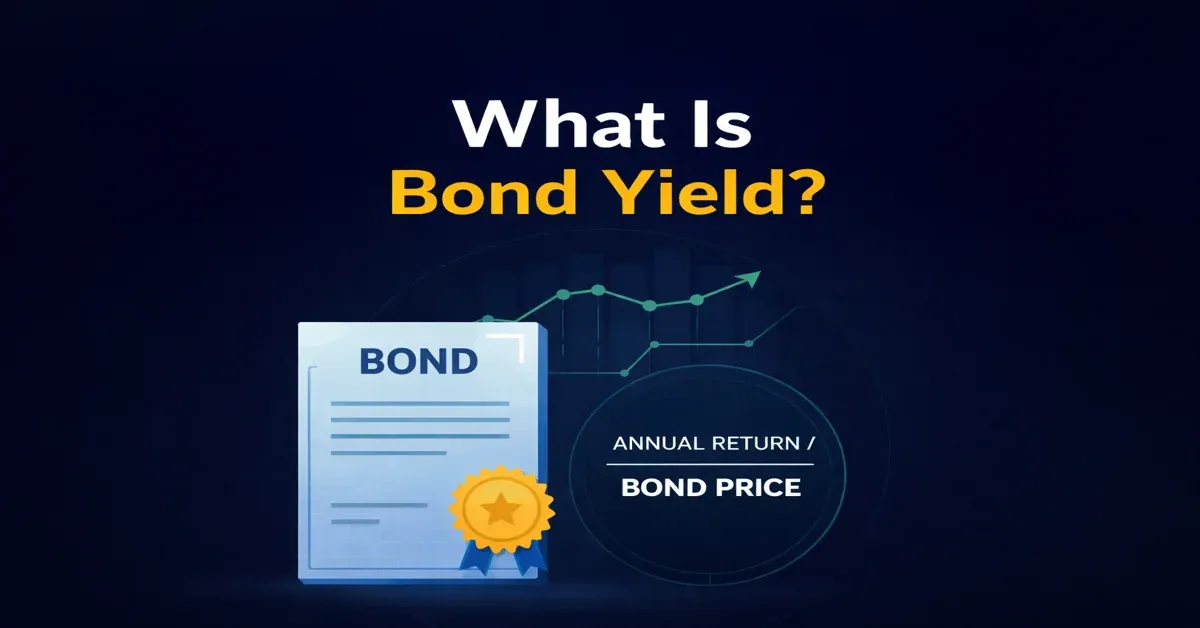
Not everyone is comfortable putting money into financial markets. There is uncertainty, prices keep moving, and keeping track of everything can get overwhelming after a point.
That is where bonds usually come in. They are often seen as a more stable option, especially if you are looking for a predictable income without taking on too much risk.
However, not all bonds work the same way. Hence, before putting money in, one thing most investors look at closely is the bond yield.
It gives a clear sense of what the investment actually offers. Therefore, understanding bond yield becomes important.
What Is Bond Yield?
In financial terms, yield simply means returns or income. The same idea applies to bonds. Bond yield is the return you earn based on what you paid to buy it.
Before getting into bond yield, let us start with bonds. Think of them as loans you give to governments or companies. In return, they pay you fixed interest over time.
There are three things to keep in mind here. The bond price, which is what you pay. Second, the fixed interest it pays. And third, the yield, which shows your actual return based on your purchase price.
Since bond yield depends on the price at which you buy the bond, it can vary across investors, as each one buys it at a different price level.
If a bond trades at its face value throughout its term, the yield may be the same for every investor. But that is not how markets behave. Bond prices move, and so does the yield.
So, what are bond yields really telling you? It shows what the bond is actually earning for you and whether the investment is worth it.
Types Of Bond Yield
Bond yield can be looked at in different ways, depending on what you want to measure. Some focus only on income, while others take into account the full holding period.
Current Yield In Bonds
Current yield is the simplest starting point. It compares the annual interest a bond pays with its current market price.
So, if you are looking at a bond today and want to know what kind of income it generates on that price, current yield gives you that answer.
But it has its limits. It does not consider what happens at maturity. Any long-term gain or loss is excluded.
Yield To Maturity (YTM)
Yield to maturity takes a more complete view. It includes multiple factors, such as interest payments, the price you pay, the time left, and the value you receive at maturity.
In simple terms, it tells you the total return if you hold the bond until the end.
While YTM gives a realistic estimate, it also assumes you stay invested till maturity and reinvest interest at the same rate, which may not always happen.
Yield to Call (YTC)
Yield to call is a concept that is specific to callable bonds. These bonds allow the issuer to redeem bonds before maturity.
Instead of assuming the bond continues till maturity, it calculates the return based on the earliest possible call date.
This usually happens if market rates come down. Issuers may refinance at lower rates and repay old bonds before maturity. In such cases, the return you get could be different from what YTM indicates.
Coupon Yield (Nominal Yield)
Coupon yield, also called nominal yield, is the most basic measure.
It is simply the interest rate stated on the bond at the time of issuance. This is fixed and does not change.
While it is easy to understand, it does not reflect market realities. It ignores price movements and therefore does not show the actual return an investor earns
Bond Yield Rate (General Yield Concept)
The general concept of bond yield rate refers to the effective annual rate of return an investor earns.
If you have ever come across the question “what is yield rate in bond?”, this is what it refers to. It is the return you actually make, adjusted for the price you pay. This bond yield rate does not stay fixed. It moves with market conditions.
When market interest rates rise, existing bond prices tend to fall since they offer lower interest. As a result, their yields move higher. The opposite happens when rates fall.
At the core of this is the relationship between bond price and yield. The two move in opposite directions. If the price of a bond goes up, the yield comes down. If the price falls, the yield rises.
The reason is fairly straightforward. The interest a bond pays is fixed on its face value and does not change. So, if the market price of the bond goes up, you are paying more for the same income, which brings your return down. If the price falls, you pay less for that same income, and your return improves.
Bond Yield Vs Interest Rate
People often treat these as the same, but they are not.
The interest rate is fixed at the time of issuance and does not change. That is what the bond pays you.
Yield is different. It depends on the price you buy the bond at. Since the market price of the bond keeps changing, the bond yield changes too.
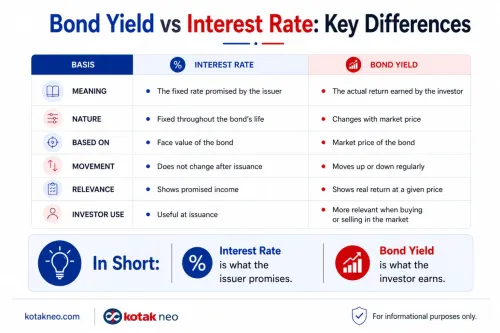
Bond Yield vs Interest Rate: Key Differences
Basis | Interest Rate | Bond Yield |
|---|---|---|
Meaning | The fixed rate promised by the issuer | The actual return earned by the investor |
Nature | Fixed throughout the bond’s life | Changes with market price |
Based on | Face value of the bond | Market price of the bond |
Movement | Does not change after issuance | Moves up or down regularly |
Relevance | Shows promised income | Shows real return at a given price |
Investor Use | Useful at issuance | More relevant when buying or selling in the market |
What Happens When Bond Yields Rise?
When bond yields rise, it usually means bond prices are falling since the two are inversely proportional.
If you are wondering what happens when bond yields increase, this is the starting point. Prices move in the opposite direction. This often happens when interest rates in the economy are expected to go up or when inflation is picking up.
Existing investors may see a drop in value if they sell before maturity. New investors, on the other hand, may benefit from higher yields.
The impact may extend beyond bonds, with equities also facing pressure as investors shift toward fixed-income instruments.
Example Of Bond Yield Calculation
Say a bond has a face value of ₹1,000 and pays ₹80 every year. That works out to an interest rate of 8%.
Now, if you buy this bond at ₹1,000, your return stays at 8%. Nothing really changes here.
But markets rarely stay that steady.
If the price drops to ₹900, you are still earning ₹80. Only now, you paid less for it. So, your yield moves up to about 8.9% (80/900 × 100).
If the price goes the other way and rises to ₹1,100, your return slips to around 7.3% (80/1,100 × 100).
So, the income stays the same throughout. It is the price that changes, and that is what moves the yield.
Importance Of Bond Yield For Investors
Bond yield is not just a number you glance at and move on. It tells you what you are actually earning, and whether the bond makes sense for you in the first place.
Here is where it helps:
-
Two bonds can offer the same interest on paper. But the yield may tell a different story. That is what helps you spot which one is actually giving you better value.
-
It can also raise a flag at times. A higher yield may look attractive, but sometimes it comes with added uncertainty. So, it is worth digging a little deeper.
-
Timing plays a role, too. When yields move, it can give a sense of whether the bond looks reasonably priced at that moment or not.
-
If you are investing for regular income, yield becomes useful. It gives you a rough idea of what you can expect over time, not just what is promised.
-
And then there is the bigger picture. When yields change, it can influence how investors shift between bonds, equities, and other assets.
Sources:
The Economic Times
Moneycontrol
FAQs On Bond Yields
This is actually the other way around. Yields increase when bond prices fall.
When market interest rates go up, bond prices tend to fall. Existing bonds start looking less attractive since newer ones offer better returns. Demand drops, prices adjust, and yields rise because the same interest is earned on a lower price.
When the Reserve Bank of India changes policy rates, it influences borrowing costs across the economy. If rates go up, existing bond prices fall, and bond yields usually rise. If rates fall, yields tend to come down.
Long-term bonds carry more uncertainty. Interest rates, inflation, and economic conditions can change over time. Investors take on that risk for longer periods, so they expect better returns. That is why yields are usually higher.
The content in this blog is intended purely for educational purposes. Any securities or mutual funds referenced are illustrative in nature and do not constitute a recommendation or endorsement by Kotak Neo. Investors are encouraged to assess their own financial situation and seek professional advice before making any investment decisions. For compliance T&C and disclaimers, Visit https://www.kotakneo.com/disclaimer/
0 people liked this article.

Kotak Neo (Kotak Neo) is India's venerable stockbroking company with a rich legacy. It offers comprehensive investment services across asset classes, prioritising a technology-first approach for a seamless experience. Trusted by 5 million+ customers, it guides you toward financial success with ease of investment and speed of trade.
Note: The opinions expressed in this blog are personal viewpoints and should not be construed as recommendations.