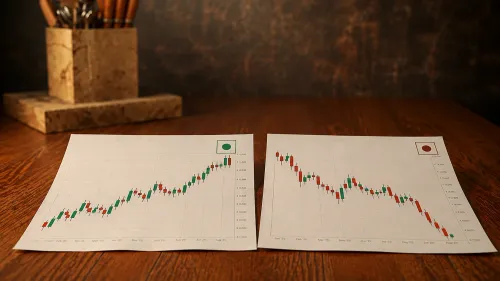
What Is Volume Spread Analysis? Distinguishing It From Fundamental And Technical Analysis
- Updated: 22 May 2026, 5:12 PM IST
- | 4 min read
- 1,844
 Add Preferred News Source
Hey there! Ever found yourself scratching your head over all the buzzwords thrown thick and fast in the stock market world? Technical analysis, fundamental analysis, volume spread analysis, they all sound pretty intimidating, right?
For beginners, definitely. For those who have spent some time in the markets, perhaps not as much. While a lot has been talked and said about technical analysis and fundamental analysis, this blog will shed light on the third part of the puzzle, volume spread analysis or VSA.
Decoding Volume Spread Analysis
Imagine finding yourself in a bustling vegetable market. Sellers are shouting prices, buyers are bargaining, and there is a flurry of activity all around. Now, imagine you are trying to figure out if tomatoes are going to get pricier tomorrow. What would you do?
You would probably observe how many people are buying tomatoes (volume), how much they are paying (price), and how quickly the tomatoes are selling out (spread).
That is pretty much what VSA does. It looks at the relationship between price movements (spread) and trading volume to determine what might happen next in the stock market.
Key Concepts In Volume Spread Analysis
Before VSA starts making sense on a chart, understanding the three things it keeps coming back to is essential.
-
Volume: Volume shows how much trading happened during a specific price move. When activity increases noticeably, traders often read the move with more attention because more market participants are involved. A price rise on a busy trading day may not be viewed the same way as a similar rise when volumes stay thin.
-
Spread: Spread refers to the gap between a candle’s high and low during that session. A wider spread often tells you that the price covered more ground, while a narrow one can suggest hesitation. On its own, this says little, so traders usually read it along with volume.
-
Closing Price: The closing price tells you where the stock finished after moving through the session. If it ends near the upper side of the candle, traders often read that as buyers staying active till late in the day. A weaker close, especially after an early rise, can suggest that selling appeared before the session ended.
How Does Volume Spread Analysis Work?
VSA looks at price and volume together because one without the other can miss part of the picture. A move in price may look strong, but traders often check whether enough activity came with it before trusting that move. If price stretches higher while volume stays muted, the move may be seen differently than one supported by broad participation. The candle spread also matters, because a wide move with active trading often carries a different meaning from a narrow move on similar volume.
VSA is often explained through three basic laws:
The first is the law of supply and demand, where price generally moves higher when buying outweighs selling, and weakens when supply becomes dominant.
The second is cause and effect. In simple terms, when buying or selling slowly builds over time (accumulation or distribution), it can sometimes set up a larger move later.
The third is the law of effort and result. If trading activity increases sharply but price barely responds, traders often look more closely because the effort and the result are not lining up.
VSA Trading Strategies
This is where VSA becomes more practical. Once you begin comparing price spread with volume regularly, certain patterns start appearing again and again. Traders watch these because they often reveal whether buying or selling pressure is strengthening, fading, or quietly shifting hands.
No Demand Bars
A no-demand bar often appears when prices rise higher, but trading activity does not rise with it. The move may still look positive, though weaker participation can make traders cautious. If a stock closes slightly above the previous session while volume drops, some may hesitate before treating that rise as strength.
No Supply Bars
A no-supply bar usually shows up when price slips, but trading remains light. That often suggests selling pressure is present but not particularly aggressive. If a stock moves lower during the day without much increase in volume, some traders read that as limited pressure on the selling side.
Buying Climax
A buying climax is seen when price pushes up sharply and volume expands at the same time. It often looks strong on the chart, though traders also consider whether too many buyers have entered together. A sharp rise after strong news, especially with unusually high activity, often gets watched carefully in the next session.
Selling Climax
A selling climax usually appears after a sharp fall accompanied by heavy activity. This often reflects panic or hurried exits. If a stock drops hard early in the session but later recovers part of that decline, some traders begin watching whether the selling is losing force.
Upthrusts And Springs
An upthrust happens when the price briefly crosses a resistance zone but does not stay there for long. A spring works in the opposite direction, where the price slips below support and then comes back. Both are watched because they can reveal whether that breakout or breakdown was accepted by the market.
Tests For Supply And Demand
At times, the market makes only a small move while volume stays light, almost as if checking whether buyers or sellers are still interested. If price dips near support without much activity and then begins to recover, some traders read that as limited selling pressure at that level.
Advantages Of Volume Spread Analysis
-
It helps traders judge whether a move is attracting broad participation or happening with limited support.
-
Price moves often make more sense when volume is read alongside them.
-
It can add another layer to chart reading when breakouts or reversals look uncertain.
-
Some traders use it to notice subtle changes before they become clearer on price charts.
-
It also helps when price and volume begin telling slightly different stories.
-
In some cases, it gives better context around how a move behaves near known levels.
Limitations Of Volume Spread Analysis
-
A similar volume pattern may lead to different outcomes in different market environments.
-
Signals often need support from price behaviour before traders rely on them.
-
Reading volume properly usually becomes easier only with repeated observation.
-
Unexpected news can quickly disturb otherwise normal volume behaviour.
-
Fast-moving sessions may make interpretation less straightforward.
-
Two traders may not always read the same setup in the same way.
How Is VSA Different From Fundamental Analysis And Technical Analysis?
Okay, let us pause for a second. You must be wondering, “Wait, how is this different from technical analysis or fundamental analysis?” Good question! Let us rewind and recall lessons on fundamental and technical analyses to understand the difference.
Fundamental Analysis
Imagine you are figuring out which company to invest in. You would want to know if it is actually worth your money, right? So, you dig into its financials revenue, profits, debts and maybe even look at its industry and competition. That is fundamental analysis.
It is all about understanding a company’s value and long-term potential. Think of it as checking a car’s engine before buying it. You are looking under the hood to see if everything is running smoothly.
Technical Analysis
Imagine being a part of a crowd watching a car race. You are not interested in the engine’s horsepower. You are instead focused on how the car is moving. Is it speeding up? Slowing down? That is technical analysis.
It involves analysing price charts, trends, and patterns to predict short-term movements. It is all about reading the market roadmap.
Volume Spread Analysis
Enter VSA, which takes your analysis a notch higher by asking:
-
Who is driving this car?
-
Are big investors (aka the “smart money”) quietly making moves?
It combines volume and price data to figure out whether the current trend is strong or just an illusion.
Think of it like this: If fundamental analysis is about knowing what to buy and technical analysis is about when to buy, VSA is about understanding why the market is behaving the way it is.
It is the secret sauce that adds depth to your trading strategy.
Conclusion
Volume spread analysis might sound complicated at first glance, but over time, the logic behind it becomes easier to recognise on charts.
At its core, it is about watching how price behaves when trading activity changes and asking whether both are telling the same story. That is why many traders use VSA as an added layer rather than a standalone method.
It helps them slow down, read market behaviour more carefully, and avoid reacting only to price movement. In many ways, it is like playing detective in the stock market, where small clues often matter more than loud signals.
Frequently Asked Questions
There isn’t a single “best” timeframe for Volume Spread Analysis (VSA). Traders typically use higher timeframes (daily/weekly) to identify the overall trend and lower timeframes (5–15 minutes) for entries. Day traders prefer 5–15 minute charts, while swing traders often use daily or 4-hour charts.
Many traders consider it fairly reliable once you understand how it works. The method studies the relationship between volume, the price range, and where the price closes to spot possible “smart money” activity. Still, it isn’t a strict rule-based system. Because interpretation plays a big role, most traders prefer to use VSA together with other indicators for confirmation.
Volume Spread Analysis (VSA) can be applied to almost any financial market—stocks, futures, or forex. The only real requirement is good, reliable data. Since VSA focuses on supply and demand created by institutional traders, often called “smart money,” the method tends to work across different asset classes and timeframes.
The Law of Effort vs. Result in Volume Spread Analysis (VSA), links volume with price movement. Volume shows the effort. Price shows the result. When the market is healthy, the two should agree. Heavy volume should push price meaningfully, while light volume usually produces a narrow spread. When they don’t line up, the mismatch can signal exhaustion, a possible reversal, or a weak breakout that isn’t backed by real participation.
The content in this blog is intended purely for educational purposes. Any securities or mutual funds referenced are illustrative in nature and do not constitute a recommendation or endorsement by Kotak Neo. Investors are encouraged to assess their own financial situation and seek professional advice before making any investment decisions. For compliance T&C and disclaimers, Visit https://www.kotakneo.com/disclaimer/
0 people liked this article.

Kotak Neo (Kotak Neo) is India's venerable stockbroking company with a rich legacy. It offers comprehensive investment services across asset classes, prioritising a technology-first approach for a seamless experience. Trusted by 5 million+ customers, it guides you toward financial success with ease of investment and speed of trade.
Note: The opinions expressed in this blog are personal viewpoints and should not be construed as recommendations.