Current Ratio: Meaning, Formula, Interpretation & Example
- Updated: 22 May 2026, 5:17 PM IST
- | 4m
- 1,002
 Add Preferred News Source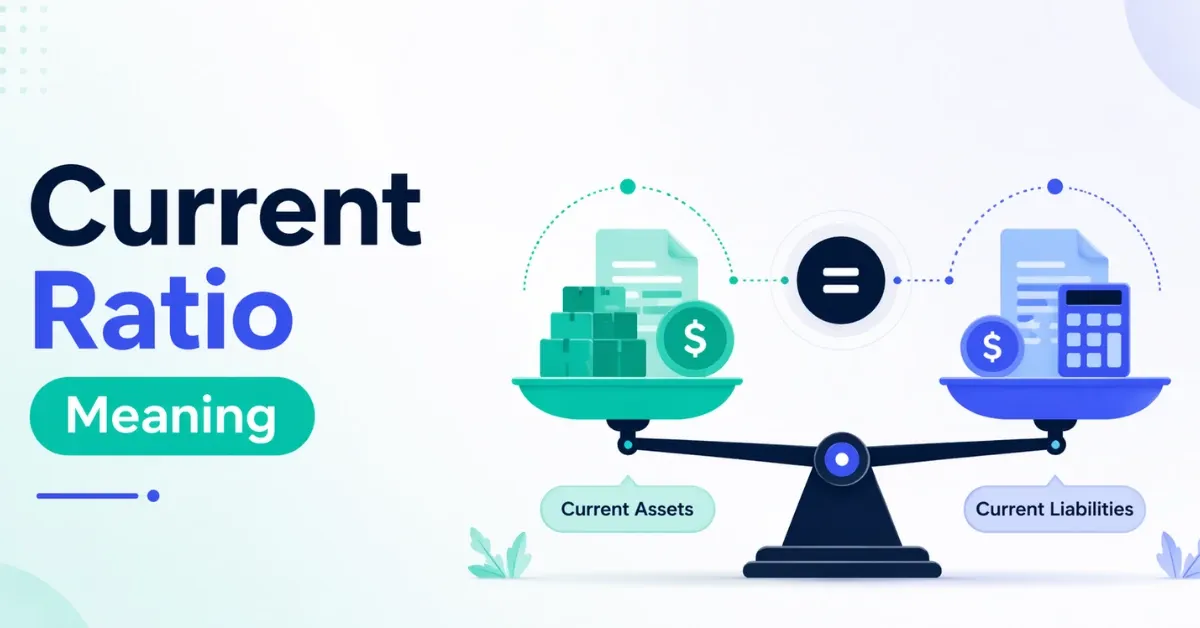
Revenue and income are the buzzwords that investors, analysts, and reporters focus on when determining the health of a company at a glance. But another equally important metric is just how easily the company can pay off its dues. The current ratio meaning helps answer that. It compares what the business owns and what it owes in the near term. To use it well, you need to understand not just the formula, but what the current ratio indicates in different situations.
What Is Current Ratio?
If you had to define the current ratio in plain words, it is a measure of whether a company has enough short-term assets to cover its short-term liabilities.
Current assets include cash, receivables, and inventory. Current liabilities include payables, short-term borrowings, and other dues payable within a year. When you compare the two, you get a sense of the company’s immediate financial cushion.
The current ratio and its significance come from this basic comparison. It helps investors, lenders, and even business owners understand whether the company is running on stable ground or stretching its finances too thin. However, this ratio is only a starting point. It tells you “how much,” but not always “how usable.”
Current Ratio Formula
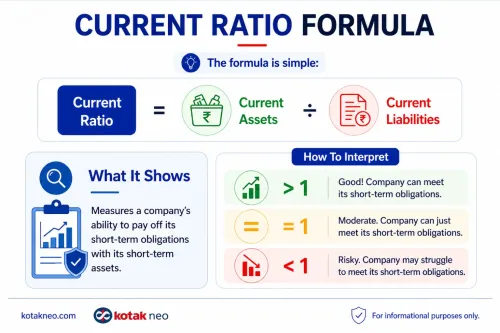
The formula is simple:
Current Ratio = Current Assets ÷ Current Liabilities
Current assets may include items that are not instantly liquid. Inventory, for example, may take time to sell. Receivables depend on customers paying on time. So even if the current ratio value looks strong, the real liquidity may be tighter than expected.
This is why the formula should be treated as a tool, not a conclusion.
Interpretation Of Current Ratio
The current ratio interpretation depends on context rather than a fixed benchmark.
- Numerical Value
A ratio of 1 means assets and liabilities are equal. This suggests the company can meet its obligations, but with little room for delay or shock. A ratio between 1.5 and 2 is often seen as comfortable. Below 1 can signal potential liquidity stress.
- Industry Context
But what the current ratio indicates changes across industries. A retail business with fast inventory turnover may operate safely with a lower ratio. A manufacturing company may need a higher one because cash is tied up in inventory.
- Efficiency
There is also the question of efficiency. A very high ratio may look safe, but it can hint at underutilised assets. Excess cash sitting idle or stockpiling up does not always create value.
- Trend
Another layer is trend. A rising ratio over time might look positive, but you need to check why it is rising. Is the company building cash, or is inventory increasing because sales are slowing?
So, while the number gives a direction, the meaning comes from digging deeper into the components and the business model.
Current Ratio Vs Quick Ratio
When people compare the current ratio vs quick ratio, they are really trying to understand one thing: how real the liquidity is.
The current ratio takes everything into account, including inventory. The quick ratio takes a stricter view. It removes inventory and also excludes prepaid expenses, as neither can be quickly converted into cash. The focus shifts to assets that are readily available, such as cash, short-term investments, and receivables.
This difference matters more than it seems. A company can show a comfortable current ratio simply because it is holding a large amount of stock. But if that stock takes time to sell, the business may not have enough ready cash when payments are due.
The quick ratio cuts through this. By ignoring inventory, it focuses on what is immediately usable. That often gives a more grounded picture of short-term financial strength.
In real analysis, relying on just one of these can be misleading. Looking at both together helps you see the gap between overall assets and truly liquid resources.
Example Of Current Ratio
Consider a company with current assets of ₹12 lakh and current liabilities of ₹6 lakh.
Using the formula:
Current Ratio = 12 ÷ 6 = 2
At first glance, this looks healthy. The company has twice the assets needed to meet its short-term obligations.
But let us break it down further. Suppose ₹7 lakh of the assets is inventory, ₹3 lakh is receivables, and only ₹2 lakh is cash. In this case, liquidity depends heavily on selling inventory and collecting payments.
This example shows that while the number is easy to calculate, understanding what drives the current ratio value is what makes it useful.
Importance And Limitations Of Current Ratio
The current ratio provides an instant impression about the capability of a business to withstand financial stress. There are various drawbacks associated with the current ratio as well.
-
Firstly, it fails to consider the liquidity of the assets.
-
Secondly, the ratio does not factor in the timing of cash flows. Even with sufficient assets, delayed payments can create short-term pressure.
-
Thirdly, it can be subject to manipulation at the time of reporting.
Because of these factors, the ratio should be used along with other measures. It works best as an initial filter, not a final judgement.
Source:
CFI
FAQs On Current Ratio
An increase in the current ratio could imply that the business has increased its current assets or decreased its current liabilities. It could indicate improved liquidity but it is critical to confirm if the current ratio is increased through effective assets such as cash or less useful assets such as excessive inventory.
When comparing current ratio and quick ratio, there is one main difference which is that quick ratio omits inventory. The quick ratio measures liquidity based on assets that can be easily converted into cash.
Disadvantages include its inability to consider the quality of assets, time value of money considerations, and a temporary increase in the ratio due to accounting practices. Despite the current ratio reflecting good financial stability in the short term, it cannot be guaranteed that cash will be generated.
The content in this blog is intended purely for educational purposes. Any securities or mutual funds referenced are illustrative in nature and do not constitute a recommendation or endorsement by Kotak Neo. Investors are encouraged to assess their own financial situation and seek professional advice before making any investment decisions. For compliance T&C and disclaimers, Visit https://www.kotakneo.com/disclaimer/
0 people liked this article.

Kotak Neo (Kotak Neo) is India's venerable stockbroking company with a rich legacy. It offers comprehensive investment services across asset classes, prioritising a technology-first approach for a seamless experience. Trusted by 5 million+ customers, it guides you toward financial success with ease of investment and speed of trade.
Note: The opinions expressed in this blog are personal viewpoints and should not be construed as recommendations.