What Is Bollinger Bands Trading Strategy?
- Updated: 22 May 2026, 5:12 PM IST
- | 8 min read
- 2,887
 Add Preferred News Source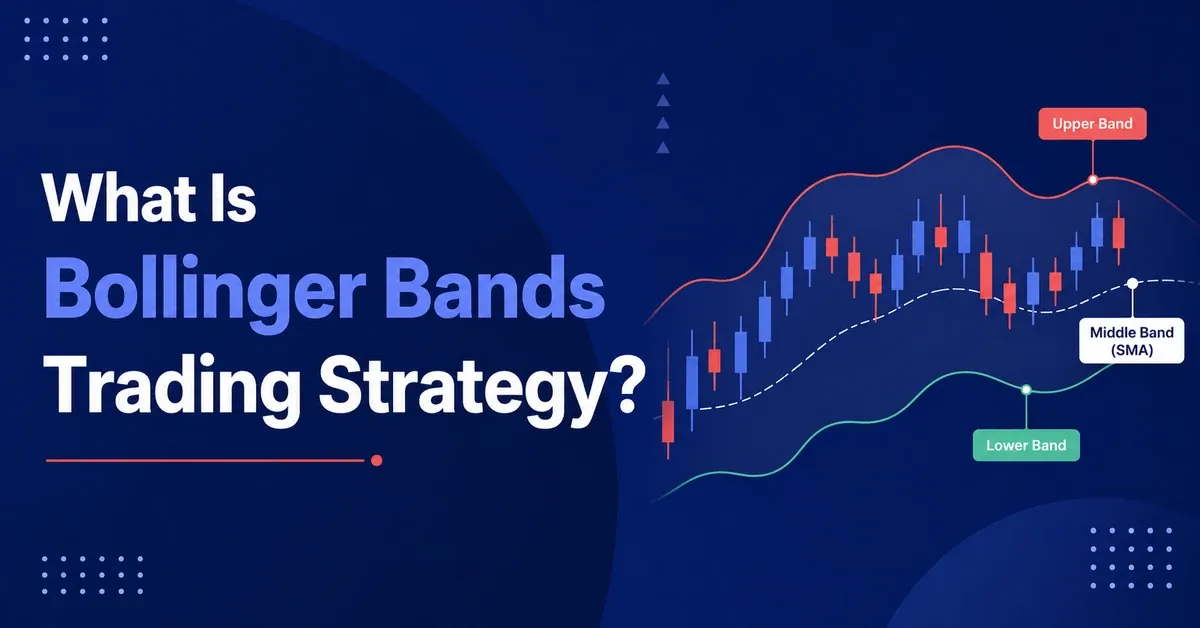
Bollinger Bands are a popular trading strategy that traders use to identify trading opportunities and manage risk. It is designed to help traders understand when an asset is overbought or oversold. It works by plotting two standard deviation bands around a Simple Moving Average (SMA). This blog will help you understand all aspects of this strategy, including its definition, formula, working, benefits, and drawbacks.
Key Takeaways
-
Bollinger Bands consist of an upper and lower band plotted two standard deviations away from a simple moving average.
-
Standard deviation is a statistical measure that shows how much a security's price fluctuates or deviates from its average price.
-
When the market is calm and prices are not volatile, the bands tend to contract or narrow down, indicating low volatility.
-
The strategy can be applied to various financial instruments, including stocks and options.
Bollinger Bands Trading Strategy: Meaning
This trading strategy uses the Bollinger Bands indicator to identify potential buy and sell signals and understand market volatility. Let's take an example to understand this concept of Bollinger Bands' trading strategy better.
Suppose you want to trade shares of a well-known Indian company called ABC. You can apply the Bollinger Bands indicator to the stock chart of the company, which will display three lines:
- A simple moving average is generally a 20-day Simple Moving Average
- Two bands plotted
- Two standard deviations which are above and below the Simple Moving Average
If the stock price moves closer to the upper Bollinger Band, it may indicate that the stock is overbought and potentially due for a correction. Similarly, if the price moves to the lower Bollinger Band, it could suggest that the stock is oversold and may need a rebound.
Additionally, Bollinger Bands can help identify breakout opportunities. If the stock price breaks above the upper band with strong volume, it could signal the start of a bullish trend. A break below the lower band may indicate a bearish trend. However, such breakouts should always be confirmed using volume, trend direction, or other indicators, as Bollinger Bands alone do not confirm direction.
How To Calculate Bollinger Bands?
Bollinger Bands are calculated using a simple moving average (SMA) and the price data's standard deviation. The following formula will help you better understand the calculation.
Middle Band = 20-day Simple Moving Average (SMA) Upper Band = 20-day SMA + (2 x 20-day Standard Deviation) Lower Band = 20-day SMA - (2 x 20-day Standard Deviation)
How To Effectively Use The Bollinger Bands Trading Strategy?
There are several ways to use the Bollinger Bands Trading Strategy. They include the following:
1. Volatility Channel
Three lines make up Bollinger Bands: an upper band, a lower band, and a middle band. When the bands squeeze or come closer together, it indicates low volatility in the market, suggesting that a sharp price move may occur, but the direction of the move is uncertain and must be confirmed.
When the bands expand, it signifies high volatility and usually indicates that a strong move or breakout has already occurred, rather than signalling that a breakout is less likely.
2. Trading Breakouts
A bullish breakout occurs when the price moves above the upper band, and a bearish breakout occurs when it moves below the lower band.
However, not all band breaks lead to sustained trends, and false breakouts are common without confirmation from volume or trend indicators.
Traders often place stop-losses based on recent swing highs/lows, support-resistance levels, or volatility measures like ATR, rather than simply placing them outside the opposite band.
3. Momentum Tool
Bollinger Bands can be used to identify overbought and oversold conditions based on the concept of mean reversion. They suggest that after reaching extremes, prices will eventually move back towards the middle band, i.e., the average price.
Traders can look to buy when the price is near or touching the lower band and sell when it's near or touching the upper band. However, this strategy may not work well in strongly trending markets, where prices can stay near the bands for extended periods.
4. Trend-Following
The Bollinger Bands will slope upwards, and prices tend to reach the upper band in a strong uptrend. While the Bollinger Bands slope downwards, prices tend to hug the lower band during a downtrend.
Traders may enter positions after pullbacks, but it is important to trade in the direction of the trend rather than assuming immediate reversals at the bands.
5. Combining With Other Indicators
Bollinger Bands can be used with other indicators, such as the Relative Strength Index (RSI) or the Moving Average Convergence Divergence (MACD), to confirm signals and understand the momentum.
Example: In an uptrend, a trader might look to enter a long position when the price is near the middle or lower band and the RSI shows an oversold condition, indicating the potential for a bullish reversal.
6. Double Bollinger Band Strategy
This strategy involves using two sets of Bollinger Bands:
- One with the default settings (20-period SMA and 2 standard deviations)
- Another with a tighter setting (20-period SMA and 1 standard deviation)
This creates three zones, which include:
- A buy zone, i.e., above the upper tight band
- A neutral zone, i.e., between the tight bands
- A sell zone, i.e., below the lower tight band
Additionally, when the price consistently stays in the upper zone, it indicates a strong uptrend; when it stays in the lower zone, it indicates a strong downtrend, making this strategy useful for trend-strength analysis, not just for entry signals.
Best Bollinger Bands Trading Strategy In Option Trading
The Bollinger Bands Trading Strategy can also be applied to options trading, particularly for volatility cases. The following are some popular strategies:
1. Long Straddle
When Bollinger Bands contract, indicating low volatility, traders may consider a long straddle strategy. However, this should only be used when there is a clear expectation of significant volatility expansion, not just a squeeze.
2. Short Straddle
When the Bollinger Bands expand, it indicates high volatility. In this situation, a trader may consider a short straddle or strangle strategy. In this technique, two options are sold at the same strike price and expiration: a call and a put. This strategy is designed to benefit from reduced volatility, as options will lose value over time if the underlying asset remains within a specific range.
3. Volatility Skew
Traders can use Bollinger Bands to identify volatility conditions, but volatility skew itself is derived from options pricing (implied volatility differences), not directly from Bollinger Bands.
Advantages And Disadvantages Of Bollinger Bands Trading Strategy
The Bollinger Bands Trading Strategy is a popular technical analysis tool that provides a visual representation of price action. Since it offers several benefits, traders should also be aware of its potential drawbacks. Therefore, understanding both the advantages and disadvantages of this strategy is crucial for making informed trading decisions. The following is the breakdown of its benefits and drawbacks.
Advantages | Disadvantages |
|---|---|
The Bollinger Bands provide a simple way to represent price action, helping traders identify potential trading opportunities | The Bollinger Bands are a lagging indicator, meaning they are based on historical data and may lag current market conditions. This may lead to delayed signals. |
The bands automatically adjust to changes in market volatility. This makes them suitable for a range of market conditions. | The strategy might generate false signals, especially in range-bound markets. This may lead to potential losses if not used in combination with other indicators or market analysis. |
Bollinger Bands are versatile and can be used for multiple purposes, such as identifying overbought/oversold conditions, breakouts, and volatility changes. | The strategy's effectiveness may depend on the chosen parameters, such as standard deviations and moving average periods, which may vary based on market conditions and trading styles. |
Traders can customize the parameters, such as the number of standard deviations and the moving average period, to suit their trading style and market conditions. | Successful implementation of the Bollinger Bands Trading Strategy requires discipline, risk management, and a well-defined trading plan. |
The bands can help traders identify potential entry and exit points, as well as set stop-loss orders, contributing to effective risk management. | The strategy may be more effective in certain market conditions (e.g., trending markets) and less effective in others (e.g., range-bound or choppy markets). |
Which Indicators Work With Bollinger Bands?
While Bollinger Bands can stand on their own, relying solely on them isn’t always the preferred approach. Traders often look for confirmation elsewhere. Because of that, they mix in additional indicators. Some of the most effective ones are listed below.
-
RSI: When the price is near the upper band and RSI is already high, some traders take it as a sign that the move may slow down.
-
MACD: This helps in seeing whether the momentum is still strong or starting to fade.
-
Stochastic Oscillator: Often used to spot short-term turning points when the price moves close to the bands.
-
Moving Averages: These help in understanding the broader trend, so you don’t go against it without a reason.
Using two or three indicators together often feels more practical than relying on just one.
Conclusion
The Bollinger Bands Trading Strategy offers traders a versatile tool for identifying potential trading opportunities, managing risk, and understanding market volatility. Traders may improve their decision-making process and potentially improve their trading performance by understanding the dynamics of the bands. However, it's crucial to remember that no trading strategy is foolproof, and discipline, risk management, and continuous learning are essential components of successful trading. Furthermore, it is important to use the Bollinger Bands Trading Strategy with other technical indicators and fundamental analysis tools. There should be a well-defined trading plan that suits your trading style and market conditions for positive results.
FAQs on Bollinger Bands Trading Strategy
Bollinger Bands are a technical analysis tool that consists of an upper and lower band plotted two standard deviations away from a simple moving average.
The benefits of using Bollinger Bands include visual intuitiveness, adaptability, versatility, customizability, complementary nature, and potential for effective risk management.
When the Bollinger Bands contract (narrow), it indicates low volatility, suggesting potential trading opportunities ahead as volatility is likely to increase.
When the Bollinger Bands expand (widen), they indicate high volatility, suggesting potential trading opportunities, as volatility is likely to decrease.
Yes, the Bollinger Bands Trading Strategy can be applied to options trading, particularly for volatility plays such as long straddles/strangles and short straddles/strangles.
The content in this blog is intended purely for educational purposes. Any securities or mutual funds referenced are illustrative in nature and do not constitute a recommendation or endorsement by Kotak Neo. Investors are encouraged to assess their own financial situation and seek professional advice before making any investment decisions. For compliance T&C and disclaimers, Visit https://www.kotakneo.com/disclaimer/
0 people liked this article.

Kotak Neo (Kotak Neo) is India's venerable stockbroking company with a rich legacy. It offers comprehensive investment services across asset classes, prioritising a technology-first approach for a seamless experience. Trusted by 5 million+ customers, it guides you toward financial success with ease of investment and speed of trade.
Note: The opinions expressed in this blog are personal viewpoints and should not be construed as recommendations.