Who Needs Financial Planning? A Complete GuideFor Every Life Stage
- Updated: 22 May 2026, 5:10 PM IST
- | 3 min read
- 1,383
 Add Preferred News Source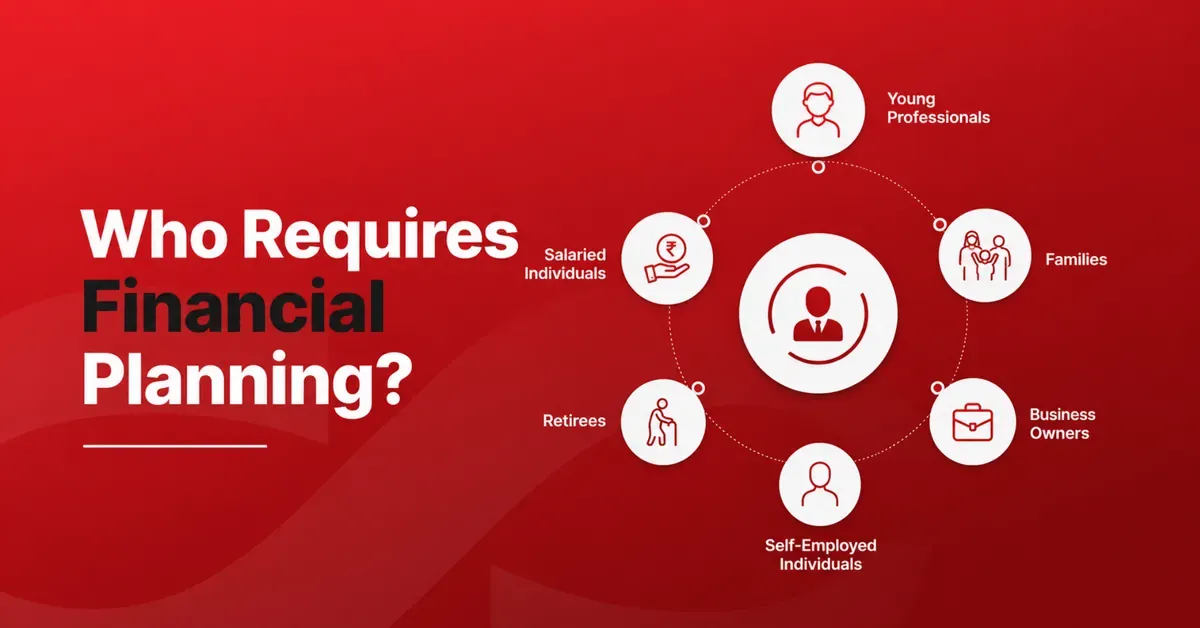
Who Should Consider Financial Planning?
Let’s start with a simple question. Who requires financial planning?
Not just high earners. Not just people nearing retirement. In reality, anyone who earns and has even a few goals in life needs it.
Financial planning is not about complexity. It is about clarity. It helps you understand where your money is going, what it should be doing, and how it can support the life you want. For some, that begins with a basic financial budget. For others, it evolves into deeper financial planning and analysis.
The stage of life you are in usually decides what your plan should look like.
Young Professionals & First-Time Earners
Start with clarity and discipline.
- Track your expenses for the next 90 days. Categorise everything. This becomes your first financial budget.
- Follow the 50:30:20 rule for budget planning. 50% for needs, 30% for wants, 20% for savings.
- Start a monthly SIP in a mutual fund.
- Build an emergency fund equal to 3 months of expenses.
Salaried Individuals
Now bring structure to your money.
- Save at least 20% to 30% of your income every month.
- Maintain an emergency fund of 6 months of expenses.
- Buy term insurance equal to 15 to 20 times your annual income.
- Review your finances once every 6 to 12 months.
This is basic financial planning and analysis.
Business Owners & Freelancers
Focus on control and stability.
- Allocate 25% to 30% of every income received towards taxes.
- Have a financial budget with a fixed withdrawal every month.
- Have an emergency fund to cover 9 to 12 months.
- Review cash flows every month as part of financial planning and analysis.
Families & Parents
Shift towards goal-based financial planning.
- Estimate future education costs using 8% to 10% inflation.
- Create separate investments for each goal.
- Buy health insurance of at least ₹10 lakh to ₹20 lakh.
- Allocate 30% to 40% of your income towards savings and goals in your financial budget.
Pre-Retirees & Retirees
Prioritise income and capital protection.
- Estimate retirement expenses using 5% to 6% inflation.
- Reduce equity exposure 5 to 7 years before retirement.
- Use structured options like NPS for retirement planning.
- Keep 1 to 2 years of expenses in liquid assets.
This forms the core of retirement investment planning.
Conclusion
Financial planning works when it is practical and consistent.
Start with a simple financial budget. Strengthen it with disciplined budget planning. Over time, use financial planning and analysis to refine decisions. As life progresses, financial planning for retirement provides stability.
So, who needs financial planning? Anyone who wants a plan and not uncertainty.
Sources
Investopedia
Kotak Life Insurance
Wright Research
FAQs on Financial Planning
Yes. You can start with a financial budget, follow financial budgeting methods, and invest regularly. As your financial situation improves, financial planning and analysis will definitely help.
As soon as you start earning. Even small steps in financial planning early on, can create a strong advantage over time.
The content in this blog is intended purely for educational purposes. Any securities or mutual funds referenced are illustrative in nature and do not constitute a recommendation or endorsement by Kotak Neo. Investors are encouraged to assess their own financial situation and seek professional advice before making any investment decisions. For compliance T&C and disclaimers, Visit https://www.kotakneo.com/disclaimer/
0 people liked this article.