From ₹24,000 Cr to ₹13.73 Lakh Cr: The Rise of Passive Investing
- Updated: 22 May 2026, 5:17 PM IST
- | 4 min read
- 1,083
 Add Preferred News Source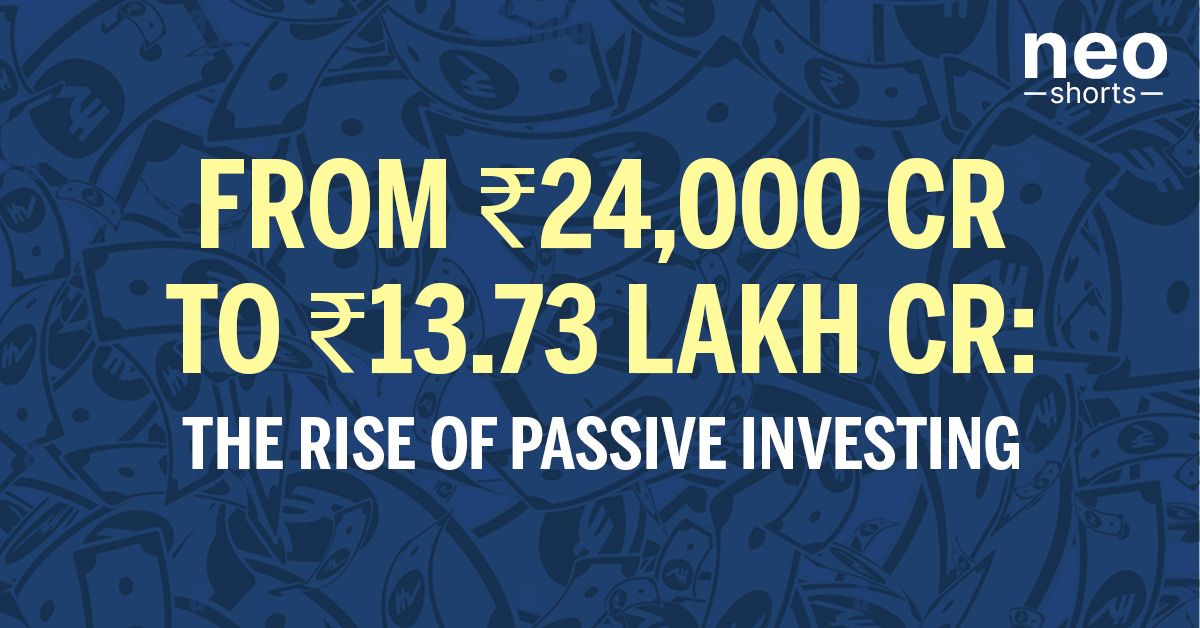
For most of India’s investing history, the goal was simple: beat the market.
Now, that focus is shifting, and a growing number of investors are asking a different question: why not just own the market?
This change in mindset has been driving the rise of passive investing
At its core, passive investing is simple.
Instead of trying to outperform the market, it focuses on matching it.
Investors allocate money to funds that replicate a market index such as the Nifty 50 or the Sensex, without active stock selection or frequent trading.
The approach is built on discipline rather than prediction, and on consistency rather than timing.
Lower costs, minimal churn, and a long-term “buy and hold” philosophy make it fundamentally different from traditional active strategies.
Access to passive investing has also become far more seamless.

Investors can participate through index funds, which function like regular mutual funds but track specific indices.
Exchange-Traded Funds, or ETFs, offer another route, trading on stock exchanges just like shares, and require a demat account.
For those looking beyond domestic markets, fund-of-funds structures provide exposure to international indices and global themes.
The scale of this shift becomes clearer when you look at how assets have evolved over time.
From ₹59,803 crore in March 2017, passive fund assets grew to ₹3.39 lakh crore by March 2021 and have now reached ₹13.73 Lakh Cr as of March 2026.
A large part of this expansion has been driven by ETFs.
Their AUM grew from ₹50,211 crore in March 2017 to ₹2.90 lakh crore in March 2021, and further to ₹10.66 Lakh Cr as of March 2026.
At the same time, the number of ETFs has expanded from just 63 to 328, reflecting both product innovation and rising demand.
Notably, this growth has been led largely by institutional investors, with corporates accounting for around 82% of ETF assets, followed by HNIs and retail investors.
Index funds, on the other hand, are beginning to see stronger traction among individual investors.
Their assets have grown from ₹2,452 crore in March 2017 to ₹18,990 crore in March 2021, and now stand at ₹3.07 lakh crore as of March 2026.
The number of index funds has surged from 21 to 360 over the same period, indicating a rapid broadening of offerings.
Unlike ETFs, the investor mix here is more balanced, with HNIs contributing 39%, corporates 37%, and retail investors accounting for 24%.
In terms of asset allocation, equity continues to dominate passive investing, accounting for ₹9.18 lakh crore or 66.8% of total assets.
Commodity-based passive funds, largely driven by gold and silver ETFs, contribute 18.3%.
This diversification across asset classes signals that passive investing is no longer limited to equity indices alone.
It also underscores that the shift towards passive investing is deliberate, not incidental.
Cost efficiency remains one of the biggest drivers, with expense ratios typically going up to just 0.5%, significantly lower than most active funds.
At the same time, the transparency of a rules-based approach eliminates fund manager bias and reduces uncertainty around decision-making.
Over longer time horizons, this predictability has started to resonate more strongly with investors.
Two structural triggers have played a defining role in accelerating this trend.
The first came in 2015, when the Employees’ Provident Fund Organisation began allocating to ETFs.
From ₹6,578 crore in FY16 to ₹34,208 crore by FY25 (till October), EPFO flows provided both scale and stability to the ETF segment, acting as an early anchor for growth.
The second trigger has been the rapid expansion of demat accounts, particularly post-COVID.
From 4.1 crore accounts in FY20 to over 21.6 crore by December 2025, access to financial markets has widened significantly.
As more investors enter the ecosystem, participation in simple, low-cost products like passive funds naturally increases.
Despite this rapid growth, India is still at a relatively early stage compared to global markets.
In the US and Europe, passive funds account for 50-55% of total mutual fund assets, whereas in India, the share currently stands at around 17-19%.
The gap highlights both the progress made so far and the significant headroom for expansion.
Looking ahead, passive investing is unlikely to remain on the sidelines.
Increasing financial awareness, wider product availability, and easier access to both domestic and global markets are expected to drive further adoption.
Many investors are already beginning to allocate 20-40% of their portfolios to passive strategies, using them as a stable core while complementing them with active bets.
If current trends continue, passive funds could account for nearly 30% of mutual fund assets over the next five years.
Ultimately, the meteoric rise of passive investing in India signals a fundamental shift toward low-cost, disciplined wealth creation that is only just beginning to tap into its long-term potential.
Sources:
Value Research
NSE
Moneycontrol
Nifty Indices
PIB
Financial Express
Mint
CNBC TV18
Cafemutual
The content in this blog is intended purely for educational purposes. Any securities or mutual funds referenced are illustrative in nature and do not constitute a recommendation or endorsement by Kotak Neo. Investors are encouraged to assess their own financial situation and seek professional advice before making any investment decisions. For compliance T&C and disclaimers, Visit https://www.kotakneo.com/disclaimer/
0 people liked this article.

Kotak Neo (Kotak Neo) is India's venerable stockbroking company with a rich legacy. It offers comprehensive investment services across asset classes, prioritising a technology-first approach for a seamless experience. Trusted by 5 million+ customers, it guides you toward financial success with ease of investment and speed of trade.
Note: The opinions expressed in this blog are personal viewpoints and should not be construed as recommendations.