What Is Accounting?
- Updated: 26 May 2026, 5:22 PM IST
- | 5 min read
- 1,836
 Add Preferred News Source
What Is Accounting?
All decisions taken regarding finance, whether it is a business or personal expense, or assessing a venture’s investment potential, depend on the knowledge of the source and the destination of the money. This is where accounting comes into the picture. For those who are asking themselves What is accounting, it is the process of recording, classifying, and summarising financial transactions so as to give a full picture of the financial situation of the company.
Accounting is not solely about record-keeping but also consists of other crucial elements. Accounting is helpful in arranging financial data, monitoring income and expenditure, and generating well-structured reports in the form of financial statements. Accounting provides accurate and relevant financial information, which helps in decision-making, enhances transparency, and enables individuals and entities to plan their financial affairs properly.
Why Is Accounting Important?
A major benefit of accounting is that it enables individuals and/or companies to determine how much money a person or a company has at any given moment in time. Accounting allows for the recording of all transactions so that people/companies can keep track of what they make, what they spend, and how much profit they are generating.
Additionally, accounting promotes transparency and informed decisions. This is possible through financial accounting, whereby organisations can present a clear picture to stakeholders through financial reports. Accurate accounting information helps with compliance, reduces uncertainty, and allows investors and organisations to make sound financial decisions.
What Are The Different Types of Accounting?
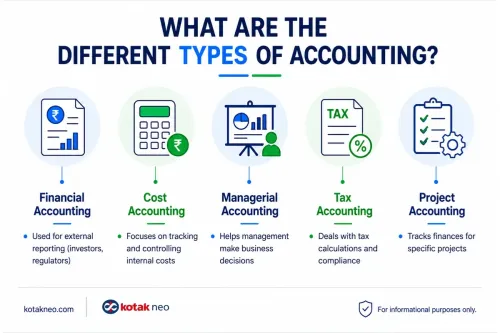
It is not possible to carry out accounting in a single method. Various types of accounting can be followed for different needs, like performance reporting, cost control, and planning of future activities. Each form of accounting deals with a particular feature of financial management and helps in the effective analysis of finance.
Financial Accounting
Financial accounting is primarily concerned with providing information on an organisation's financial transactions over a particular period. This involves preparing structured reports, such as the balance sheet and cash flow statements, which offer an overview of an organisation's financial situation. These reports are usually for external stakeholders.
Financial accounting, through the application of standardised principles, ensures the consistency, transparency, and comparability of financial data. This enables the evaluation of profitability, financial stability, and the making of appropriate financial or investment decisions.
Cost Accounting
Cost accounting primarily deals with the analysis and control of costs involved in producing goods or providing services. With cost accounting, an organisation can identify costs related to procuring materials and overheads, enabling it to understand the actual cost of operations.
Using cost accounting techniques, an organisation can establish budgets, pricing strategies, and improve its overall efficiency. It helps them make better decisions regarding resource allocation and helps them reduce costs while maintaining quality.
Managerial Accounting
Managerial accounting, on the other hand, is concerned with providing financial information that is used in decision-making. It entails the analysis of financial information, which is used in planning, budgeting, and performance evaluation. The information prepared in managerial accounting differs from that in financial accounting because it is used by managers in decision-making.
Business organisations benefit from managerial accounting by using it to predict future trends, plan the utilisation of their resources, and evaluate performance across various departments. Managerial accounting basically helps organisations address issues affecting their operations.
Tax Accounting
Tax accounting is the process of preparing and reporting financial information, especially for the purpose of taxation. The main aim is to compute the amount of income that is taxable, the deductions that are allowed, and ensure that the financial records comply with the relevant tax laws and regulations. The main difference between financial accounting and tax accounting is that the former is governed by general principles, while the latter is governed by tax laws.
With the help of tax accounting, an individual or an organisation is able to ascertain their tax dues and maintain appropriate records while filing their returns.
Project Accounting
Project accounting is a unique method that is utilised to keep track of the financial performance of each project. Instead of keeping track of the financial performance of the entire business, project accounting is focused on the financial performance of each project, including the revenue, cost, budget, and schedule. This enables the evaluation of the financial viability of each project.
The use of project accounting enables the monitoring of project expenditure, profitability, and cost control, among other aspects.
Conclusion
Accounting is the foundation upon which the entire concept of financial management is built, as it helps individuals and organisations make important decisions. From the basics of financial accounting statements to the application of cost accounting and efficiency, the entire gamut of accounting helps an individual or an organisation make important decisions.
Sources
The Economic Times
Investopedia
The content in this blog is intended purely for educational purposes. Any securities or mutual funds referenced are illustrative in nature and do not constitute a recommendation or endorsement by Kotak Neo. Investors are encouraged to assess their own financial situation and seek professional advice before making any investment decisions. For compliance T&C and disclaimers, Visit https://www.kotakneo.com/disclaimer/
0 people liked this article.