Ola Electric Plans Full Switch To In-House Battery Cells By September 2026
 Add Preferred News Source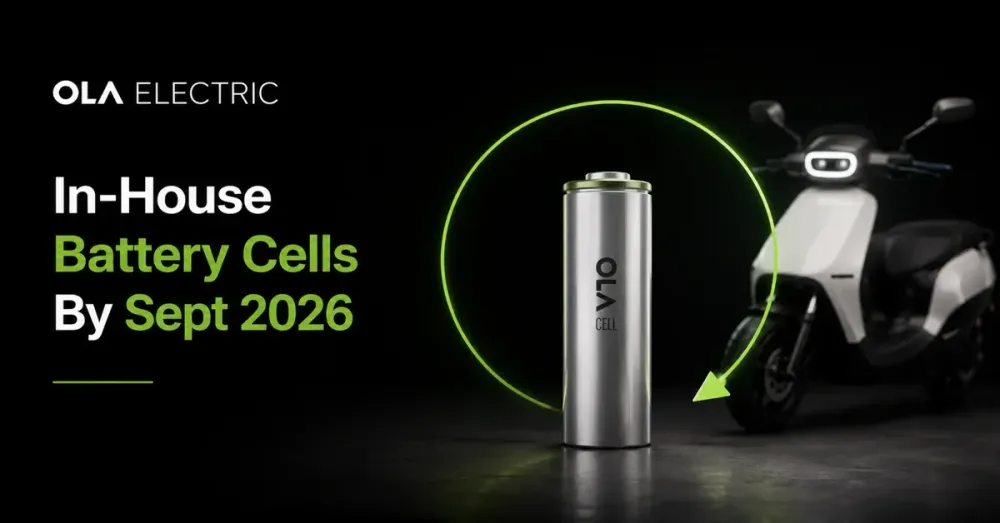
Ola Electric plans to shift its entire vehicle portfolio to in-house battery cells by September 2026 as Q4FY26 gross margins hit 38.5% and the company turns operating cash flow positive.
Ola Electric's Chairman and Managing Director Bhavish Aggarwal told shareholders on 21 May that the company is targeting a complete transition to internally manufactured battery cells across its entire vehicle portfolio by September 2026.
Around 15% of current vehicle orders already run on Ola's own 4680 Bharat Cells, which have been commercialised and deployed. The company's Gigafactory currently operates at 2.5 GWh of capacity, with installation work for scaling to 6 GWh largely finished. Full commercialisation of the expanded capacity is expected by the end of the current quarter.
The Battery Technology Claim
The detail that stands out in the investor presentation is Ola's claim to have commercialised dry-electrode manufacturing technology. If the numbers hold, this process cuts capital expenditure by 33%, lowers energy consumption by 40 to 60% and reduces factory footprint by 70% compared with conventional battery manufacturing methods.
The company described the Gigafactory as an operating manufacturing platform running at commercially viable yields rather than a pilot project.
Plans to expand battery capacity from 6 GWh to 20 GWh will be funded through a capital raise at the cell subsidiary level, a structure that could eventually allow the battery business to attract its own standalone valuation separate from the vehicle operations.
Margin Recovery And Cost Control
The company’s consolidated gross margin reaching 38.5% in Q4FY26 from 13.7% a year ago is the financial headline of the quarter. Ola Electric attributed the expansion to vertical integration benefits, maturity of the Generation 3 platform and pricing optimisation. Operating expenditure has been cut nearly in half over the past year and the company is projecting a further reduction to around ₹350 crore per quarter over coming periods.
The company reported its first quarter of positive operating cash flow. Consolidated cash flow from operations came in at ₹91 crore. The auto business also remained strong. It generated ₹213 crore in operating cash flow and ₹173 crore in free cash flow during the quarter.
Service metrics have also improved. Turnaround time is down 88%, same-day closure rates are at 87%, parts pendency has been reduced by 69% and Generation 3 warranty costs have dropped 70% compared to Generation 2.
Also Read - 22 May 2026: Sensex, Nifty 50 Rise In Mid-Session Trade As Bank Stocks Gain
Battery Market Outlook And Ola Growth Plans
According to a research estimate, India’s battery market could reach 420 GWh annually by 2035, creating an addressable opportunity of nearly $30 billion.
The company also said vehicle registrations in April rose 20% from the previous month, even as the wider electric two-wheeler market saw a decline of more than 22%. Ola now aims to capture a 15%-20% market share across the country over the next six months.
Sources:
Businessline
NDTV
This article is for informational purposes only and should not be considered investment advice from Kotak Neo. For compliance T&C and disclaimers, Visit www.kotakneo.com/disclaimer
Right Tools, Rich Insights