Silicon Storm: Why Trump’s 100% Chip Tariff Could Be a Game-Changer for India’s Semiconductor Dream
 Add Preferred News Source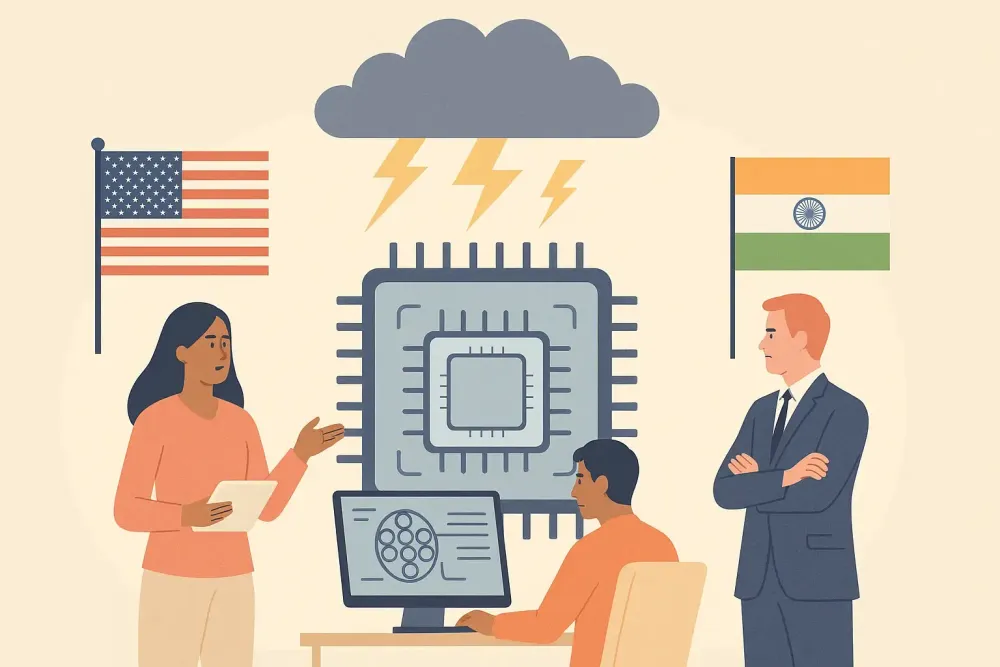
On 6 August 2025, the technology and trade world was jolted by a bold US move — President Trump announced a 100% tariff on all imported semiconductors. The aim? To accelerate domestic chip production.
The decision sent shockwaves through global supply chains, unsettled major exporters, and reignited debates on technological sovereignty. But for India, which is scaling up its semiconductor ambitions with projects such as Micron’s Sanand plant, this disruption could open new opportunities.
What’s the News?
US President Donald Trump has announced a sweeping 100% tariff on all imported semiconductors, a move aimed at boosting domestic manufacturing and cutting reliance on foreign chips. Companies like Apple, which pledged an additional $100 billion investment in US production, bringing its total commitment to $600 billion , will be exempt. Taiwan’s TSMC, South Korea’s Samsung, and SK Hynix also escape the tariff because of existing US facilities.
The move threatens to inflate the prices of electronics, autos, and appliances, as semiconductors power nearly all modern devices. The Philippines, where chips account for 70% of exports, warned of ‘devastating’ consequences.
The US currently produces just 12% of global chips, down from 40% in 1990 . Trump’s tariff marks a sharp pivot from subsidy-driven strategies under the 2022 CHIPS Act, signalling a more aggressive push for reshoring.
Why Recent Tariffs Can Be a Boon for India?
Here is how the 100% tariff on semiconductors opens the door for India:
- Growth Trajectory:
India’s semiconductor market was valued at $38 billion in 2023 and is projected to reach $45–50 billion by the end of 2025, with expectations to surpass $100 billion by 2030 . This growth is stimulated by rising demand across mobile, automotive, and industrial electronics. In 2025 alone, India is expected to ship over 83.96 billion semiconductor units, doubling to 170.71 billion by 2030. The CAGR of 13.76% reflects not just consumption but increasing domestic production capacity.
- Capital Commitments:
India has attracted over ₹1.55 lakh crore (approximately $18.6 billion) in semiconductor investments since 2023 . Key projects include Tata-Powerchip’s ₹91,000 crore fab in Dholera with a capacity of 50,000 wafers/month, and Micron’s ₹22,516 crore ATMP facility in Sanand. HCL-Foxconn’s ₹3,700 crore fab in Jewar aims to produce 36 million units annually. These facilities are not speculative; they are under construction or operational. The tariff shock accelerates the urgency for global firms to localise production, and India’s infrastructure readiness offers a viable landing pad for such shifts.
- Policy Overhaul:
India’s revised Semiconductor Policy 2025 introduces aggressive incentives: up to 50% capital expenditure subsidy for fabs, 50% R&D support under the Design-Linked Incentive (DLI) scheme, and annual Production-Linked Incentives (PLI) for output. These are not generic subsidies; they are tailored to reduce entry barriers for advanced node manufacturing (28nm and below). The streamlined application process and fast-track environmental clearances make India one of the most attractive destinations globally for semiconductor investment.
- Strength in Packaging:
India is rapidly emerging as a leader in Outsourced Semiconductor Assembly and Test (OSAT) and ATMP (assembly, testing, marking, packaging). Facilities like TSAT in Assam (₹27,000 crore) and CG Power-Renesas in Gujarat (₹7,600 crore) are designed to produce 48 million and 15 million chips per day, respectively. These segments are less capital-intensive and offer faster turnaround than full-scale fabs.
- Talent Pool:
India is training over 85,000 engineers in VLSI design, cleanroom operations, and nanotechnology under the Semicon India FutureSkills Program. Over 44,000 have already been certified. Partnerships with Purdue University, IBM, and Lam Research are aligning Indian talent with global standards . This talent pipeline is critical for sustaining fab operations and design centres. In contrast, countries like Vietnam and Bangladesh, despite lower labour costs, lack the depth in semiconductor-specific engineering talent, limiting their ability to scale under tariff pressure.
Compound Semiconductor Capabilities:
Trump’s tariff disproportionately affects commodity silicon chips, but India’s growing expertise in wide-bandgap semiconductors, such as silicon carbide (SiC) and gallium nitride (GaN), offers a differentiated export lane. Tata Electronics has mapped pilot SiC lines targeting ISO 26262 automotive compliance by 2027 . With SiC demand growing at a CAGR of 21.2% through 2030, driven by EV inverters and fast chargers, India could become a niche supplier of high-voltage chips.
- IP Creation:
India’s semiconductor design ecosystem is expanding rapidly. Under the DLI scheme, 22 startups have received ₹234 crore in support for chip design projects with a total cost of ₹690 crore . These chips target applications are used in surveillance, automotive, and smart devices. India’s fabless model held 53.5% of the market share in 2024, and pure-play foundries are projected to grow at a 16.1% CAGR through 2030. This design-first approach allows India to leapfrog into IP creation, a segment largely dominated by the US and Taiwan.
Read More: Trump Slaps 25% Tariff on Indian Imports
Conclusion
The 100% US chip tariff may look like a global disruption, but for India, it opens a rare strategic window. With strong policies, growing talent, and massive capital inflows, India is not just a backup option; it is becoming a central hub for future chip innovation. As global firms seek resilient supply chains, India’s semiconductor dream is no longer distant.
Read More: India’s Private 5G Era Begins
This article is for informational purposes only and should not be considered investment advice from Kotak Neo. For compliance T&C and disclaimers, Visit www.kotakneo.com/disclaimer
Right Tools, Rich Insights