How Minimum Balance Rules Cost Bank Customers ₹19,083 Crore
 Add Preferred News Source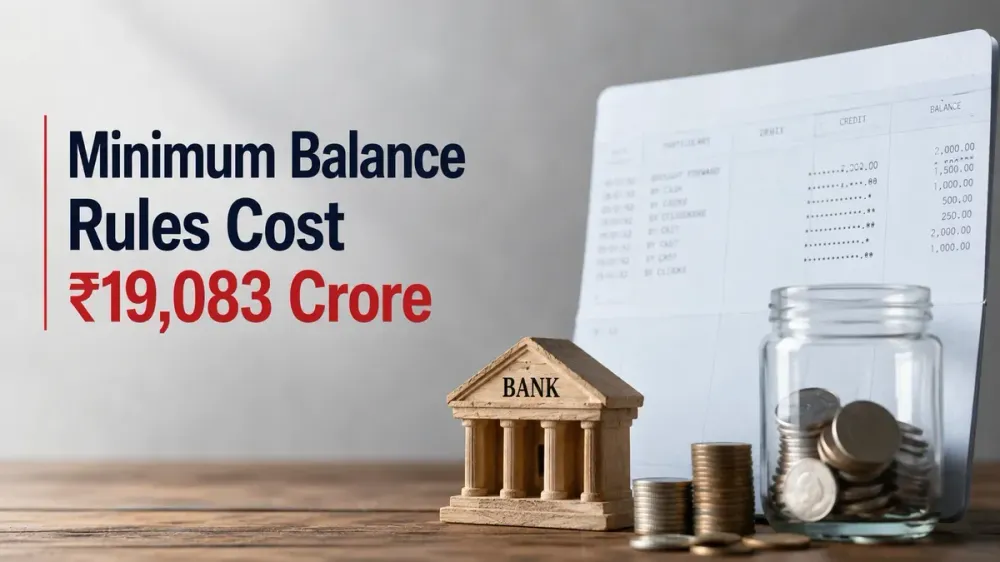
Indian banks collected ₹19,083 crore in penalties for low account balances in three years. Private lenders led collections. Understand how these charges work and avoid them. Read more.
Indian banks have pulled in ₹19,083 crore over three years from a single source: penalties on accounts that did not meet the minimum balance rules. The number, based on compiled data, points to a steady stream of fee income that often goes unnoticed by customers until it starts adding up.
These charges are not tied to loans or credit cards. They apply to basic banking itself. If the balance in an account slips below the required level, a fee is triggered. The rule sounds simple, but its impact depends heavily on the kind of account and the bank involved.
Why Do These Charges Keep Adding Up?
Banks set a minimum balance for most savings accounts. Fall short, and a penalty follows. The gap between requirements can be wide. In smaller towns, some accounts need only ₹500. In metro cities, especially with private lenders, the bar can go up to ₹10,000 to ₹50,000.
That difference matters. A missed threshold once may not hurt much. But if it happens repeatedly, the deductions begin to show. For many customers, these are not one-off charges. They come back month after month.
Private banks account for a large share of this fee pool. HDFC Bank reported collections of about ₹3,871 crore over three years. Axis Bank, ICICI Bank and Bank of Baroda also crossed ₹1,000 crore each in penalty income during the period.
Are Banks Moving Away From These Fees?
There has been some shift, though not across the board. State Bank of India no longer charges such penalties on savings accounts. Punjab National Bank has also removed them in July 2025.
Even so, the practice has not disappeared. Charges still apply in several cases, including current accounts and many private bank offerings. That is why the overall number remains large despite these changes.
Also Read - CMPDI Shares Fall After Q4 Results Show Profit And Margin Decline
What Does This Mean For Account Holders?
The issue is not just the rule, but how easy it is to miss. Salaries get delayed, expenses rise, or money is moved out for other needs. A shortfall can happen without much notice.
Once it does, the penalty is automatic. If the balance is not restored, the charge can repeat. Over time, that chips away at savings.
There is another side to it. Keeping a large amount idle in a savings account just to avoid penalties is not always efficient either. That money could be used elsewhere.
The Reserve Bank of India allows banks to set these limits, but it requires them to clearly inform customers. It also keeps some accounts outside this system. Basic Savings Bank Deposit Accounts and Jan Dhan accounts do not need any minimum balance.
For customers, the takeaway is practical. Know the requirements attached to your account. If it feels too high, there are alternatives with lower or zero balance conditions. The rule may look small, but the cost of ignoring it is not.
Sources:
Business Today
NDTV Profit
This article is for informational purposes only and should not be considered investment advice from Kotak Neo. For compliance T&C and disclaimers, Visit www.kotakneo.com/disclaimer
Right Tools, Rich Insights