RBI Adds ₹50,000 Crore To Banking System Through Open Market Operations
 Add Preferred News Source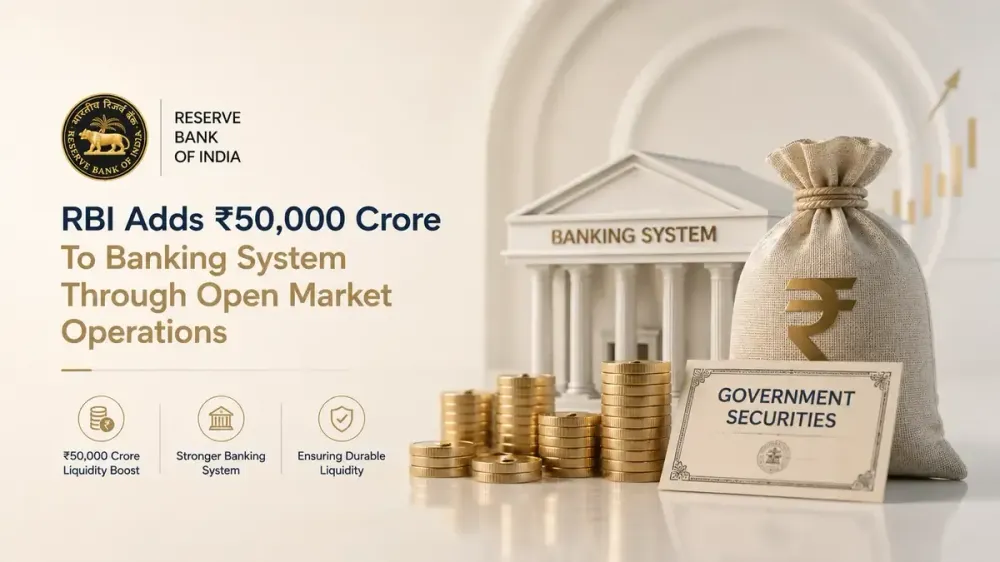
The Reserve Bank of India injected ₹50,000 crore into the banking system through open market operation (OMO) purchases of government securities to ensure durable liquidity.
The Reserve Bank of India (RBI) has injected ₹50,000 crore of durable liquidity into the banking system through open market operation (OMO) purchases of government securities.
The central bank purchased various government bonds of various maturities through the OMO auction. These included 6.33% GS (Government Security) 2035 bonds worth ₹13,507 crore, 6.01% GS 2030 bonds worth ₹13,494 crore, and 6.10% GS 2031 securities worth ₹8,157 crore.
It also purchased 7.30% GS 2053 bonds worth ₹6,955 crore, 7.18% GS 2033 securities worth ₹4,479 crore, 6.92% GS 2039 bonds worth ₹2,304 crore, and 6.19% GS 2034 bonds worth ₹1,104 crore.
Why Did The RBI Conduct The OMO Purchase?
The liquidity injection comes ahead of anticipated cash outflows from the banking system. This is due to advance tax payments and Goods and Services Tax (GST) payments scheduled later this month.
Even though the banking system currently has a liquidity surplus of ₹3.02 trillion, the RBI’s action aims to ensure stable funding conditions. It also aims to prevent any sudden tightening in money markets.
How Much Liquidity Exists In The Banking System?
According to central bank estimates, liquidity in the banking system remains in surplus of around ₹2.41 lakh crore.
Data from the RBI also shows that the central bank has already infused around ₹2.50 lakh crore through OMO purchases of government securities since the beginning of the year. This highlights its continued efforts to maintain adequate liquidity in the financial system.
Also Read: IRFC Board Approves Massive ₹70,000 Crore Capital Raise
What Does This Mean For Investors?
To the market participants, the injection of liquidity is an indication that the central bank is still determined to ensure that the banking system operates within comfortable financial conditions. Higher liquidity typically supports credit growth, bond market stability, and overall financial market sentiment.
To the investors, particularly those who are following the bond market and banking industries, long-term liquidity support may assist in maintaining the cost of borrowing at a stable level. It also favours the need for government securities and financial assets.
Sources:
Economic Times
Business Standard
This article is for informational purposes only and should not be considered investment advice from Kotak Neo. For compliance T&C and disclaimers, Visit www.kotakneo.com/disclaimer
Right Tools, Rich Insights