Liquid Funds Explained: Meaning, Benefits, Risks & How They Work
- Updated: 26 May 2026, 5:14 PM IST
- | 4 min read
- 2,023
 Add Preferred News Source
A lot of investment decisions focus on where to invest money for maximum growth. Very few people think about how to handle money that is only meant to be parked for a short period.
Whether it is a bonus, an emergency fund, or cash waiting to be invested, short-term money often ends up sitting idle without much thought. Over time, this can quietly reduce overall portfolio efficiency.
This is where liquid funds come in. They are not built for high returns. They are meant to keep your money accessible while still putting it to some work.
So, what are liquid mutual funds and how do they actually work?
What Are Liquid Funds?
Liquid funds are debt mutual funds designed for short-term use. They are commonly used to manage surplus cash without locking funds away.
They invest in short-term debt instruments such as treasury bills, commercial papers, and certificates of deposit. These are low-duration instruments, usually maturing within 91 days.
The short maturity window is the unique feature of these funds. It helps keep price movements relatively stable and limits the impact of interest rate changes.
They are useful in situations where you want flexibility. The money stays accessible, and at the same time, it continues to earn instead of just sitting unused.
How Do Liquid Funds Work?
Think of a liquid fund as a pool of money that gets invested into short-term money market instruments.
The fund earns interest through these debt instruments. Because they are short-term, the money does not stay locked in for long. It comes back, gets reinvested, and the process continues, gradually building the fund's value.
Liquid funds allow you to redeem your investment whenever needed. In most cases, money can be withdrawn in one day. Many fund houses also offer instant redemption within specified limits.
As per Securities and Exchange Board of India (SEBI) rules, investors can withdraw up to ₹50,000 or 90% of the invested amount per day, whichever is lower.
Key Features Of Liquid Funds
Liquid funds stand out because of how they are structured and how they behave in practice. Some of their key features include:
High Liquidity
Access is the biggest advantage of these funds. You do not have to wait for long processing timelines or maturity dates.
Money can be withdrawn within 24 hours. Some fund houses go a step further and offer instant redemption. In case of emergencies, this can be of significant help.
No Lock-In Period
There are no restrictions on when you can exit.
You can invest for a few days, a few weeks, or slightly longer, depending on your needs. That flexibility makes liquid funds easy to use, especially when cash flow requirements are uncertain or constantly changing.
Low Risk Investment
Liquid funds invest in short-term, high-quality instruments. Hence, they are less exposed to volatility compared to many other market-linked options.
That said, the risk is only lower, not zero. Credit-related issues, although uncommon, can still have an impact.
Stable Returns
The underlying instruments mature quickly, so price fluctuations remain limited, leading to a relatively steady return profile.
Hence, this works in favour of investors who prefer consistency over chasing higher but uncertain gains.
Advantages Of Investing In Liquid Funds
The benefits of liquid funds become clearer when you look at how they fit into everyday financial decisions.
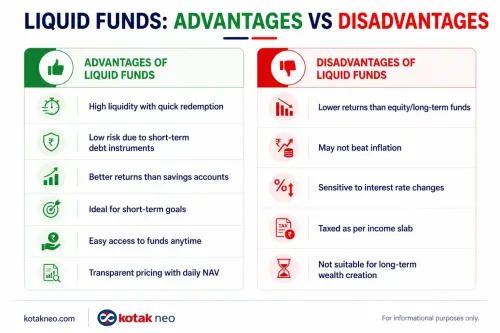
Better Returns Than Savings Accounts
Banks typically offer around 2.5% to 4% per annum, depending on the amount and where you keep your money. Whilst safe, this is not particularly rewarding.
Liquid funds tend to do slightly better. Returns have generally been in the range of about 6% to 7% in recent years, although this moves with interest rates and market conditions.
Ideal For Emergency Funds
An emergency fund is something you should be able to access without thinking twice.
At the same time, keeping a large amount completely idle does not always make sense.
This is where liquid funds tend to fit in well. You still have access when you need it, but the money is being productive until then.
Low Expense Ratio
Costs matter more in short-term investments than most people realise. Since returns are relatively moderate, even a small difference in expenses can affect what you finally earn. Liquid funds help retain a bigger portion of returns since the expense ratio is generally lower compared to many other mutual fund categories.
Capital Preservation
Liquid funds focus on protecting the invested amount and generating steady, modest returns. They do not aggressively chase returns or high growth.
That makes liquid funds useful for money that cannot be exposed to significant volatility.
Flexibility For Short-Term Goals
Short-term money rarely follows a fixed plan. You may need it for an upcoming expense, or you might just be waiting for the right time to invest elsewhere.
In both cases, flexibility becomes important. Liquid funds allow you to move in and out without restrictions.
Risks Associated With Liquid Funds
Liquid funds are often seen as low-risk, and that is largely true. But low risk does not mean no risk.
Credit Risk
These funds deal with debt instruments. If the issuer runs into financial trouble or fails to repay on time, it can adversely affect the fund.
Most liquid funds try to avoid this by sticking to high-quality issuers. Even then, the risk does not disappear completely. It just becomes less likely.
Interest Rate Risk
Interest rates move, and debt instruments respond to those changes.
In the case of liquid funds, the effect is usually mild. Since the securities mature quickly, there is not much time for large fluctuations to build up. Still, small changes in returns can happen when rates shift.
Not Completely Risk-Free
This is where expectations need to be clear.
Liquid funds are market-linked. While they aim for stability, they do not promise fixed returns. So they are relatively safer than many other options, but they are not a replacement for guaranteed instruments.
Who Should Invest In Liquid Funds?
Investors with short-term needs rely on liquid funds. These funds are not ideal for those seeking long-term wealth creation.
They may be relevant for:
- Individuals who have surplus cash lying idle, and would prefer generate some return.
- Those building an emergency fund, where access matters just as much as safety.
- Salaried professionals who have not yet decided where to invest their bonuses or short-term savings.
- Businesses looking to optimise idle working capital without locking it in.
- Conservative investors who want stability over higher returns.
Taxation Of Liquid Funds In India
Taxation of liquid funds depends on when the investment was made.
For investments made after 01 April 2023, gains from liquid funds are taxed as per the investor’s income tax slab, irrespective of the holding period.
For investments made before this date, the tax treatment depends on how long you stay invested.
- If you redeem within 24 months, the gains are treated as short-term and taxed as per your income slab.
- If you hold for more than 24 months, the gains are considered long-term and taxed at 12.5%, without indexation.
Sources:
Moneycontrol
Live Mint
The Economic Times
FAQs On Liquid Funds
Not necessarily. It depends on what you are looking for. If you want certainty, fixed deposits are straightforward. You know exactly what you will earn.
Liquid funds work differently. They give you more flexibility and easier access to your money. Returns can be slightly better at times, but they are not guaranteed.
So it really comes down to whether you value predictability more or flexibility.
In most cases, you will get your money within one working day.
There is also an option of instant redemption that some fund houses offer. This comes in handy when money is immediately required.
However, there is a limit. As per Securities and Exchange Board of India guidelines, you can withdraw up to ₹50,000 or 90% of the invested amount per day, whichever is lower.
Liquid funds are meant for short durations. It could be just a few days, or it could go up to around 3 months. The exact duration really depends on when you might need access to that money again.
The content in this blog is intended purely for educational purposes. Any securities or mutual funds referenced are illustrative in nature and do not constitute a recommendation or endorsement by Kotak Neo. Investors are encouraged to assess their own financial situation and seek professional advice before making any investment decisions. For compliance T&C and disclaimers, Visit https://www.kotakneo.com/disclaimer/
0 people liked this article.

Kotak Neo (Kotak Neo) is India's venerable stockbroking company with a rich legacy. It offers comprehensive investment services across asset classes, prioritising a technology-first approach for a seamless experience. Trusted by 5 million+ customers, it guides you toward financial success with ease of investment and speed of trade.
Note: The opinions expressed in this blog are personal viewpoints and should not be construed as recommendations.