Benefits Of ELSS: Why It’s One of the Best Tax-Saving Investment Options
- Updated: 22 May 2026, 5:10 PM IST
- | 4 min read
- 1,243
 Add Preferred News Source
Most people approach tax saving as a deadline problem. March comes around, and suddenly, there is a rush to invest in anything that qualifies under Section 80C.
But not all tax-saving funds behave the same way after you invest.
An ELSS mutual fund works differently. It does give you a deduction, but more importantly, it puts your money into equities. That changes the outcome over time.
The real question is this: are you just trying to reduce tax this year, or are you trying to build something alongside it?
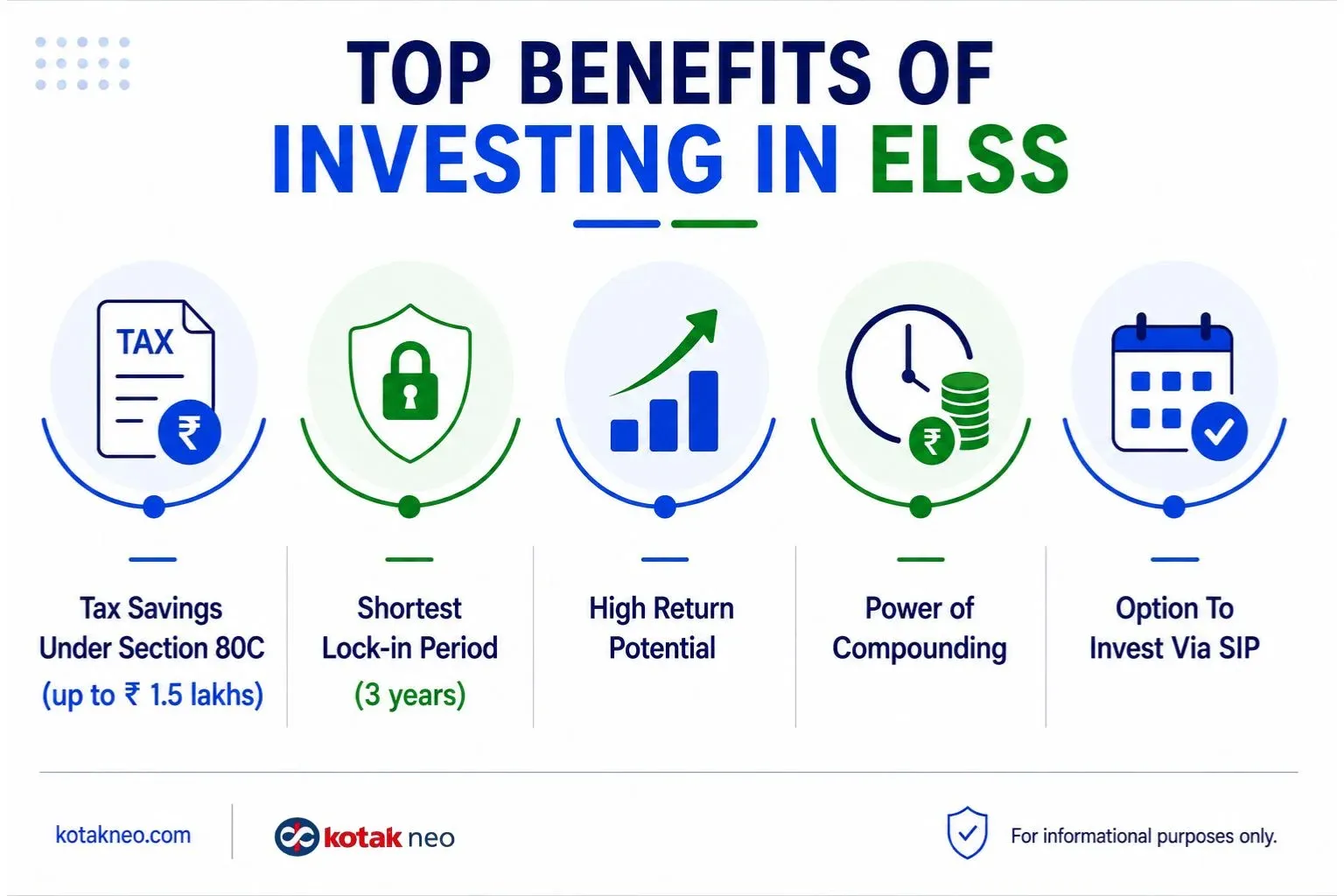
Top Benefits Of Investing In ELSS
Here’s how you can benefit from investing in ELSS.
Tax Savings Under Section 80C
The most visible ELSS tax benefit is that investments up to ₹1.5 lakh qualify for deduction under Section 80C of the Income Tax Act.
But the practical use depends on your situation.
If your EPF and insurance premiums already cover most of this limit, ELSS becomes a top-up. If they do not, it becomes your primary tool.
Now look at taxation on returns, because that completes the picture of ELSS and tax benefit:
- Long-term capital gains are taxed at 12.5% beyond ₹1.25 lakh in a financial year
- Short-term capital gains are taxed at 20%
In reality, ELSS investments almost always fall into the long-term category because of the lock-in.
Shortest Lock-in Period
Every ELSS savings scheme comes with a 3-year lock-in. That is not just a feature: it changes how you can use it.
Compare that with:
- Public Provident Fund at 15 years
- Tax-saving fixed deposits at 5 years
Three years gives you flexibility. But there is a catch.
Many investors treat 3 years as an exit point. That is where the mistake usually happens. Equity needs more time than that to deliver meaningful outcomes.
High Return Potential
An ELSS mutual fund is required to invest predominantly in equities. That is where the return potential comes from.
Unlike traditional tax-saving funds, the outcome is not fixed.
Some years will look strong. Some will not. Over longer periods, equities have historically done better than fixed-income options, but only for those who stay invested. So, the benefit here is conditional. The return potential exists, but only if you give it time.
Power of Compounding
This is where most of the benefits of ELSS are either realised or lost.
If you redeem right after 3 years, you are using ELSS like a short-term product. It is not designed for that.
If you let it continue:
- Your earlier gains start generating further gains
- Market cycles begin to even out
A simple shift helps. Instead of asking “When does the lock-in end?”, ask “Do I need this money right now?”
That one question changes how compounding works for you.
Option To Invest Via SIP
You do not have to invest a lump sum. You can enter through SIP. This matters more than it seems.
With SIP:
- You spread your investment across the year
- You avoid putting all your money at one market level
- You build a routine instead of reacting to deadlines
Each instalment in an ELSS mutual fund carries its own 3-year lock-in. That is a detail many people overlook when planning withdrawals.
Still, for most investors, SIP remains the more practical route into ELSS tax saving.
Who Should Invest In ELSS?
ELSS tends to work well in a few specific cases.
If you are salaried and looking to optimise Section 80C, it fits naturally. If you are comfortable with some volatility and have a horizon beyond 5 years, it becomes more relevant.
On the other hand, if you are expecting stability or guaranteed returns, this may not align with your expectations.
So, the decision is less about tax and more about behaviour. Can you stay invested when markets are not performing?
Things To Keep In Mind Before Investing In ELSS
- First, check your tax regime. The ELSS tax benefit applies only under the old regime. Under the new regime, the deduction is not available.
- Second, understand how the lock-in works. It is not a single 3-year period if you are investing through SIP. Each instalment is counted separately.
- Third, do not rely on past returns alone. They tell you what has happened, not what will happen.
- Finally, look at where ELSS fits in your overall allocation. It should not exist in isolation.
Tips To Maximise ELSS Benefits
Start early in the financial year. This gives your investments more time in the market.
Use SIP instead of waiting till the last quarter. It reduces timing risk and smoothens entry.
Stay invested beyond the lock-in if you do not need the funds. This is where the real tax benefits of ELSS funds begin to show.
And one more practical step. Reinvest the tax you save. That is how you turn a one-time benefit into a recurring advantage.
Conclusion
ELSS is often seen as a tax-saving shortcut. That is only part of the story.
The real advantage shows up later, depending on how long you stay invested and how you use it within your broader portfolio.
So, the better question is not whether ELSS saves tax, but whether you are using it only for that purpose or allowing it to compound into something more.
Sources
SEBI
Cleartax
FAQs On ELSS Benefits
ELSS offers growth potential but comes with volatility. Public Provident Fund offers stability but lower returns. So “better” is not universal. It is contextual.
No. There is no provision for early withdrawal. Every investment remains locked for 3 years.
Yes, and for many investors, it is the more practical way to approach tax-saving funds. It removes the need to time the market and turns investing into a process instead of an event.
The content in this blog is intended purely for educational purposes. Any securities or mutual funds referenced are illustrative in nature and do not constitute a recommendation or endorsement by Kotak Neo. Investors are encouraged to assess their own financial situation and seek professional advice before making any investment decisions. For compliance T&C and disclaimers, Visit https://www.kotakneo.com/disclaimer/
0 people liked this article.

Kotak Neo (Kotak Neo) is India's venerable stockbroking company with a rich legacy. It offers comprehensive investment services across asset classes, prioritising a technology-first approach for a seamless experience. Trusted by 5 million+ customers, it guides you toward financial success with ease of investment and speed of trade.
Note: The opinions expressed in this blog are personal viewpoints and should not be construed as recommendations.