

Kotak
Stockshaala
Chapter 3 | 3 min read
VWAP Quick Reclaim Scalping
Price had been holding above a single line all session. Then it slipped below for two candles, and it looked like the buyers were done. Seconds later it snapped back above that line on a burst of volume, and the uptrend resumed as if nothing had happened. The traders who understood that line were ready. The rest were shaken out.
That line is the VWAP, and this is the VWAP Quick Reclaim Scalp. It trades the fast recovery of a key intraday level in a trending session.
The Setup
VWAP stands for Volume Weighted Average Price. It is the average price of a stock across the day, weighted by the volume traded at each price.
Because it reflects where most of the day's actual business was done, large institutional traders use it as a benchmark for fair value. That is why price so often respects it.
On your chart it appears as a single line that resets each morning.
In a trending session, price sometimes loses VWAP briefly then reclaims it fast. That quick reclaim is the signal.
It tells you the dip below was a shakeout, not a genuine shift, and the trend is reasserting. You treat the reclaim as a momentum trigger.
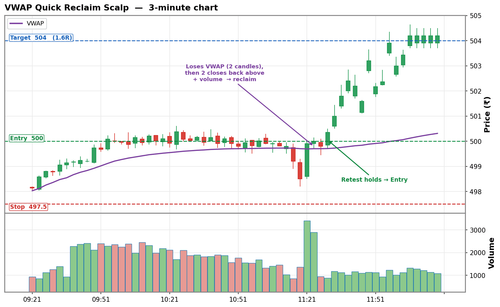
Entry (long): wait for two closes back above VWAP after the brief loss, then enter on the first retest that holds, meaning price dips toward VWAP again but does not close below it.
Stop: below the low of the reclaim.
Exit: a quick fixed target, or leave immediately if price closes back below VWAP, because the reclaim has failed.
The Analogy
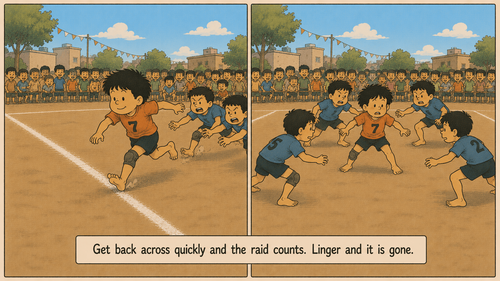
Think of a kabaddi raider who has crossed the centre line into the opponents' half. Everything now depends on how fast he gets back. Touch a defender and return across that line quickly and the raid counts. Linger on the wrong side and the defenders close in and he is out. VWAP is that centre line. A quick reclaim is the raider stepping back across in time. Stay below too long and the chance is gone.
A Worked Example
This example uses: entry ₹500, account capital ₹5,00,000, 1% risk per trade (₹5,000). The stop distance varies by setup.
In a trending session, price briefly loses VWAP, which sits around ₹499, then posts two closes back above it.
Step | Level (₹) | Detail |
|---|---|---|
Session context | - | Stock trending up, price above VWAP most of the day |
Brief loss of VWAP | 498.5 | Price dips below VWAP (approx. ₹499) for two candles |
Two closes back above VWAP | 499.5 | Reclaim confirmed |
Entry (first retest that holds) | 500 | Price retests VWAP, holds, does not close below |
Stop (below reclaim low) | 497.5 | Risk = ₹2.5 per share |
Position size | 2,000 shares | ₹5,000 / ₹2.5 |
Target (fixed scalp) | 504 | Reward = ₹4 per share, R-multiple = 1.6R |
Fail-safe exit | - | Price closes back below VWAP: exit immediately |
Common Mistakes
Mistake 1: Entering on the first tick back above VWAP
A single candle poking above VWAP is not a reclaim. The setup asks for two closes back above, then a retest that holds. Jumping in on the first tick means getting caught in the chop that often surrounds the line.
Mistake 2: Ignoring the fail-safe exit
If price closes back below VWAP after your entry, the reclaim has failed and the reason for the trade is gone. Holding past that point is how a small planned loss becomes a larger one. Leave immediately.
Key Takeaways
- VWAP is the volume-weighted average price of the session, a fair-value benchmark that institutions watch, which is why price respects it.
- The setup trades a brief loss of VWAP followed by a fast reclaim: two closes back above, then entry on the first retest that holds.
- Stop goes below the reclaim low. Exit at a quick fixed target, or immediately if price closes back below VWAP.
Assignment
- Add VWAP to a 1 or 3-minute chart of a liquid stock or index on a trending day.
- Find one instance where price lost VWAP and reclaimed it with two closes back above.
Did a retest hold? How far did price travel after the reclaim before stalling?
Note also any instance where the reclaim failed and price closed back below, and see how quickly the fail-safe exit would have protected you.
That completes the trend-based module. Next we turn to the opposite idea. In the Mean Reversion module, we stop following the trend and start fading exhaustion, beginning with the RSI Exhaustion Reversion Scalp.
Disclaimer: This article is for informational purposes only and does not constitute financial advice. It is not produced by the desk of the Kotak Neo Research Team, nor is it a report published by the Kotak Neo Research Team. The information presented is compiled from several secondary sources available on the internet and may change over time. Investors should conduct their own research and consult with financial professionals before making any investment decisions. Read the full disclaimer here.
Investments in securities market are subject to market risks, read all the related documents carefully before investing. Brokerage will not exceed SEBI prescribed limit. The securities are quoted as an example and not as a recommendation. SEBI Registration No-INZ000200137 Member Id NSE-08081; BSE-673; MSE-1024, MCX-56285, NCDEX-1262.
Recommended Courses for you



















Learn, Invest, and Grow with Kotak Videos
Explore our comprehensive video library that blends expert market insights with Kotak's innovative financial solutions to support your goals.

Trading with collateral as margin with Kotak Neo

How India is Redefining Space Exploration